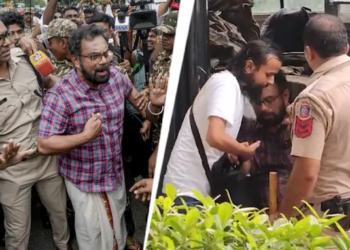
The controversy intensified after actor Rakhi Sawant launched a scathing attack on Ranaut, while politicians, celebrities and thousands of X users weighed in, turning the debate into one of the biggest online flashpoints of the week.
BY PC Bureau
New Delhi | July 29, 2026: BJP MP and actor Kangana Ranaut has come under intense criticism after a series of Instagram Stories targeting Gen Z student protesters sparked a massive backlash online. Her remarks, in which she described sections of the youth as “Generation Gutter”, called some young women “ugly and corrupt”, and labelled protest videos “puke-inducing”, have fuelled a heated debate over free speech, youth activism and political discourse.
The controversy erupted after Ranaut reacted to the recent protests organised by the Cockroach Janta Party (CJP. The protests, known for their satirical style and provocative slogans, drew nationwide attention and eventually coincided with significant political developments, including the resignation of the Union Education Minister and government assurances on exam reforms and protections for protesters.
The Remarks
In a series of Instagram Stories, Ranaut criticised the language and style adopted by some protesters, writing that she had “never in my life… seen so much ugliness in one place.”
She described the protest reels as “puke-inducing”, criticised what she called their “jarring and crass” language, and coined the phrase “Generation Gutter” for a section of Gen Z.
Among her most controversial remarks, she wrote:
“I call them Generation Gutter. They are not good at studies. They are so ugly and corrupt that they can’t even be homemakers.”
@KanganaTeam जी ये सब करते हुए बड़े बुजर्गो की याद नहीं आई!
सांसद बनते ही फ़िल्मों की तरह करेक्टर बदल दिया अपना?मुझे तो सच कहु ये वीडियो भी डालते हुए शर्म आ रही है लेकिन देश की बेटियों के लिए आपकी भद्दी टिप्पणी सुनकर ख़ुद को आपको आईना दिखाने से रोक नहीं पाई!
हो तो आप भी महिला… pic.twitter.com/UYr0DaJa49— Preeti Dogra (@preeti_dog22864) July 29, 2026
She also criticised what she described as “westernised Indian women” who, according to her, glorify drugs, alcohol and promiscuity while seeking independence without responsibility.
Referring to protesters who jokingly identified themselves as “cockroaches”, Ranaut wrote:
“You call yourself cockroaches and look and behave like them as well… subjecting the world to your filth, garbage and ugliness. I am scarred from these reels. I need some healing, digital detox.”
Ranaut defended her comments by arguing that she was responding to abusive slogans directed at Prime Minister Narendra Modi and his late mother. She later clarified that her criticism was aimed at the conduct of specific protesters rather than Gen Z as a whole and questioned whether such behaviour should be considered acceptable in public discourse.
Backlash Across Social Media
The remarks quickly went viral on X, Instagram and other platforms, attracting criticism from politicians, celebrities and social media users.
Many accused Ranaut of body-shaming young women, stereotyping an entire generation, moral policing and dismissing legitimate concerns over examination integrity.
Congress MP Sukhdeo Bhagat dismissed the remarks, saying “no one takes Kangana Ranaut seriously”, while AIMIM leader Waris Pathan described her language as “highly condemnable” and demanded an apology.
Andha Bhakts’ Sanatani has Returned
𝐊𝐚𝐧𝐠𝐚𝐧𝐚 𝐢𝐬 𝐧𝐨𝐰 𝐂𝐥𝐚𝐫𝐢𝐟𝐲𝐢𝐧𝐠 𝐡𝐞𝐫 “𝐆𝐮𝐭𝐭𝐞𝐫”-𝐭𝐲𝐩𝐞 𝐒𝐭𝐚𝐭𝐞𝐦𝐞𝐧𝐭 𝐛𝐲 𝐩𝐨𝐬𝐭𝐢𝐧𝐠 𝐚 𝐍𝐞𝐰 𝐑𝐞𝐞𝐥.
Now She is Turning Around and Blaming The Media Instead.#KanganaRanaut #GuruPurnima pic.twitter.com/yzZVOqiHrD
— তন্ময় l T͞anmoy l (@tanmoyofc) July 29, 2026
Actor Sonu Sood also criticised Ranaut, calling her remarks “shameful”. Stressing that young audiences are the backbone of the entertainment industry, he urged her to think carefully before making such statements.
Music composer Vishal Dadlani defended the student protesters, arguing that public attention should remain focused on allegations of excessive force against demonstrators rather than on their choice of language.
Numerous social media users also accused Ranaut of hypocrisy, citing her own past controversies while questioning her criticism of young women.
At the same time, she found support among sections of social media users who argued that the abusive slogans used during the protests justified her criticism and that she was speaking out against what they described as the normalisation of vulgarity in political protests.
Rakhi Sawant’s Counterattack
Adding another layer to the controversy, actor Rakhi Sawant released a strongly worded Instagram video criticising Ranaut.
Sawant accused the BJP MP of insulting young women and students and questioned her performance as a Member of Parliament. She also referred to the 2024 incident in which Ranaut was slapped by a CISF constable at Chandigarh airport, challenging her to face the public without security protection.
The video, widely shared across social media platforms, generated millions of views and further intensified the online debate. While many praised Sawant for defending students, others criticised the personal nature of her attack and the language she used.
#Slippers_Slogans_Fire#UttarPradesh |Kangana Ranaut Faces Congress Protest#lucknow | A political controversy erupted after BJP MP and actor Kangana Ranaut allegedly made objectionable remarks about Gen-Z. In protest, women workers of the Indian National Congress staged a… pic.twitter.com/yMJJqG02jY
— NEWS POP (@NEWSPOPFFF) July 29, 2026
A Wider Debate
The episode has reignited broader discussions about the limits of political speech, celebrity responsibility, youth activism and the standards of public discourse.
Supporters argue that Ranaut was highlighting the increasingly abusive tone of some political protests and defending civility in public life. Critics contend that her remarks unfairly stereotyped young people, particularly women, while diverting attention from the substantive issues raised by students protesting alleged irregularities in the NEET examination.
As of Wednesday, Ranaut had not withdrawn her comments and continued to defend her position, while demands for an apology persisted across social media.
The controversy has once again underscored Ranaut’s status as one of India’s most polarising public figures, with her remarks sparking as much debate over the messenger as the message itself.
X Users React
The controversy dominated discussions on X, where the hashtag #GenerationGutter began trending as users from across the political spectrum weighed in on Ranaut’s remarks.
Several posts condemned the BJP MP for what they described as sweeping attacks on an entire generation of students and young women.
One widely shared post by @bekhayalime said: “Kangana Ranaut is getting absolutely thrashed everywhere, especially on Instagram, for calling Gen Z a ‘Gutter Generation’ and making derogatory remarks about girls.”
Another user, @nirupamakotekar, questioned Ranaut’s moral authority, writing: “Who is the real gutter here? The students asking for accountability or the MP insulting an entire generation of young women?”
Journalist @ZahidParwaz accused Ranaut of hypocrisy, arguing that “body-shaming women while claiming to champion women’s empowerment exposes a glaring double standard.”
READ: Falling Bridges, Crumbling Roads: Shocking State of India’s Infra Dream
Another viral post by @TheDalitVoice read: “Students demanded fair exams. Kangana responded with insults about their looks. That says everything about where the debate has gone.”
Political commentator @TheSquind wrote: “Disagree with the slogans if you want, but mocking students as ‘ugly’ and ‘corrupt’ is unbecoming of a Member of Parliament.”
Not all reactions were critical. Supporters argued that Ranaut was objecting to abusive political rhetoric rather than peaceful protest.
One user, @raajeevshharma, posted: “Someone finally said what many Indians were thinking. Freedom of expression doesn’t mean vulgarity should become the new normal.”
Another supporter wrote: “You can’t abuse the Prime Minister and then complain when someone calls out your behaviour. Kangana criticised conduct, not every young person.”
Several users also defended the protesters, saying the focus should remain on the alleged irregularities in the NEET examination rather than on the language used during the demonstrations.
The online debate remained sharply polarised through Wednesday, with thousands of posts either praising Ranaut for speaking bluntly or accusing her of insulting an entire generation and trivialising the concerns of students demanding accountability.
A number of X users also accused Ranaut of hypocrisy, pointing to the glamorous and sexually suggestive roles and photo shoots she had done during her Bollywood career. Several posts juxtaposed her recent criticism of young women with stills from her films and magazine covers, asking why she was now policing the behaviour, clothing and personal choices of Gen Z. Others revived interviews in which Ranaut had spoken openly about her relationships and life in the film industry, arguing that she was applying a different moral standard to today’s youth.
Some users also referred to Ranaut’s personal life, including her long-running legal dispute over a Mumbai bungalow and her residence outside Himachal Pradesh, to counter her remarks that young people “can’t even be homemakers.” One widely shared sentiment read: “The woman lecturing girls on being homemakers doesn’t live the life she’s prescribing to others.” Another post remarked: “You built a career in Bollywood glamour. Don’t shame young women for making their own choices.”
Other users shared side-by-side images from Ranaut’s films and fashion shoots with screenshots of her Instagram Stories, arguing that “there’s a difference between evolving one’s views and condemning an entire generation.” Many criticised what they described as selective morality, while others defended Ranaut’s right to change her views over time, saying past work should not invalidate her present opinions.