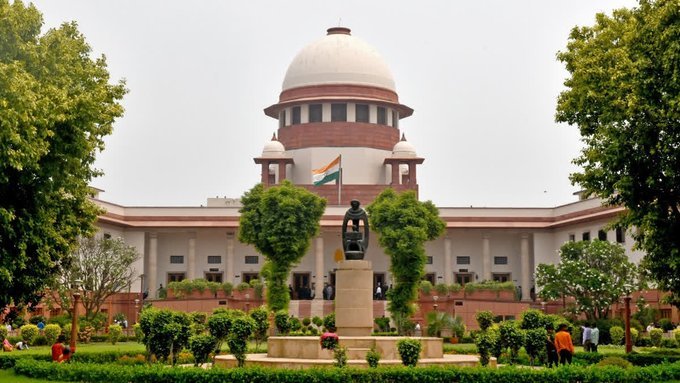
Justice B.V. Nagarathna clarified that the three-language policy does not mandate Hindi and said any third language should ideally be introduced from Class 6 for easier learning.
BY PC Bureau
New Delhi/ Jukly 16: The Supreme Court on Thursday questioned the timing of introducing a third language in Class 9 under the CBSE curriculum, observing that students at that stage are already under immense academic pressure as they prepare for their board examinations. The court urged the Centre to consider introducing the additional language much earlier, preferably from Class 6, to reduce the burden on students.
The observations were made by a Bench comprising Justice B.V. Nagarathna and Justice R. Mahadevan while hearing an appeal filed by the Tamil Nadu government against a Madras High Court order directing the establishment of Jawahar Navodaya Vidyalayas (JNVs) in every district of the state.
Tamil Nadu has consistently opposed the opening of JNVs, largely because the centrally funded schools follow the three-language formula, a policy the state has resisted for decades in favour of its long-standing two-language policy of Tamil and English.
Although the constitutional validity of the three-language policy was not directly under challenge in the proceedings, Justice Nagarathna made significant observations on the academic implications of introducing a new language in Class 9.
“Ninth standard is already stressful. Why introduce a new language in Class 9? It should be introduced in Class 6,” the judge remarked.
Addressing the Union government, Justice Nagarathna said, “Union of India, please don’t have a third language in 9th standard. Whether it is CBSE, ICSE or State Boards, students begin preparing for the Class 10 board examinations from the end of Class 8 itself. Adding a new language at that stage only increases their burden.”
The judge clarified that the three-language policy does not mandate Hindi as the third language.
“The state language has to be taught, English has to be taught, and any third language. It does not say Hindi,” she observed, seeking to dispel the common perception that the policy necessarily imposes Hindi.
Drawing from her own educational experience, Justice Nagarathna recalled that during her school years, students began learning a third language in middle school because it formed part of the Secondary School Leaving Certificate (SSLC) curriculum.
“We had options such as Kannada, Hindi and Sanskrit. The earlier a language is introduced, the better students are able to learn it,” she said, adding that language acquisition is significantly easier at a younger age.
She also noted that academic pressure begins much earlier than Class 10.
READ: Doctors Warns of Organ Damage as Wangchuk’s Fast Enters 19th Day
“Even in the 1970s, we were introduced to Class 10 concepts from Class 8 so that we would be adequately prepared. Today, the pressure is even greater. Introducing a completely new language in Class 9 only makes matters more difficult.”
During the hearing, counsel appearing for Tamil Nadu reiterated the state’s objections to the three-language policy. Justice Nagarathna responded by asking, “If the third language is Sanskrit and not Hindi, what is the issue?”
The state’s counsel replied that the concern was not merely about the choice of language but the fact that the third language becomes compulsory only from Class 9, a point that prompted the court’s criticism of the timing rather than the policy itself.
The Bench also advised the Tamil Nadu government not to reject Central education initiatives solely because they originate from the Union government.
“You may have your own education system, but don’t prevent Central government schools from functioning. Don’t have the attitude that because it is a Union government scheme, it should not be accepted,” the court observed.
The judges noted that discussions between the Centre and the Tamil Nadu government regarding the establishment of Jawahar Navodaya Vidyalayas are still underway. The Bench declined to stay implementation of the three-language policy and observed that related legal challenges, including separate public interest litigations pending before a Bench headed by Chief Justice Surya Kant, would be heard in due course.
The Supreme Court also granted Tamil Nadu additional time to respond on identifying land for the proposed Jawahar Navodaya Vidyalayas, while making it clear that the broader issues concerning language policy and the establishment of Central schools remain under judicial consideration.
The matter will now come up for further hearing on a later date.