India’s Highest Commercial Lilium Farm Takes Root in Ladakh, Opening New Livelihood Avenues for Farmers
BY PC Bureau
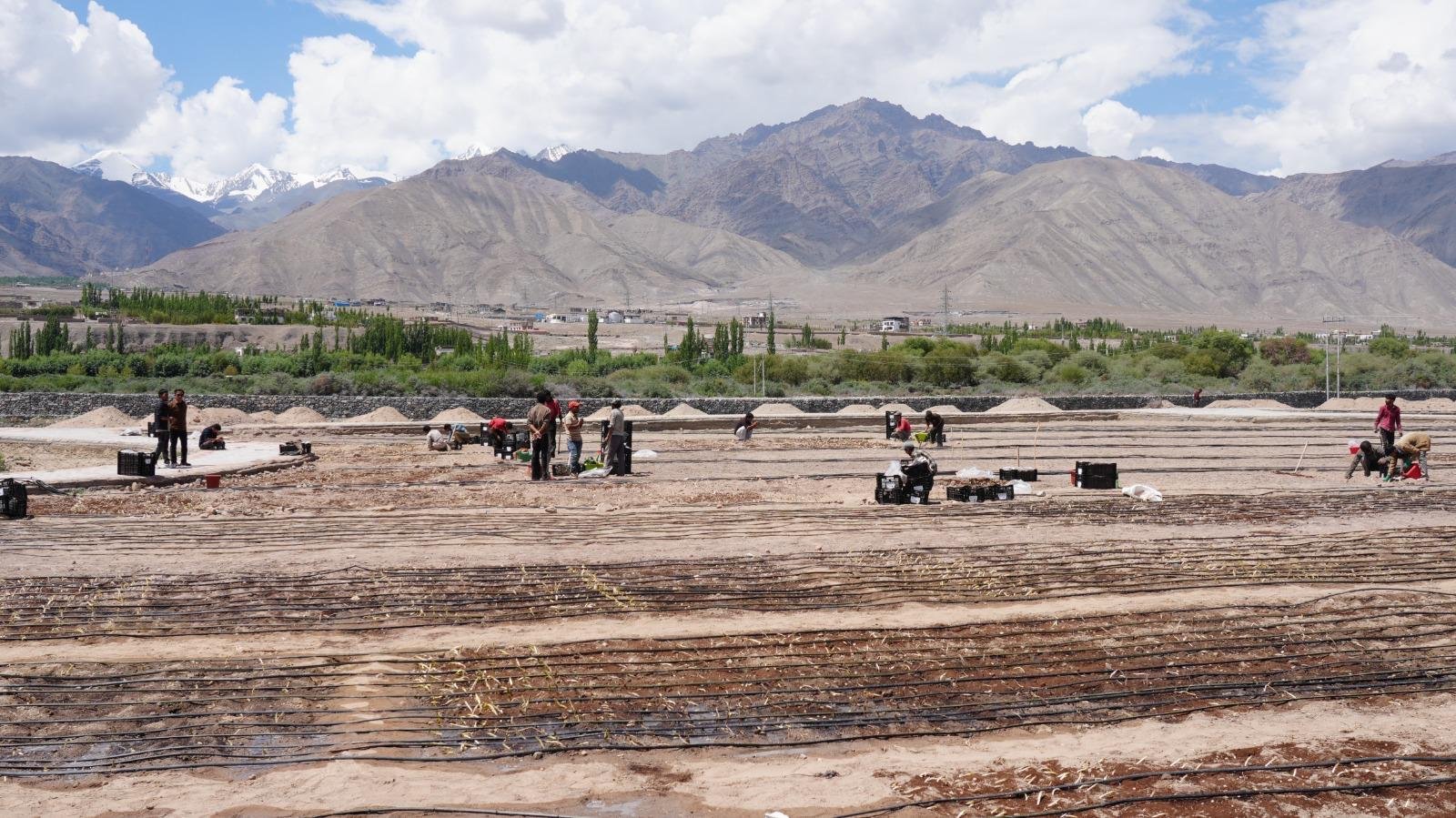
July 16: Work has begun on India’s highest commercial Lilium cultivation field in Ladakh, marking the launch of an ambitious high-altitude floriculture project aimed at creating sustainable livelihoods for farmers, self-help groups (SHGs) and cooperative societies while positioning the Union Territory as a premium flower-growing hub.
Located at Choglamsar, on the banks of the Indus (Sindhu) River near Leh, the project is spread over 93,000 square metres and is expected to become one of the country’s largest organised high-altitude floriculture parks.
Officials said more than 50,000 premium Lilium bulbs have been planted over the past three days, with the first blooms expected in the first week of September.
At an altitude of nearly 3,265 metres, the Choglamsar flower field has surpassed the country’s current highest commercial flower cultivation site at Mana in Uttarakhand, situated at about 3,200 metres.
The project is being implemented by the Ladakh Administration with scientific and technical support from the CSIR-Institute of Himalayan Bioresource Technology (CSIR-IHBT), Palampur. Lieutenant Governor Vinai Kumar Saxena had laid the foundation stone for the project on June 22, 2026.
READ: Manipur: CoTU Slams MLAs Silence After Fresh Arson Attack
The initiative seeks to establish commercial cultivation of premium Lilium flowers and buds, which enjoy strong demand in domestic and international markets because of their ornamental appeal, long vase life and use in the hospitality and floral industries. Premium Lilium stems currently fetch Rs 150-200 per stick in retail markets.
Officials said the project is designed to diversify Ladakh’s agriculture beyond traditional crops and generate new income opportunities for rural communities, particularly women and farmer collectives.
The initiative aligns with Union Home Minister and Cooperation Minister Amit Shah’s vision of “Sahkar se Samriddhi”, which focuses on strengthening cooperative institutions to create sustainable employment and improve rural incomes.
Under the project, the Agriculture Department will develop and maintain the flower field during its first year. Once the flowers bloom, the cultivation site will be handed over to selected SHGs and cooperative societies, which will receive technical guidance and marketing support to sell flowers in national and international markets.
From the following year, the cooperatives will independently undertake commercial cultivation, harvesting, processing and value addition, enabling them to establish floriculture as a sustainable business.
Local farmers are also being trained in scientific floriculture, modern cultivation techniques and post-harvest management to build long-term expertise in the sector.
Experts say Ladakh’s unique climate makes it ideally suited for Lilium cultivation. The bulbs thrive in temperatures ranging between minus 4°C and 4°C, allowing them to adapt naturally to the region’s high-altitude conditions.
Another significant advantage is that Lilium bulbs begin multiplying naturally after about three years, increasing production without requiring additional investment and thereby improving farmers’ profitability over time.
“Ladakh’s climate, often perceived as a challenge, is actually one of our greatest strengths,” Lieutenant Governor Saxena said.
“Through commercial Lilium cultivation, we are creating an entirely new source of income for our farmers, women and youth. Our vision is to transform Ladakh into a high-altitude floriculture hub where scientific farming, value addition and strong market linkages create sustainable livelihoods. This initiative will diversify agriculture while empowering Self-Help Groups, cooperatives and young entrepreneurs through high-value floriculture,” he said.
Besides boosting the local economy, the Choglamsar Flower Field is also expected to emerge as a major tourist attraction, adding a new dimension to Ladakh’s growing tourism sector while showcasing the region’s potential in high-value horticulture.