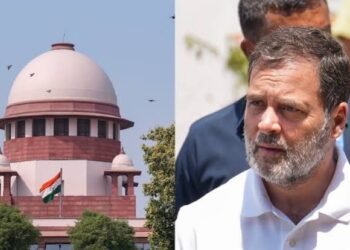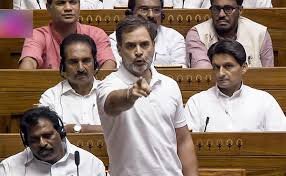
Congress leader Rahul Gandhi told the Lok Sabha that the bill “cannot be passed” in its current form, questioning its intent and impact on representation.
BY PC Bureau
New Delhi, April 17: The Opposition has decided to oppose the government’s proposed legislation on women’s reservation and delimitation, with Congress leader Rahul Gandhi asserting that the bill, in its current form, “cannot be passed.”
The remarks came during a heated debate in the Lok Sabha, where several Opposition parties questioned the intent and timing of the proposed law. Gandhi argued that the bill fails to genuinely address women’s empowerment and instead seeks to alter India’s electoral framework without adequate safeguards.
The legislation, introduced as the Constitution (One Hundred and Thirty-First Amendment) Bill, 2026, aims to amend provisions related to women’s reservation while also paving the way for the creation of a delimitation commission. The government maintains that the move is intended to enhance representation and streamline electoral boundaries.
I want to assure my friends, brothers, and sisters across the country – southern states, smaller states, and northeastern states – do not worry. We are not going to allow them to attack the Union of India. You are equal participants in the Union of India. They will not dare to… pic.twitter.com/gC2OEh9Ctr
— Congress (@INCIndia) April 17, 2026
READ: SC Denies Bail; Pawan Khera Asks: “Am I a Terrorist?”
Rahul Gandhi said that the women’s quota bill is meant to “sideline the caste census”.
At one point, Rahul Gandhi, triggered a storm in Parliament after referring to Prime Minister Narendra Modi as a “magician” , drawing sharp protests from the ruling Bharatiya Janata Party.
Gandhi accused the BJP of attempting to redraw India’s electoral map out of political insecurity. “You are scared of the changing political landscape and the erosion of your strength. You are trying to rejig the Indian political map. You did it in Assam and Jammu and Kashmir, and now you think you can do it across India. For that, you need a constitutional amendment,” he said.
In a series of pointed remarks, Gandhi alleged that the government was aware the bill would not pass and was acting out of “panic.” “The truth is the magician has been caught,” he said, in an apparent swipe at the Prime Minister, also referencing past decisions such as the Balakot airstrikes and demonetisation.
The comments sparked immediate outrage from BJP members. Union Parliamentary Affairs Minister Kiren Rijiju accused Gandhi of using inappropriate language for the Prime Minister and of undermining the country and its armed forces. Defence Minister Rajnath Singh urged Speaker Om Birla to expunge the remarks, calling them “extremely unfortunate” and demanding an apology.
Responding to the uproar, Speaker Birla warned against the use of “such words” in the House and asked Gandhi to confine his remarks to the subject under discussion. Gandhi later agreed to refrain from using the term “magician,” though he maintained his criticism of the government.
Clarifying his position, Gandhi said his remarks were directed at the BJP as a political organisation and not at the country or the armed forces. “You are not the people of India, you are a political organisation. We are attacking you, not the nation or the military,” he said.
However, Opposition leaders have raised concerns that the bill sidelines key issues such as the caste census and does not sufficiently account for representation of Other Backward Classes (OBCs), Dalits, and minorities. Gandhi claimed the proposal prioritises political considerations over constitutional principles and social equity.
Union Parliamentary Affairs Minister Kiren Rijiju defended the bill, stating that it would be discussed extensively in the House before being put to vote. He added that the Speaker could extend the debate beyond the scheduled duration to ensure all पक्ष are heard.
With voting expected soon, the government faces a challenging legislative battle as Opposition parties appear united in resisting the bill, setting the stage for a sharp confrontation in Parliament.