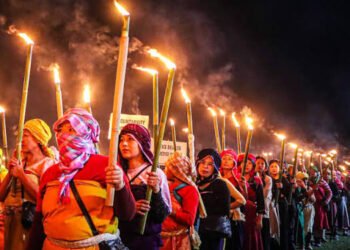
KOHUR warned that standard house-to-house voter verification may leave many conflict-displaced citizens unenumerated, raising the risk of disenfranchisement ahead of future elections.
BY PC Bureau
June 4, 2026: The Kuki Organisation for Human Rights Trust (KOHUR) has urged the Election Commission of India (ECI) to adopt special measures to safeguard the voting rights of thousands of internally displaced persons (IDPs) in Manipur during the ongoing Special Intensive Revision (SIR) of electoral rolls.
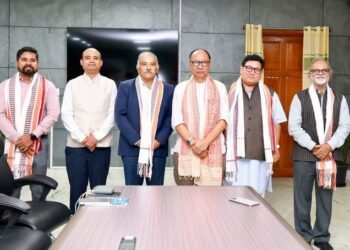
In a memorandum submitted to Chief Election Commissioner Gyanesh Kumar on June 3, KOHUR Chairman H.S. Benjamin Mate expressed concern that the current electoral roll revision process could inadvertently disenfranchise citizens displaced by the ethnic violence that erupted in the state in 2023.
The organisation has called on the ECI to immediately issue a “displacement-sensitive enumeration protocol” tailored specifically for Manipur to ensure that conflict-affected citizens are not excluded from the electoral rolls.
Unique Challenge Facing Manipur
KOHUR pointed out that among the four states currently undergoing the third phase of the SIR exercise — Manipur, Odisha, Mizoram and Sikkim — Manipur is the only state facing large-scale conflict-induced displacement.
According to official figures obtained through the Right to Information (RTI) Act, 58,821 displaced persons were residing in 174 relief camps across Manipur as of March 2026. Thousands of homes were destroyed or rendered uninhabitable during the violence, while many displaced families continue to live in neighbouring states such as Mizoram and Meghalaya.
The organisation noted that the SIR process relies heavily on house-to-house verification by Booth Level Officers (BLOs), who are required to visit an elector’s ordinary place of residence to distribute and verify forms before the June 28, 2026 deadline.
For thousands of displaced citizens whose homes no longer exist or who remain unable to return safely to their native localities, the conventional enumeration process may prove ineffective.
KOHUR warned that this could create a “real and foreseeable risk of differential deletion” from electoral rolls, disproportionately affecting displaced communities caught in the hill-valley conflict.
Concerns Over Lack of Specific Guidelines
The memorandum expressed concern that despite the unprecedented scale of displacement in Manipur, the Election Commission has yet to issue any public clarification on how displaced electors will be identified, verified and retained in the voter rolls.
KOHUR argued that the compressed timeline of the revision exercise further compounds the problem. Draft electoral rolls are scheduled to be published on July 5, while the period for filing claims and objections ends on August 4. The final electoral rolls are expected to be published on September 6.
According to the organisation, displaced citizens may have limited opportunity to verify their inclusion in the draft rolls and seek corrections if omissions occur.
The memorandum also emphasised that displacement caused by violence does not affect an individual’s eligibility to remain registered as an elector. Citing Section 20 of the Representation of the People Act, 1950, KOHUR argued that forced displacement does not extinguish a person’s ordinary residence or create any new disqualification from voting.
READ: India Unveils Major Tax Break to Attract Foreign Capital
Key Demands Placed Before the Election Commission
KOHUR has urged the Commission to adopt a series of safeguards, including:
- Immediate publication of a detailed displacement-sensitive enumeration protocol for Manipur.
- Assurance that no displaced elector is removed from the rolls solely because they are unavailable at their original residence.
- Enumeration of displaced persons at relief camps and temporary shelters while maintaining linkage with their home constituencies.
- Adoption of flexible documentation requirements for individuals who lost identity or residence records during the violence.
- Acceptance of alternative proofs such as relief camp records, previous electoral roll entries, and certificates issued by camp or district authorities.
- Deployment of special camp-based enumeration drives and dedicated BLOs for relief camps.
- Coordination with election authorities in Mizoram and Meghalaya to facilitate enrolment and verification of displaced Manipur residents currently living outside the state.
- Establishment of a transparent grievance redressal and voter-tracking mechanism to help displaced citizens verify their electoral status and seek timely corrections.
- Issuance of a public clarification detailing safeguards available to internally displaced electors.
Call for an Inclusive Electoral Process
The memorandum has also been forwarded to the Chief Electoral Officer of Manipur and the National Human Rights Commission.
KOHUR clarified that it is not opposing the Special Intensive Revision exercise, which falls within the Election Commission’s constitutional mandate under Article 324 of the Constitution. Rather, the organisation seeks safeguards to ensure that a neutral administrative process does not inadvertently deprive displaced citizens of their democratic rights.
The organisation has offered to provide any additional information required by the Commission and has requested a formal acknowledgement and response.
The intervention marks the latest effort by Kuki civil society groups to draw attention to the electoral challenges faced by thousands of displaced residents in Manipur. The Election Commission has not yet issued an official response to the memorandum.