



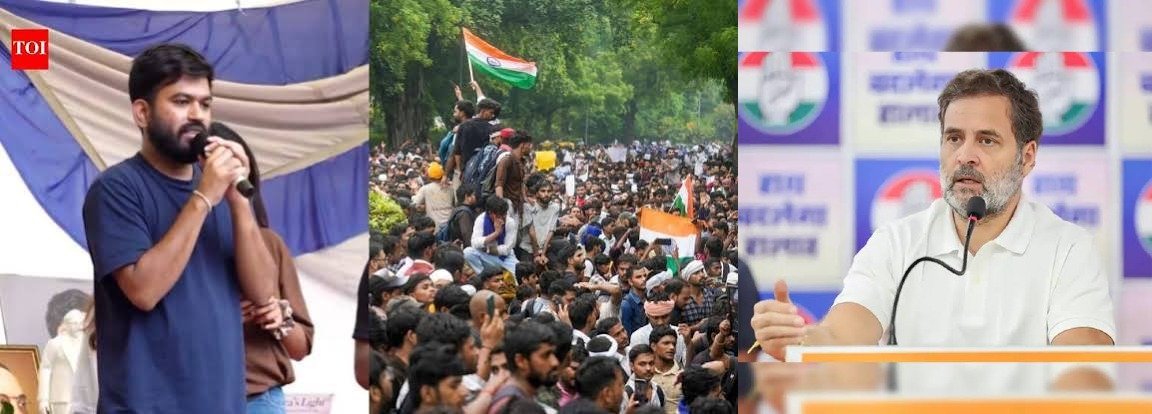
Backing the CJP leaders, Rahul Gandhi said waving the Tricolour during a peaceful protest was not a crime. He also called for opposition unity, arguing that citizens from different political backgrounds were united in demanding their constitutional rights.
BY PC Bureau
New Delhi/ October 14: Leader of the Opposition Rahul Gandhi has publicly backed the Cockroach Janata Party (CJP) after its co-convenors Ashutosh Ranka and Saurav Das were remanded to five days of judicial custody, signalling a call for opposition unity amid the escalating confrontation over the right to protest in the national capital. CJP leader Abhijit Dipke thanked Rahul Gandhi for speaking out against the arrest of Saurav Das and Ashutosh Ranka.
In a post on X, Gandhi condemned the jailing of the activists following a flag-hoisting demonstration at Jantar Mantar, where protesters were demanding the resignation of Chief Election Commissioner Gyanesh Kumar over alleged irregularities in the Special Intensive Revision (SIR) of electoral rolls.
“Waving the Tricolour at Jantar Mantar in a peaceful protest is not a crime. Jailing youth for it is an act of cowardice,” Gandhi wrote.
Calling for a united response across political and social groups, he added: “Students. Youth. Journalists. The INDIA bloc. Different banners, one cause. All protests are one: citizens demanding their constitutional rights. Jantar Mantar belongs to the people of India. We will reclaim it.”
The intervention brings the Congress leader into more direct alignment with the youth-led group, which has emerged as a prominent force in recent protests in Delhi. It also comes amid a wider dispute over the Delhi Police’s decision to remove Jantar Mantar from the list of authorised protest venues and designate alternative locations for demonstrations.
A common cause
The CJP has attracted attention through its mobilisation of students and young protesters around issues of public accountability and government policy. Its agitation over the NEET examination controversy earlier this year brought it into the same political arena as the Congress, which had also criticised the handling of the examination crisis.
However, the two operated largely on separate tracks during the earlier phase of the agitation. The Congress pursued its own political campaign, while CJP supporters sought to establish an independent identity for the movement.
That separation reflected a broader challenge for the opposition: how to coordinate with emerging grassroots movements without undermining their independent character or competing for ownership of public discontent.
Gandhi’s latest statement appears to place greater emphasis on a shared cause than on organisational distinctions. By explicitly naming students, young people, journalists and the INDIA bloc, he sought to frame the dispute as a question of constitutional rights extending beyond any single party or organisation.
Jantar Mantar becomes a flashpoint
The arrests of Ranka and Das have intensified the confrontation over access to public spaces for political demonstrations.
The two CJP leaders, along with Ajinkya Shinde, were remanded to five days of judicial custody after being accused of trespassing at Jantar Mantar and crossing police barricades during the protest. The allegations include trespassing, violation of bond conditions and obstruction of a public servant.
The CJP has opposed the removal of Jantar Mantar from the list of authorised protest sites, arguing that shifting demonstrations to locations farther from the centre of the capital would diminish their visibility and impact.
Gandhi’s intervention places the Congress behind the demand to restore access to the site, while raising the broader issue of whether administrative restrictions are being applied in a manner that unduly limits peaceful political expression.
The allegations against the arrested activists and the legal basis for their remand remain matters for the judicial process. At the same time, the right to peaceful assembly and the proportionality of restrictions on demonstrations remain legitimate subjects of public debate.
READ: Barking Isn’t Enough, SC Must ‘Bite’ to Save Democracy: Ex-Judge Kurian Joseph
Thank you, LoP @RahulGandhi sir, for speaking out against the illegal arrest of @AshutoshRanka & @SauravDassss
— Abhijeet Dipke (@abhijeet_dipke) October 14, 2026
Can the opposition turn solidarity into a united campaign?
Gandhi’s appeal for unity comes as opposition parties seek to challenge the government’s handling of the SIR exercise and defend the right to protest. The political significance of the statement lies in its acknowledgement that a movement need not be controlled by an established political party for its demands to merit support.
The challenge for the Congress and the INDIA bloc will be to sustain coordination with independent activists while allowing them to retain their own voice and organisational identity.
A broader alliance could give the campaign greater reach, but public solidarity alone will not resolve differences over strategy, leadership or the conduct of protests.
For now, Gandhi’s message is that the dispute should not be reduced to a contest between the Congress and the CJP. By calling for demonstrators operating under different banners to unite around constitutional rights, he has sought to shift the focus towards the larger question of democratic freedoms.
Whether that appeal produces a coordinated opposition campaign remains to be seen. But the jailing of the CJP leaders has created a point of convergence between the established opposition and a youth-led movement that had previously pursued its agitation largely on its own.




Comments 1