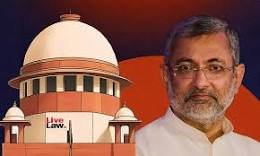
Speaking at a legal convention in Kerala, ex-SC judge Kurian Joseph cautioned that a compromised Election Commission threatens Indian democracy, calling on the judiciary to take decisive action beyond issuing mere warnings.
BY PC Bureau
October 14: Former Supreme Court judge Kurian Joseph has issued a strong call to citizens, urging them to defend democracy through peaceful protest when constitutional institutions fail to discharge their responsibilities. Speaking at a legal convention in Kerala, Justice Joseph argued that declining public confidence in bodies like the courts and Parliament has made popular mobilization a necessity.
Invoking the words of socialist leader Ram Manohar Lohia, Justice Joseph said: “When the Parliament and courts fail, then the street would come to our rescue.”
He pointed out that the current wave of protests across the country is a direct reflection of this erosion of trust. “The credibility of the institutions, there is a perception which is very grossly shaken, and that is the reason what we see in the street. As Dr. Ram Manohar Lohia said, now the street is coming to the rescue of democracy,” Joseph remarked.
He emphasized that citizens must not remain passive, stating, “They have a duty to come out in an informed way and in a civil way to protest and also take steps for the protection of democracy.”
Joseph was speaking at the Kerala High Court Chamber Complex at an event titled “Independence of Election Commission of India – Compromised?”, organized by the Indian Association of Lawyers (IAL). His comments arrive amid ongoing protests in Delhi—marked by police detentions and judicial scrutiny—demanding the resignation of Chief Election Commissioner Gyanesh Kumar over alleged electoral roll irregularities.
READ: Good over Evil This Navratri? CJP Leaders Saurav Das, Ashutosh Ranka Jailed
Addressing the autonomy of the poll panel directly, Joseph delivered a stark warning: “Once the integrity of the person holding that high office is compromised, then there is no independence, and that is death knell for democracy in India.”
To protect this institutional autonomy, the former judge advocated for strict constitutional safeguards. “There should be an appropriate amendment to the Constitution itself regarding the appointment and service conditions of the Election Commission, rather than leaving it to Parliament,” he argued.
“The EC’s appointment and service conditions should be ingrained in the Constitution itself,” he continued. “That would probably serve as a better safeguard and go a long way in ensuring the integrity and independence of the EC and will be in tune with the Constitution.” He further questioned the disparity between the removal procedures for the Chief Election Commissioner and other Election Commissioners, suggesting that equivalent status demands consistent safeguards.
The former judge also directed a poignant message at the legal fraternity, expressing concern over internal divisions and reminding lawyers of their historical role in defending constitutional principles. Urging them to rise above political and communal differences, he cautioned, “I always held a position that the silence of the lawmen would create more violence, more problems in society than the violence of the lawless men.”
Drawing his address to a close, Justice Joseph called upon the Supreme Court to go beyond mere warnings when democratic principles are under threat.
“We always say the constitutional courts, and more particularly the Supreme Court of India, are the guardians of the Constitution, the watchdogs of the Constitution,” he explained. “When does the watchdog bark? It barks when something entrusted to its custody is sought to be or perceived to be or threatened to be disturbed.”
However, he asserted that issuing warnings must lead to meaningful action. “We have heard that famous saying that the barking dog seldom bites. But this watchdog, this guardian, is bound to bite also if the barking does not lead to the desired result,” he said.
Reiterating the core mandate of the Election Commission, Joseph concluded: “It is meant to be independent, and is never meant to be otherwise.”