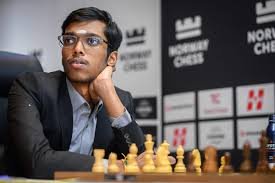
The Indian grandmaster’s victory was built on a sensational late-tournament surge, where he produced clutch wins under pressure and outperformed the strongest lineup in elite chess today.
BY PC Bureau
June 6, 2026: Norway Chess 2026 will be remembered not just as another elite tournament on the calendar, but as the moment when India’s Rameshbabu Praggnanandhaa stepped fully into the highest tier of world chess — not as a prodigy with potential, but as a finished champion capable of dismantling the very best in the game.
In a field stacked with reigning World Champion D. Gukesh, former world number one Magnus Carlsen, and elite contenders like Alireza Firouzja, Wesley So, and Vincent Keymer, Praggnanandhaa did not merely participate. He dictated the most decisive phases of the tournament, absorbing pressure, surviving complications, and striking at the exact moments when elite fields typically separate winners from the rest.
By the end of the event, the 20-year-old had achieved something extraordinary and almost unprecedented in modern elite chess: victories over Magnus Carlsen twice, a crucial win over World Champion D. Gukesh, and a final-round triumph that sealed the title against Vincent Keymer, all while outperforming one of the strongest assembled fields in recent chess history.
Norway Chess 2026, Round 10: The Indian Praggnanandhaa R. versus the German Vincent Keymer.
Indian Grandmaster R. Praggnanandhaa defeated Germany’s Vincent Keymer in the classical game during Round 10, securing a landmark 2026 Norway Chess title. By achieving this victory, the… pic.twitter.com/WJgKPxBUQs
— Gamer 🕹️🏓 (@miniclip8pool) June 6, 2026
A Rocky Start, Then a Quiet Rise
Praggnanandhaa’s campaign did not begin with dominance or early separation from the pack. In the opening rounds, momentum belonged elsewhere. Firouzja’s sharp play and Wesley So’s steadiness briefly defined the top of the standings, while Carlsen and Gukesh alternated between flashes of brilliance and moments of vulnerability.
Pragg, by contrast, remained composed but unremarkable on the leaderboard. He neither collapsed nor surged early. Instead, he positioned himself within striking distance — a quiet presence in a field where overextension often leads to immediate elimination from contention.
What ultimately defined his tournament was not how he started, but how ruthlessly he finished.
Round 3 Shock: First Strike Against Carlsen
The first major turning point arrived in Round 3, when Praggnanandhaa faced Magnus Carlsen in a tense and chaotic encounter that quickly escalated into a psychological battle as much as a technical one.
Playing in front of a home crowd in Oslo, Carlsen appeared to have steered the game into stable territory, with structural advantages and time pressure seemingly under control. But as the clock began to dominate the position, precision began to slip.
Praggnanandhaa, alert to every micro-error, did not rush. He calculated deeply in the endgame phase, converting a volatile position into a full point with clinical accuracy. The victory was not just significant in terms of score — it was symbolic.
It was a statement that even the greatest modern champion was not immune to pressure from the Indian teenager now operating with elite composure.
Norway Chess 2026, Round 10: The Indian Praggnanandhaa R. versus the German Vincent Keymer.
Indian Grandmaster R. Praggnanandhaa defeated Germany’s Vincent Keymer in the classical game during Round 10, securing a landmark 2026 Norway Chess title. By achieving this victory, the… pic.twitter.com/WJgKPxBUQs
— Gamer 🕹️🏓 (@miniclip8pool) June 6, 2026
Round 4: Taking Down the World Champion Gukesh
If Round 3 announced his arrival on the biggest stage, Round 4 confirmed that Praggnanandhaa was not a surprise factor — he was a title contender.
Facing reigning World Champion D. Gukesh, Praggnanandhaa entered a game that oscillated repeatedly between aggression and defense. Gukesh pressed with characteristic ambition, seizing space in the middlegame and attempting to impose initiative.
For long stretches, the world champion appeared to be building momentum. But the balance shifted under time pressure. In the critical phase, inaccuracies crept into Gukesh’s position, and Praggnanandhaa’s defensive resilience became the foundation for a counterstrike.
Once the structure began to collapse, Pragg transitioned from survival to execution with remarkable clarity, flipping the game and securing a defining victory.
The consequences were immediate and significant:
It halted Gukesh’s rhythm in the tournament.
It elevated Praggnanandhaa into the core group of title contenders.
It reshaped the psychological landscape of the event.
At this point, Praggnanandhaa was no longer chasing leaders — he was directly confronting them.
The Turning Point: Mid-Tournament Consistency
While Firouzja and Wesley So continued to feature prominently in the standings, the critical differentiator in the middle rounds was Praggnanandhaa’s consistency under pressure.
He did not need constant brilliance. Instead, he demonstrated something often more valuable in elite tournaments: control in unstable positions.
Even in games that did not end in outright victory, he remained tactically alert, avoided collapses, and ensured that every round kept him within striking distance of the lead. Where others oscillated between peaks and setbacks, Pragg’s trajectory remained steady.
Analysts noted a defining trend emerging: he was peaking at exactly the moment the field was beginning to fracture.
Round 8: Second Blow to Magnus Carlsen
The most shocking result of the tournament arrived in Round 8, when Praggnanandhaa once again faced Magnus Carlsen — this time with the Black pieces.
The game developed into a tense strategic battle, with Carlsen appearing to maintain equilibrium for long stretches. However, as time pressure intensified, accuracy began to erode at the highest level of the position.
In the critical endgame phase, Carlsen committed a decisive error under severe time constraints. Praggnanandhaa, maintaining composure in a position where even small inaccuracies could reverse the outcome, converted efficiently and without hesitation.
With this result, he achieved a rarity in modern elite chess:
Two victories over Magnus Carlsen in a single classical tournament.
The psychological weight of that achievement reverberated across the event.
READ: TN Politics Gets New Player as Annamalai Quits BJP
Final Round Drama: The Decisive Finish
As the tournament entered its final round, the title race remained unresolved. Praggnanandhaa, Wesley So, and Alireza Firouzja were still mathematically in contention, with multiple scenarios dependent on final results.
Everything came down to one game.
Praggnanandhaa faced Vincent Keymer in a high-pressure classical encounter where precision, patience, and nerves would determine the championship outcome.
The game unfolded as a tense strategic struggle. Keymer attempted to hold balance through careful structure, but Praggnanandhaa gradually increased pressure, improving his pieces step by step and tightening control over critical squares.
Eventually, the position broke under sustained strain. When Keymer resigned, the standings shifted instantly.
Praggnanandhaa was Norway Chess 2026 champion.
Who He Beat: The Full Elite List
Across the tournament, Praggnanandhaa’s victories formed a list that underlined the scale of his achievement:
Magnus Carlsen — defeated twice (Rounds 3 and 8)
D. Gukesh — defeated in a crucial mid-tournament clash
Vincent Keymer — defeated in the final round, which directly decided the title
Alongside these wins, he also produced key performances against elite opposition such as Alireza Firouzja and Wesley So, where draws, conversions, and pressure games shaped the final standings.
This was not a tournament defined by a single upset or isolated brilliance.
It was a sustained breakdown of the strongest competitive field in contemporary chess.
The most decisive pattern of Praggnanandhaa’s victory was his extraordinary finishing surge.
While others struggled with pressure accumulation, fatigue, and shifting standings, Praggnanandhaa’s performance trajectory moved in the opposite direction — upward, sharper, and more decisive with every passing round.
More importantly, Praggnanandhaa’s performance signals a deeper shift in competitive dynamics — the rise of a generation that is not intimidated by legacy dominance, but instead increasingly capable of breaking it through precision, resilience, and psychological control.
The Making of a Champion
Norway Chess 2026 will not be remembered for a single game, nor even a single upset.
It will be remembered for a young Indian grandmaster who, in the most pressure-intensive final stretch of elite chess competition, did not merely survive — he dominated.
He beat Carlsen. He beat Gukesh. He beat the field.
And when the tournament demanded absolute clarity in the final round, Praggnanandhaa delivered it without hesitation.
A new chapter in world chess has begun — and it was written in Oslo.