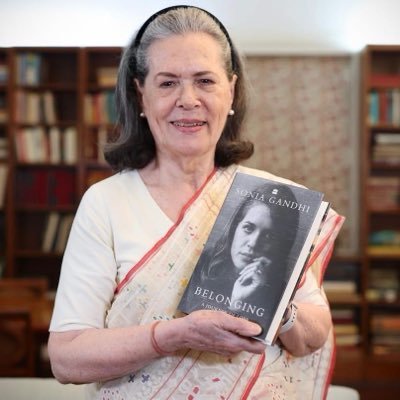
Sonia Gandhi’s memoir has triggered a fresh exchange with Pranab Mukherjee’s daughter, Sharmistha, after the former Congress chief recalled being “shocked” when the veteran leader appeared to hint at his ambition to become prime minister in 2010.
BY PC Bureau
November 10: A fresh controversy has emerged over the political ambitions of former President Pranab Mukherjee, with his daughter Sharmistha pushing back against Sonia Gandhi’s account of a conversation in which he allegedly hinted at his desire to become prime minister.
While Sonia says the suggestion left her “shocked” during a meeting in 2010, Sharmistha has questioned why her father’s ambition should have come as a surprise, arguing that his long record in public life and governance gave him every reason to aspire to the country’s highest political office.
The exchange follows the release of Sonia Gandhi’s memoir, Belonging: A Journey of Love. In the book, the former Congress president recalls that Mukherjee, then a senior party leader and minister, suggested during a conversation that perhaps “it was time for a change at the top”. She interpreted the remark as an indication of his long-standing desire to become prime minister.
Reacting to the account, Sharmistha said there was nothing unusual or improper about a politician aspiring to lead the country, particularly someone with her father’s experience.
“What’s there to get ‘shocked’ about? Is it a crime to be ambitious, especially when that ‘ambition’ was supported by decades of experience in politics and governance, hard work and a brilliant mind?” she wrote on X.
Recalling a conversation with her father, Sharmistha said she had once asked him whether he wanted to become prime minister. Mukherjee, she said, had replied candidly that “any politician worth his salt has this ambition”.
She added that her father had risen from a humble background through merit and hard work, without the advantage of dynastic connections.
“There was no one to serve him positions, including PM-ship, on a platter due to dynastic entitlements,” she said, questioning whether Sonia was surprised that someone outside the Gandhi-Nehru family could harbour such an ambition and express it to her.
Sharmistha also addressed Sonia’s observation that Mukherjee never made her feel that he resented her response to the suggestion. Sonia writes that she gently changed the subject and believed he may have been disappointed, but never held it against her.
Drawing on her father’s diaries and conversations with him, Sharmistha said she wanted to reassure Sonia that Mukherjee had not taken offence. She described him as a pragmatic politician who understood the reasons behind Sonia’s response and the insecurities that people could have.
READ: US Mercenary VanDyke Links India Arrest to Russia-Ukraine War, Promises ‘Shocking Revelations’+
STORY | Pranab hinted at PM ambitions, shocked me with ‘time for change at top’ suggestion: Sonia
Congress leader Pranab Mukherjee hinted at his “long-held desire” to become prime minister during a 2010 conversation with then party chief Sonia Gandhi when he shocked her with the suggestion that perhaps “it was time for a change at the top”, according to her memoir.
READ: https://t.co/0MugvDK17z
— Press Trust of India (@PTI_News) November 10, 2026
SONIA ON POWER-SHARING WITH MANMOHAN SINGH
In her memoir, Sonia also describes the working relationship between herself and former Prime Minister Manmohan Singh during the UPA years from 2004 to 2014.
She says she was clear that Singh was the head of the government and that, while she could offer suggestions or disagree with him as Congress president, it was her responsibility to defer to his authority as prime minister.
Sonia describes an “unspoken division of responsibility” under which the government was led by Singh while she headed the party. She says the arrangement functioned smoothly and that she was determined not to allow any misunderstanding between them to weaken the government or provide ammunition to political opponents.
The two sides coordinated through a core group that met the prime minister every week. Its members included Mukherjee, former Madhya Pradesh chief minister Arjun Singh, former Kerala chief minister A K Antony and Ahmed Patel.
Sonia also recalls regular meetings of the Strategy Group, which discussed parliamentary business. Mukherjee, whom she says she always addressed as Pranab ji, would sometimes stay back for informal conversations.
WHAT SONIA RECALLS ABOUT PRANAB MUKHERJEE
Sonia says Mukherjee had developed serious differences with then Finance Minister P Chidambaram. During one conversation in 2010, after expressing his frustration, he made a remark that she interpreted as a hint that he wanted to replace Manmohan Singh as prime minister.
She writes that she was taken aback by the suggestion and changed the subject. Although she thought Mukherjee might have been disappointed, she says he never gave her reason to believe that he held her response against him.
The Congress subsequently nominated Mukherjee as its candidate for the presidential election in 2012. He won and became the 13th President of India, serving from 2012 to 2017.
Sonia says she continued to meet him, often simply to benefit from conversations with a politician she regarded as erudite and knowledgeable.
SONIA REJECTS CHARGE OF BEING THE UPA’S ‘BACK-SEAT DRIVER’
The memoir also revisits allegations that Sonia exercised authority over the government from outside the constitutional framework while Manmohan Singh was prime minister.
Rejecting the charge that she interfered in government decisions, appointments or the functioning of the Prime Minister’s Office (PMO), Sonia says such claims were part of a sustained campaign by her political opponents. She also alleges that some of the stories were encouraged by people close to the prime minister.
She refers to a book published years after the UPA government left office by one of Singh’s former aides, which she says repeated allegations that she had summoned official files from the PMO, intervened in administrative matters and influenced key appointments.
Sonia describes the allegation that she had access to official files as particularly distressing, saying she had been careful to respect established rules and procedures. She adds that the PMO had issued a categorical denial that such files had ever been shown to her.
She also cites an interview with Singh’s daughter, Upinder Singh, who criticised the former aide’s book as a betrayal of trust and defended the relationship between her father and Sonia as one based on mutual trust and respect.
Despite this, Sonia says, political opponents and sections of the media continued to portray her as the real power behind the government.
The memoir also discusses Sonia’s decision to decline the prime minister’s post after the Congress-led UPA won the 2004 general election.