

Sonia Gandhi has drawn a sharp ideological contrast with Prime Minister Narendra Modi, accusing the RSS of shaping an exclusionary vision of India. She says their political differences reflect competing ideas about the country’s future.
BY PC Bureau
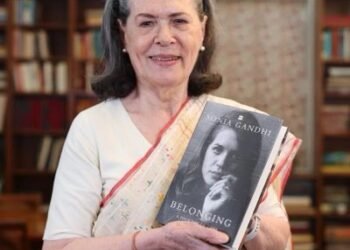
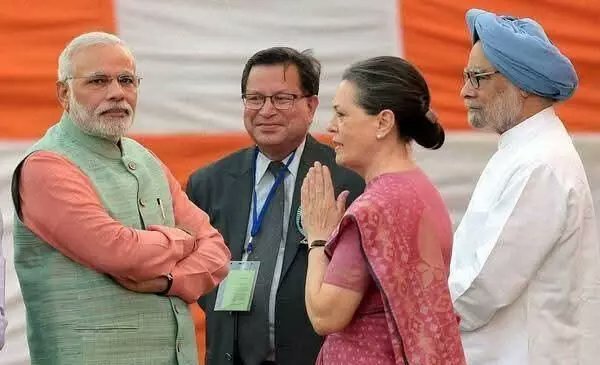
NEW DELHI/ November10: Sonia Gandhi has offered a revealing account of her limited interactions with Prime Minister Narendra Modi, alleging that he avoids eye contact when they meet at official functions. In her memoir, Belonging: A Journey Of Love, released worldwide on Tuesday, the former Congress president contrasts what she describes as Modi’s distant demeanour with the cordial relations that earlier leaders maintained across political divides.
“Whenever he comes face-to-face with me, we greet each other with a formal namaste. This is different from the past, when leaders across party divides would treat one another with cordiality. He tends to look away, avoiding eye contact,” Gandhi writes.
She recalls that the two occasionally meet at semi-official gatherings, including the customary meetings of party leaders in the Lok Sabha Speaker’s chamber at the end of Parliament sessions.
“Apart from such brief exchanges, we have never really conversed, though we’ve exchanged formal birthday and New Year greetings over the years,” she says.
Gandhi acknowledges that she and Modi belong to vastly different ideological worlds and have fundamentally different visions of India.
READ: Sonia Gandhi’s Memoir Triggers Row Over Pranab’s PM Ambition
“I knew in my heart what my husband and my mother-in-law would have expected of me. I had felt an inner call of duty towards them and all that they had fought for throughout their lives. But now I was at sea; I had to search within my troubled self for an answer. One part of me rejected the idea completely, the other part was calling on my sense of obligation…”
Here is an excerpt from CPP Chairperson Smt. @SoniaGandhi ji’s memoir, Belonging: A Journey of Love, featured in The Indian Express on 10 November.
In this excerpt, she reflects on the inner conflict and sense of duty that shaped her decision to decline the post of Prime Minister.
Click👇
https://t.co/o8j4vYqaIa— Congress (@INCIndia) November 10, 2026
Sonia Gandhi says that on occasions when she returned after a hospital stay, the Prime Minister enquired about her health, asking, “Theek hain aap?” (Are you all right?). She would respond, “Jee, ab main theek hoon, shukriya” (Yes, I am fine now, thank you).
The former Congress chief draws a sharp contrast between their respective political and ideological influences. She says her understanding of India came from her family, its commitment to public service and its belief in a pluralistic nation founded on liberty and equality.
“All I learnt about India was assimilated from the members of my family, their lives of service, and their faith in a nation that encompassed a host of races and cultures, languages and faiths, based on principles of liberty and equality for all,” she writes.
In contrast, Sonia Gandhi argues that Modi’s idea of India was shaped by RSS ideologues and his own formative experiences. She says this worldview affirmed a form of fundamentalism in which one faith and culture were placed above others.
“In that India, hierarchy, order, and control are central,” she writes.
Gandhi describes the political contest between the two sides as a clash of competing visions rather than a personal battle.
“He was fighting for his vision of India, and I for mine: an India against hegemony, an India that stands for inclusiveness, secularism, and social justice. It wasn’t personal,” she says.
She also reflects on Modi’s political journey, noting that his route to power was very different from hers. At the same time, she says she understood his discomfort with the political and social elite.
Gandhi recalls feeling out of place during drawing-room discussions in Delhi, where political opinions often appeared disconnected from the hardships she had witnessed in her constituency and during travels across the country.
She also questions the portrayal of Modi’s humble origins by his publicity machinery, while acknowledging that he worked his way up within the RSS from an underprivileged background.
Turning to Modi’s parliamentary speeches, Gandhi accuses him of using the coarse language of election rallies and frequently attacking the Opposition. She says Jawaharlal Nehru, India’s first prime minister, remains a particular target of hostility from the BJP.
She also criticises what she describes as sustained attacks on Nehru by Sangh Parivar-linked websites, accusing them of spreading malicious abuse and falsehoods about the former prime minister.
Sonia Gandhi says the BJP’s stated objective of a “Congress-free India” reflects hostility not merely towards the party but also towards its policies and ideology.
She attributes this antipathy to Modi’s RSS background, arguing that the organisation has shaped an exclusionary political interpretation of Hinduism.
Contrasting this with her own understanding of Hinduism, Sonia Gandhi says she inherited from her mother-in-law a faith that embraces diverse beliefs, different paths and traditions of dissent, without insisting on a single deity, dogma, prophet or scripture.
She also writes about her intellectual debt to Mahatma Gandhi, saying she was educated in the principles of ahimsa and dharma as he interpreted them.
While acknowledging the oppression and inequality embedded in India’s centuries-old caste system, Sonia argues that several major reformers have drawn upon Hindu philosophical traditions to challenge caste discrimination.
The memoir, Belonging: A Journey Of Love, was released worldwide on November 10.