Hindus, Muslims, Sikhs and Christians stood shoulder to shoulder as students, parents and ordinary citizens transformed a protest over examination irregularities into a larger movement celebrating humanity, unity and democratic dissent.
By Navin Upadhyay
Tuesday evening, 8.30 PM. We reached Jantar Mantar a day after the police crackdown left more than a hundred students with broken limbs and bloodied heads, and a young girl fighting for her life on a ventilator.
If the authorities imagined the crackdown would scare the protestors away, the reverse happened. Hurt, grief, and anger bonded them closer, and thousands more poured in to express their solidarity—a cause that, in retrospect, had been swallowed by a larger one: the fight for the soul of India.
Slogans reverberated in the air. Songs played in knots across the ground. Hundreds of tricolours fluttered. Not all of them were about the NEET paper leak anymore.
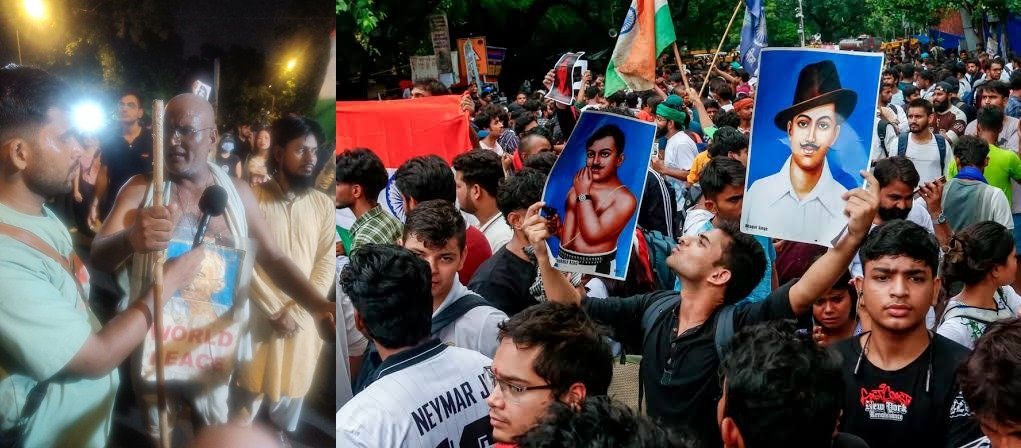
They echoed something wider—the youth of the country and their parents, the young and the old, Hindus, Muslims, Sikhs, and Christians, gathered there as one India. The demand for the resignation of Union Education Minister Dharmendra Pradhan may have been the trigger. But the placards of Mahatma Gandhi, Che Guevara, Bhagat Singh, and Chandrashekhar Azad spoke to something deeper—a yearning for change in a system that protestors said reverted to the colonial instinct of meeting a raised voice with a baton rather than a table.
Wading through the crowd with my colleagues—Arpit, Mansi, Rishi, and Hardik—I found someone thrusting a warm samosa or kachori into my hands every few steps, or offering pizza or a burger. I kept shaking my head, politely refusing, thinking such offerings should go to the protestors, not to a curious visitor.
READ: ‘Don’t Waste Our Time’: CJI Snubs Plea on Police Brutality
READ: London to The Hague: Diaspora Rallies in Solidarity with Jantar Mantar Protesters
But it soon became clear the supply was so unbroken and abundant that the roughly 15,000 people present could have been fed many times over. None of it came from the CJP’s own organisers. It came from ordinary people across the country, placing orders from their own cities and towns to feed protestors they would never meet.
There was a stall giving out free medicine to anyone who needed it. The man running it was from Jaipur, and he himself had been a victim of police excess the day before.
“I can’t even walk,” he said, limping toward his stall.
He had arrived in Delhi two weeks earlier with medicine he had paid for out of his own pocket.
“Now, every day, people come and bring medicine and offer it to me. We have more than enough to meet anyone’s need here.”
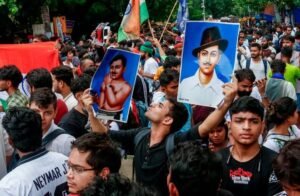
Entering the protest site meant standing in a long, disciplined queue. The lights went off at one point, but phone flashlights pushed back the darkness. It took a long while before I could slip past the security check to the main area before the podium, where Abhijit Dipke was urging the crowd to hold the peace.
Hundreds of people stood there fanning visitors with pieces of cardboard, and it was only later that I realised they weren’t volunteers in any organised sense—just people like you and me who had decided to help.
The whole arrangement ran with a startling efficiency. As some distributed food and water, practically pleading with you to take it, others carried garbage bags through the crowd, collecting empty bottles, wrappers, and meal containers.
What stood out most was how the lathicharge had galvanised, not broken, the protest.
Boys and girls in equal numbers, often with their parents alongside them, filled the ground, trading views with the hundreds of YouTubers who were carrying the events live to the rest of the country.
The mainstream television reporters were nowhere to be seen.
“We don’t want them here. They come only to spread misinformation and hatred,” a young student told me when I asked if she’d seen anyone from the news channels.
Another, with curly hair, a Che Guevara placard tucked under her arm, was blunter still.
“All they do is paint us as anti-national. They don’t come here to report—they come to sabotage our protest. People are very angry, and channels would do well to stay away from Jantar Mantar.”
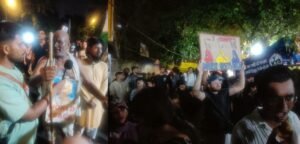
The ground wasn’t one crowd but many—circles of students sitting together, chanting and singing protest songs of their own choosing.
At the centre of it all stood an old man dressed as Gandhi, carrying the Mahatma’s trademark stick, speaking with real passion.
“I’m here to take part in India’s second freedom movement,” he said. “I’m here to fight for the future of the nation.”
The people around him clapped.
He went on: “India needs a revolution. India needs a system of governance that does not treat its youth as slaves and criminals.”
In a country where political and social discourse is now so often drawn along communal lines, Jantar Mantar showed the true colour of secular India.
A Muslim man, Junaiz, had been distributing snacks freely for days, and no one hesitated to accept from him—his smile was reassuring in a way that felt almost necessary, especially set against the news of fanatics elsewhere calling on people to refuse food from Muslim delivery riders.
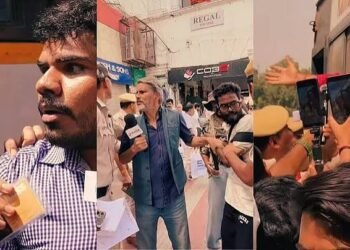
Mansi, Hardik, and Rishi busied themselves with recording vox pops for The Power Corridors and Panchayati Times. The protestors were unguarded, eager to talk about what brought them there, repeating again and again their resolve that no amount of police brutality would turn them back.
As they asked around about how the food chain worked, Arpit joined in and began distributing meals himself. Soon all of us were doing the same. By then it was close to 11 PM, but still more people arrived than left.
A group of Sikh volunteers came bearing more food. A bearded Muslim man pulled up in an auto-rickshaw stacked with meal packets, and no one stopped to ask his name before reaching for what he carried.
Somewhere in the dark, an old speaker crackled to life with Rafi, then Lata—voices from an India that had fought for its freedom once already—and for a moment the sloganeering fell away, and people simply swayed, or hummed, or wiped their eyes and said nothing at all.
Strangers passed food into each other’s hands like family passing a plate at a shared table, and it struck me that no lathi, however brutal, can break something that gives itself away this freely, to people it will never see again.
The CJP protest may not change India’s education system. It may not even survive the news cycle. But standing there past midnight, listening to the quiet voice of humanity rise above the slogans, hearing the melody of the India we once knew, watching strangers treat one another like family, and seeing the Jaipur medicine-seller—who could barely stand himself—refuse to close his stall while a single person still needed him, I understood that something far greater than an exam or a minister’s resignation had already been won.
Whatever else this country forgets, it should not forget that on one wounded evening at Jantar Mantar, it remembered how to be one.