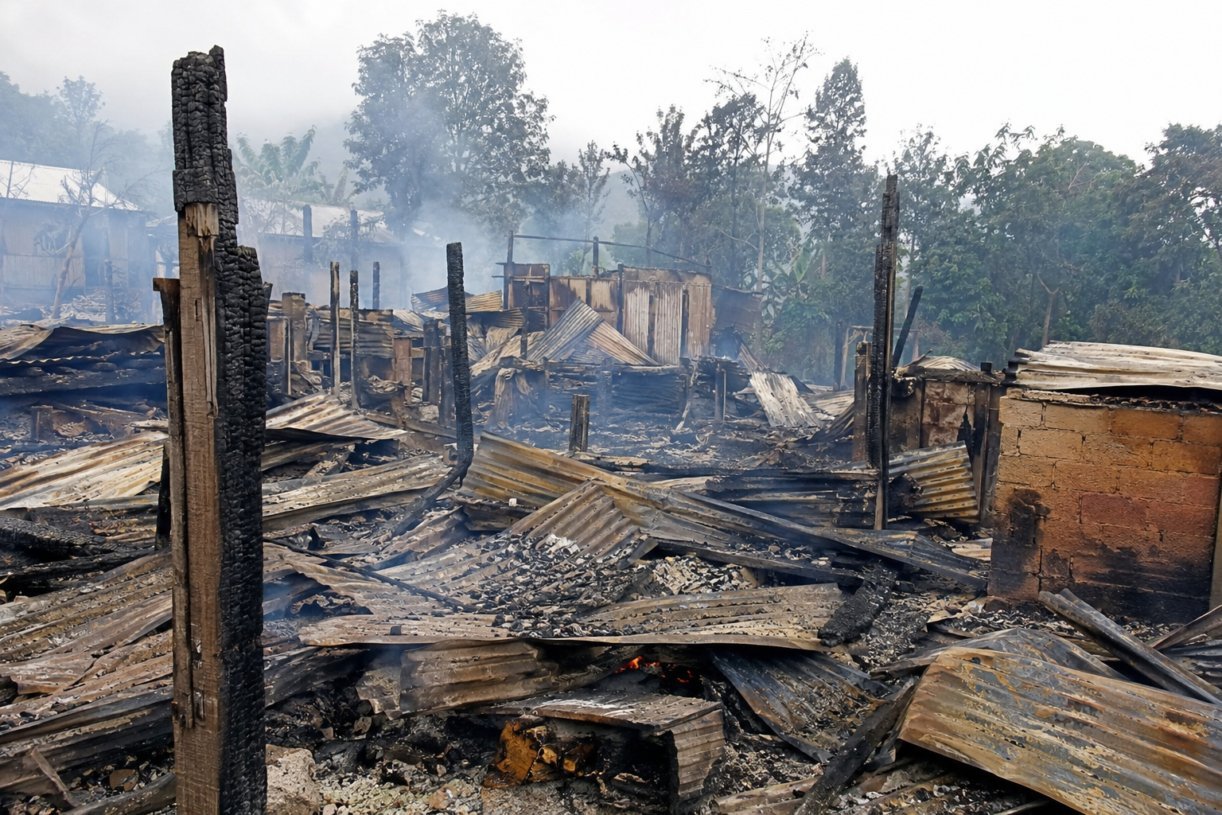
A growing sense of impunity is fuelling repeated violent incidents in Manipur’s hill districts, with Kuki-Zo civilians and villages continuing to face deadly attacks and large-scale arson.
BY PC Bureau
June 6, 2026: Suspected Naga militants appear to enjoy a disturbing level of impunity when targeting Kuki-Zo villagers, burning homes, and carrying out killings in Manipur’s hill districts. Despite a clear pattern of repeated assaults throughout 2026, not a single suspect has been arrested or held accountable in any major case where Kuki-Zo civilians have been the victims. This pattern of unpunished violence continues unabated, as seen in the latest killing of three Kuki-Zo civilians on Friday morning, June 5, 2026.
In the pre-dawn attack on Loibol Khullen village in Kangpokpi district, armed assailants killed village chief Letkhongam Haokip, his seven-month-pregnant wife Tinmary Haokip, and another resident, Jangminlal Haokip. At least seven homes were reportedly set on fire. Kuki organizations have alleged the involvement of NSCN-IM cadres and its proxy ZUF-Kamsong groups. As of now,the police describe the attackers as “unidentified armed miscreants,” with investigations ongoing but no arrests reported.
READ: Thousands Rally at Cockroach Janta Party Protest at Jantar Mantar
READ: Khan Sir: A Beacon of Hope Amid Communal Smears
This latest outrage fits into a longer sequence of similar incidents in 2026 where Kuki-Zo communities have borne the brunt of targeted violence:
- Homes and farmhouses torched in K. Songlung and other villages in January.
- Organised arson and bunker construction in Litan Sareikhong in February.
- The cold-blooded abduction and murder of two Kuki-Zo labourers (Thenkhogin Baite and Thangboimang Lunkim) on March 13, with FIRs naming NSCN-IM elements — yet no arrests.
- The April 24 pre-dawn assault on Mulam Kuki village, killing two young volunteers and burning multiple houses, during which attackers even fired on a police team.
- The May 13 ambush that murdered three Thadou Baptist pastors returning from a peace mission.
- Arson in Kharam Vaiphei on May 30, shortly after security redeployments.
Manipur: Kuki-Zo Bodies Target NSCN(I-M) Over Brutal Killings https://t.co/N69vs6JTvD Manipur #KukiZo #LoibolKhullen #Kangpokpi #HumanRights #JusticeForVictims
— POWER CORRIDORS (@power_corridors) June 5, 2026
In nearly all these cases, Kuki-Zo civil society groups have named specific Naga militant outfits or their proxies. First Information Reports (FIRs) often cite the same groups. Yet the outcome remains consistent: zero arrests of named suspects, minimal visible crackdowns, and a return to normal operations for the alleged perpetrators. Security responses tend to be reactive — statements of condemnation, promises of probes, and temporary force movements — without translating into tangible justice or deterrence.
This selective impunity is not lost on the Kuki-Zo people. When civilians — including pregnant women, church leaders, labourers, and village volunteers — are systematically targeted, the absence of accountability sends a dangerous message: attacks on Kuki-Zo soft targets carry little to no consequence. It emboldens further violence and deepens the sense of abandonment by the state machinery.
While the broader Manipur conflict involves allegations and counter-allegations from multiple ethnic groups (with violence reported in both directions), the consistent failure to prosecute perpetrators in cases involving Kuki-Zo victims stands out as a glaring failure of governance and the rule of law. Every unpunished attack adds another scar, another displaced family, and another reason for the community to question whether justice is possible in the hills of Manipur.
The people of Loibol Khullen and countless other affected villages deserve more than condolences and inquiries that go nowhere. They deserve swift, impartial arrests, credible investigations, and concrete measures to prevent the next inevitable strike. Without breaking this cycle of impunity, peace will remain an empty promise.