A fresh battle over who has the right to speak for the Nagas has erupted after Ao organisations challenged remarks attributed to NSCN (I-M) leaders against veteran Naga leader S.C. Jamir.
BY PC Bureau
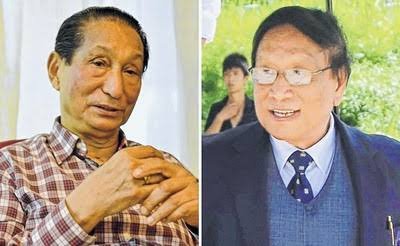
September 20: Who has the right to speak for the Nagas? That question has moved to the centre of a widening debate after two prominent naga bodies–the Ao Senso Telongjem Dimapur (ASTD) and Dimapur Ao Youth Organisation (DAYO)– challenged remarks attributed to NSCN (I-M) leaders V.S. Atem and R.H. Raising against former Nagaland chief minister and governor Dr S.C. Jamir.
In a joint statement, ASTD and DAYO described as “unfortunate and deeply unsettling” the reported remarks portraying Jamir as “out and out Indian”, saying he was not an advocate of the Naga people and had “no right” to speak on the Naga political issue.
The two organisations argued that the Naga political issue should not be reduced to a contest over who has exclusive authority to speak for the Naga people.
“A Naga’s right to speak cannot be dictated by an organisation,” they said.
ASTD and DAYO pointed to Jamir’s political record, noting that he is a Naga from a native village who was elected from his constituency and went on to serve as Parliamentary Secretary at the Centre under Prime Minister Jawaharlal Nehru, chief minister of Nagaland and governor of several Indian states.
They said Jamir’s political record and views could be debated, criticised or challenged, but disagreement with his political position could not deprive him of the right to express his views on matters concerning Nagaland and its people.
“If the NSCN (I-M) or any other political organisation disagrees with Jamir’s reading of Naga history or his approach to a settlement, such differences should be met with facts, historical evidence, reasoned argument and open public debate,” the organisations said, rather than by questioning his Naga identity or declaring that he had no right to speak.
The statement raised a broader question: who has the authority to determine whether a Naga is sufficiently “Naga” to speak about the Naga people?
ASTD and DAYO asked whether such authority could rest with an individual, organisation, political group, leadership or negotiating body, arguing that the Naga political journey has involved generations of political leaders, civil society organisations, churches, intellectuals, elected representatives, national workers and ordinary citizens.
“No organisation,” they said, should place itself above the collective conscience of the Nagas by assuming the power to decide who may or may not speak for the people.
NNC/FGN also challenges Jamir
The latest exchange follows a separate rejoinder issued last week the Naga National Council/Federal Government of Nagaland (NNC/FGN), which criticised Jamir over his call for an early settlement of the Naga political issue.
In its September 15 response issued by Kedahge Zhopra Vero, the NNC/FGN said it did not question Jamir’s stated desire for an early settlement but questioned his political record and approach to the decades-old conflict.
The organisation alleged that aspects of Jamir’s political career had contributed to divisions within Naga society and criticised positions it said were contrary to the political aspirations of the Naga people.
It also questioned his earlier opposition to dialogue between Naga leaders and the Government of India.
The NNC/FGN particularly criticised the Naga Peoples Convention and the subsequent 16-Point Agreement, arguing that the process contributed to political divisions rather than resolving the underlying sovereignty question.
The historical significance of the 16-Point Agreement is undisputed, although its political interpretation remains sharply contested. The Naga Peoples Convention was formed in 1957, and its negotiations with New Delhi culminated in the 1960 agreement that provided for the creation of Nagaland as a state within the Indian Union. Nagaland became the 16th state of India in 1963.
Jamir was among the members of the NPC negotiating body that participated in the process leading to the agreement.
For sections of Naga political opinion, however, the 16-Point Agreement remains controversial because the underground Naga nationalist leadership did not participate in the NPC process. Critics have consequently argued that it did not settle the wider political question.
The deeper dispute over the Naga mandate
At the heart of the present confrontation is a much larger disagreement over the nature and ownership of the Naga political struggle.
The NSCN (I-M) has consistently presented the Naga issue as a political question rooted in what it describes as the “unique history” of the Naga people. The organisation has treated the 2015 Framework Agreement with the Government of India as the principal basis for a final settlement. The Government of India has described the agreement as laying down broad parameters within which a final settlement was to be worked out.
READ: SC Jamir’s “Alien Elements” Remark Puts Manipur Nagas, Tangkhul Leadership in Spotlight
The NSCN (I-M) has also repeatedly insisted that the Naga flag and constitution, or Yehzabo, should form part of the final settlement. In its public statements, the group has linked these demands to its interpretation of the Framework Agreement and to the concept of peaceful coexistence and shared sovereignty.
This position differs fundamentally from the constitutional route represented by the 16-Point Agreement, under which Nagaland was established as a state within the Indian Union.
The resulting disagreement is therefore not merely over Jamir personally. It reflects competing interpretations of the Naga political inheritance: whether the movement’s political legitimacy flows principally from the historical struggle and subsequent armed nationalist organisations, from the constitutional settlement that created Nagaland, or from the wider Naga population and its diverse political and civil institutions.
That question has remained unresolved through decades of conflict, ceasefires and negotiations.
A question of political voice
ASTD and DAYO have sought to shift the immediate debate away from competing claims of exclusive political authority.
They said Jamir’s views could be accepted, rejected or critically examined by the Naga public, but argued that the decision over the legitimacy of his views should not be determined by an organisation declaring that he had no right to speak.
The organisations called for restraint and greater responsibility in public discourse, warning that personal attacks, questions of identity and competing claims of exclusive mandate could deepen existing divisions.
The latest exchange thus brings an old question back into public view: who speaks for the Nagas — an organisation claiming a negotiating mandate, elected political representatives, historical institutions, civil society, or the Naga people themselves?
For now, the competing answers remain sharply divided.