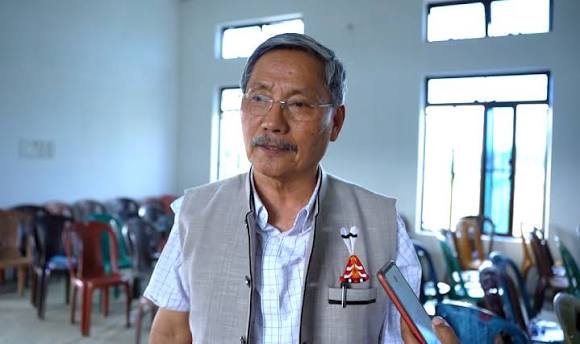
NSCN (I-M) leader V.S. Atem has urged Nagas to stand together amid the Manipur conflict, while former Chief Minister S.C. Jamir and several Naga organisations have challenged the group’s claim to speak on the wider Naga political issue.
BY PC Bureau
September 22: The NSCN (I-M)’s renewed push for Naga unity amid the Naga-Kuki tensions in Manipur has brought fresh scrutiny to allegations that the group is using the conflict to rebuild support and deflect criticism over the delayed implementation of the 2015 Framework Agreement.
The allegation, made recently in New Delhi by Kuki National Organisation spokesperson Dr Seilen Haokip, came into sharper focus yesterday after NSCN (I-M) leader Lt Gen (Retd.) V.S. Atem called on Nagas to remain united, portraying the Manipur conflict as a threat to Naga ancestral land and accusing the Government of India of using Kuki armed groups in a “proxy war” against the Nagas.
Speaking at the inauguration of the Mao Students’ Union Martyrs’ Trophy 2026 at the AFA Turf Ground in Asufii, Punanamei, Atem alleged that the Government of India was pursuing policies aimed at keeping the Nagas “divided and sub-divided”, which he described as a form of “apartheid”.
Atem also accused security forces of attempting to “fence” Naga ancestral land under the pretext of preventing infiltration. He further alleged that the Centre was using Kuki armed groups as part of what he described as a “proxy war” against the Nagas.
“There arises no trans-border infiltration within Nagalim,” Atem said, while alleging that the infiltration issue was being linked to Kukis whom he described as illegal immigrant refugees in parts of Manipur. He said the Nagas would not accept what he termed a “Berlin wall” being erected across their ancestral land.
He further alleged that Kuki armed groups operating under the Suspension of Operations arrangement were being armed and protected to confront Naga village guards. Atem claimed that Kuki militants had been transported in armoured vehicles to engage Naga village guards and alleged that they were being encouraged to occupy Naga land.
The remarks come amid a widening ethnic fault line in Manipur, where clashes between Kuki-Zo and Naga groups have added another layer to the State’s prolonged conflict. The Print reported last week that at least 27 people had been killed in Kuki-Zo-Naga clashes since the BJP-led government assumed office in February 2026, while more than 100 houses were reportedly burned.
Referring to the killing of six Naga civilians at Leilon Vaiphei, Atem questioned the role of security forces and alleged that Naga villages and village guards were being treated differently.
He claimed that Naga villages had come under attack without adequate security intervention, while village guards defending their communities were being detained and their licensed weapons seized.
“Nagas are treading on thin lines. We must be very cautious of our own actions,” Atem said, urging Nagas to distinguish between an adversary and a fellow Naga.
He called for Naga unity “whatever the circumstances”, stressing the need for the community to remain together amid the growing tensions in Manipur.
KNO allegation: Manipur violence being used to rebuild Naga unity
Atem’s remarks came days after Kuki National Organisation spokesperson Dr Seilen Haokip alleged in New Delhi that the NSCN (I-M) was attempting to turn the Manipur conflict into a Naga-Kuki confrontation in order to revive its support base and divert attention from its own problems.
Haokip said the conflict that began in Manipur in May 2023 was not originally a Naga-Kuki conflict and accused the NSCN (I-M) of trying to create a “false narrative” around the recent violence. He alleged that the organisation was attempting to emotionally rally Nagas around the conflict and regain support in the hill areas.
The allegation comes at a time when questions are being raised within Naga society over the long delay in translating the 2015 Framework Agreement into a final settlement.
The Framework Agreement was signed between the Government of India and the NSCN (I-M) in August 2015 after years of negotiations. More than a decade later, however, the final political settlement remains unresolved.
The delay has increasingly become a source of public and political debate in Nagaland, with former chief minister S.C. Jamir among those demanding that the Centre bring the negotiations to a conclusion.
Jamir calls for settlement by 2026
A message to Mr.#Thuingaleng_Muivah, NSCN-IM Supremo:
Remember the words of #SC_Jamir: “Leave the future of the Naga people to the Naga people.”
Mr.#VS_Atem, Thuingaleng deputy should well remember that SC Jamir, Former CM of Nagaland and former Governor of Maharashtra, Goa,… pic.twitter.com/MLWhxthBM8
— Seimin Doungel (@SeiminDoungel_) September 17, 2026
Jamir, who recently met RSS chief Mohan Bhagwat in New Delhi, has urged the RSS and the Centre to intervene to push the Naga peace process towards an early and honourable settlement.
At a September 12 press conference in Dimapur, Jamir said public hope was steadily fading after decades of negotiations and called for a final settlement agreement with the Naga underground groups, preferably by the end of 2026. He also called for President’s Rule in Nagaland, arguing that governance had deteriorated and that the political impasse could not continue indefinitely.
Jamir has subsequently argued that the Naga political struggle originated and matured in Nagaland and that questions of mandate and representation should be left to the people of Nagaland.
His intervention has, however, triggered a sharp response from the NSCN (I-M).
NSCN (I-M) questions Jamir’s authority
NSCN (I-M) leaders have questioned Jamir’s authority to speak on the Naga political issue.
R.H. Raising, a member of the group’s Collective Leadership, said Jamir was “not the advocate of the Naga people” and described him as “out and out Indian”. V.S. Atem also questioned whether Jamir was authorised or mandated to represent the Nagas in the ongoing negotiations.
READ: NSCN (I-M) Under Fire Over Attack on Veteran S.C. Jamir
The remarks have themselves triggered a backlash from several Ao organisations.
The Ao Lanur Telongjem (ALT) condemned what it described as personal attacks on Jamir and demanded that Atem and Raising retract their statements. The organisation said no organisation should have exclusive authority to determine which Naga has the right to speak on issues concerning the community.
The Ao Senso Telongjem Dimapur (ASTD) and Dimapur Ao Youth Organisation (DAYO) also criticised the NSCN (I-M) remarks, saying Jamir’s long public career gave him a legitimate right to express his views on the political future of the Nagas. They argued that the Naga political issue should not be reduced to a contest over who has exclusive authority to speak for the community.
Two Ao organisations in Chümoukedima — the Ao Senso Telongjem Chümoukedima and Ao Youth Organisation Chümoukedima — likewise backed Jamir, rejecting attempts to question his Naga identity or right to comment on the political issue.
The reactions illustrate a widening debate within Naga society over representation, political legitimacy and the prolonged peace process.
NPF rejects both Jamir and Therie’s route to a settlement
The political sparring has also intensified within Nagaland.
The Naga People’s Front has rejected Jamir’s demand for President’s Rule, saying Nagaland has an elected government and that Article 356 cannot be used as a shortcut to achieve a political settlement. The party said previous periods of President’s Rule had not brought lasting stability or advanced the Naga political issue.
The NPF also rejected former minister K. Therie’s recent accusation that the party was delaying a settlement for electoral advantage or because of its alleged proximity to the NSCN (I-M).
Therie had argued that President’s Rule would be the quickest route to implementing the agreements and questioned why the Centre had not moved towards an execution plan despite the prolonged negotiations. He also alleged that the NPF was acting as a “roadblock” to the settlement.
In its latest rejoinder, the NPF described Therie’s allegations as “baseless, politically motivated and misleading”. It said the state government was not a signatory to agreements between the Naga political groups and the Centre but acted as a facilitator.
The party maintained that it had consistently supported an early, honourable, inclusive and acceptable settlement involving all Naga political groups.
“The Naga issue is much bigger than any party or any election,” the NPF said, rejecting the allegation that it was seeking electoral advantage through proximity to the NSCN (I-M).
The NPF also defended its position on the proposed ministerial-level intervention in the peace process, saying the Centre had assured the state of an apex committee to take the process forward.