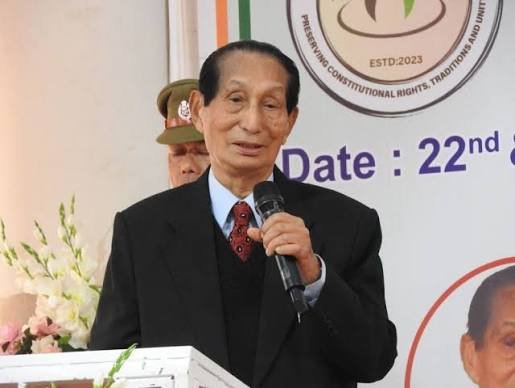
S.C. Jamir’s remarks have brought the historical fault lines within the Naga movement back into focus, particularly over the role of Naga communities in Manipur and the question of who can legitimately claim the movement’s original political mandate.
BY NAVIN UPADHYAY
SEPTEMBER 21: Former Nagaland chief minister and governor Dr S.C. Jamir’s latest intervention in the Naga political debate goes beyond a dispute over the interpretation of the 2015 Framework Agreement. At its core is a pointed challenge to who can claim ownership of the Naga political movement — and whether its mandate, born in the Naga Hills, can now be exercised by leaders and organisations whose political leadership has emerged from outside present-day Nagaland.
In a published statement , “Unveiling Bare Facts of Naga Political Struggle,” Jamir says the movement was “born and fully matured in the soil of Nagaland” but was subsequently “hijacked by alien elements.” He does not name the Tangkhul Nagas or any particular community in that passage. However, his reference to Naga tribes outside Nagaland, and particularly to the “southern Nagas,” places the spotlight on the role of Naga communities in Manipur in the later evolution of the movement.
The sharper of Jamir’s questions comes when he turns to the years of armed conflict that followed the breakdown of relations with the Indian state in the 1950s. Recalling the violence, destruction and suffering endured in Nagaland, he asks: “Have the southern Nagas shown any sympathy when the Nagas of Nagaland had been living in such terrible agony?” His answer is unequivocal: “The reply is a big ‘No’.”
Jamir’s formulation is significant because the political landscape of the Naga movement changed substantially in the decades that followed. The NSCN (I-M), which emerged as the principal interlocutor with New Delhi in the later phase of the Naga peace process, has a leadership structure that includes prominent Naga leaders from Manipur. Its current collective leadership includes Th. Muivah and V.S. Atem, alongside Q. Tuccu and Tongmeth Wangnao.
Muivah and Atem are both Tangkhul Nagas from Manipur, making the geographical question raised by Jamir particularly relevant to the organisation that has negotiated the Framework Agreement with the Government of India. The connection, however, is an analytical one: Jamir himself does not identify the Tangkhuls in his statement as the “alien elements.” His language is broader, referring to Naga tribes outside Nagaland and to southern Nagas.
That distinction matters because Jamir’s argument is not simply about ethnicity. It is fundamentally about political provenance and mandate. He traces the early institutional history of the movement to the Naga Hills, citing the 1929 memorandum to the Simon Commission, the formation of the Naga National Council and the 1951 plebiscite. He argues that these developments established a political mandate associated with the people of what became Nagaland.
His subsequent reference to the years of “terrible agony” adds a second layer to that argument. Jamir recalls the period after 1955, when armed conflict brought widespread violence to Nagaland, and asks whether Naga communities to the south shared or demonstrated solidarity with Nagaland during those years. He then credits leaders from Nagaland with salvaging the political hopes and aspirations of the movement when it reached what he describes as a critical point.
That historical argument cuts directly into a contemporary reality. The Naga political movement is no longer led exclusively from the territory that constituted the original Naga Hills political arena. The NSCN (I-M), for example, has for years been led by figures from different Naga areas, with Muivah — a Tangkhul from Manipur — remaining its most prominent political figure. The organisation continues to describe its collective leadership, including Muivah and Atem, as responsible for guiding the Naga political movement.
READ: Three Years, 3,020 Cases, Just 33 Trials: The Long Wait for Justice in Manipur
This is what gives Jamir’s reference to “alien elements” its political resonance. He does not name those elements, but his broader argument questions whether later leaders from outside Nagaland can legitimately speak for the historical mandate that, in his account, originated in the Naga Hills.
Jamir makes the point even more explicitly when he says that the question of mandate and advocacy should be left to the people of Nagaland, adding that historical records would establish the movement’s “legitimate progenitor/precursor.”
The intervention therefore revives an old but unresolved fault line within Naga politics: is the Naga political struggle primarily a historical movement rooted in Nagaland, or has its political mandate evolved into a broader claim encompassing Naga-inhabited areas across state boundaries?
Jamir’s answer appears to favour the former interpretation. His critics, however, have already challenged his authority to speak on the Naga political issue. The NSCN (I-M), responding to one of his earlier remarks, questioned whether Jamir was authorised or mandated to represent the Naga people, with senior leaders V.S. Atem and R.H. Raising publicly questioning his standing on the issue.
The resulting confrontation is therefore not merely another exchange over the Framework Agreement. It goes to a deeper question that has shadowed the Naga political movement for decades: who owns its history, who inherited its mandate, and who has the right to speak in its name?