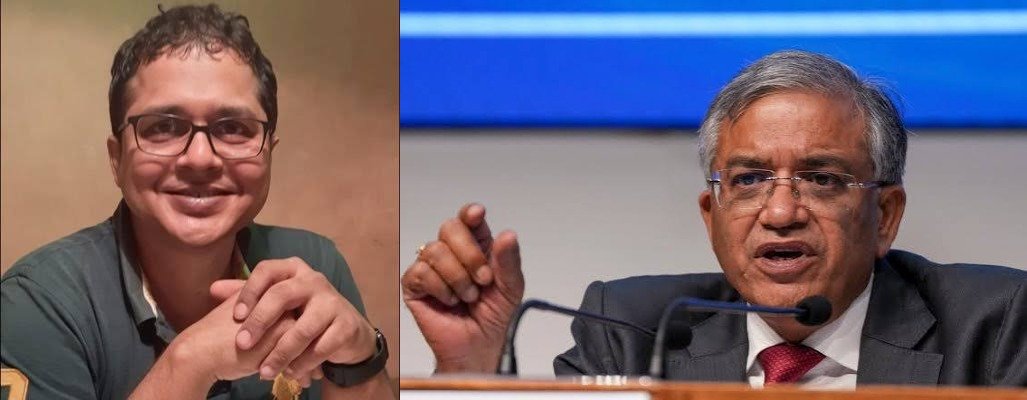
Gokhale said Kumar is listed as a voter in Delhi but claimed that an entry matching “Gyanesh Kumar, son of Subodh Kumar” was not found in the 2002–03 SIR rolls of the three states. He has sought clarification from the Election Commission
BY PC Bureau
New Delhi, September 21: Trinamool Congress leader and former Rajya Sabha MP Saket Gokhale has questioned how Chief Election Commissioner Gyanesh Kumar’s name was mapped into Delhi’s draft electoral roll under the ongoing Special Intensive Revision (SIR), claiming that he could not find a matching entry in the previous SIR rolls of Delhi, Uttar Pradesh and Kerala.
In a post on X, Gokhale said Kumar is listed in the Delhi draft SIR roll as “Gyanesh Kumar, son of Subodh Kumar” and questioned which previous SIR record was used to establish his electoral-roll mapping.
Gokhale said he searched the 2002/03 SIR records of Uttar Pradesh, Kerala and Delhi for an entry matching Kumar’s name and parentage but claimed that no such entry was found.
Under the SIR process, voters whose current details cannot be mapped to the relevant previous electoral roll may be classified as “unmapped”, while certain inconsistencies can be flagged as a “logical discrepancy”. Gokhale argued that if Kumar’s entry could not be mapped to an earlier roll, the same rules should apply to him as to other electors.
Important:
Is CEC Gyanesh Kumar a citizen of India?
In the Delhi draft SIR electoral roll, CEC Gyanesh Kumar is shown as a voter. He is registered as Gyanesh Kumar, son of Subodh Kumar.
If a person cannot be mapped to the last SIR in 2002/2003, they are flagged as a “logical… pic.twitter.com/GVPDx0Sl7P
— Saket Gokhale (@SaketGokhale) September 21, 2026
He asked the Election Commission to clarify four points: which state’s previous SIR roll Kumar has been mapped to; whether he was registered as a voter in 2002/03; how his current entry appears on the electoral roll if no matching record exists in the three states he searched; and whether he received a notice for being an “unmapped voter” or having a “logical discrepancy”.
Gokhale also asked, rhetorically, whether Kumar was an Indian citizen. However, the absence of a matching name in a public search of three previous SIR rolls does not establish any conclusion about Kumar’s citizenship. The issue at this stage concerns the basis on which his current electoral entry was mapped.
The Election Commission had not issued a specific public response to Gokhale’s questions by Monday evening, according to reports.
Important:
Is CEC Gyanesh Kumar a citizen of India?
In the Delhi draft SIR electoral roll, CEC Gyanesh Kumar is shown as a voter. He is registered as Gyanesh Kumar, son of Subodh Kumar.
If a person cannot be mapped to the last SIR in 2002/2003, they are flagged as a “logical… pic.twitter.com/GVPDx0Sl7P
— Saket Gokhale (@SaketGokhale) September 21, 2026
Gokhale’s questions come amid Delhi SIR controversy
Gokhale’s post comes amid controversy over the ongoing SIR of Delhi’s electoral rolls. The draft roll contains more than 97 lakh electors, while the Election Commission has issued notices to a large number of voters over discrepancies in their details, including mismatches with the previous SIR roll.
Several prominent names have reportedly received notices, including former deputy prime minister L.K. Advani, External Affairs Minister S. Jaishankar, former vice-president Jagdeep Dhankhar and Election Commissioner S.S. Sandhu.
The controversy has focused particularly on how present-day voters are being linked to older electoral rolls and how discrepancies are being dealt with.
READ: NSCN (I-M) Under Fire Over Attack on Veteran S.C. Jamir
What remains unanswered
The key factual question raised by Gokhale is narrower than his citizenship reference: which previous electoral-roll entry, if any, was used to map Gyanesh Kumar’s current Delhi voter record?
A public search failing to produce an exact name-and-parentage match does not necessarily establish that no earlier record exists. Differences in spelling, electoral-roll entries, constituency records or the manner in which the Election Commission links current voters to earlier rolls could potentially affect such searches.
The Election Commission’s response would therefore be required to establish whether Kumar was mapped through a previous SIR entry, what record was used, and whether any discrepancy or unmapped-voter notice was generated.
Until those records are made public, Gokhale’s claims remain allegations based on his search of the publicly available SIR records rather than an independently established finding about the CEC’s electoral status or citizenship.
Social Media Reaction: Double-Standard Claims and Pushback
Many users on X interpreted Saket Gokhale’s post as evidence that SIR rules may not be applied uniformly. Some alleged that Gyanesh Kumar, as the head of the Election Commission overseeing the exercise, could have benefited from a “backdoor entry” or avoided the logical-discrepancy checks faced by other voters. Others used phrases such as “ethical discrepancy” sarcastically and alleged that the SIR exercise was being used to remove eligible voters, while demanding an explanation from the Election Commission.
Several users tagged the Election Commission’s official account, @ECISVEEP, seeking details of Kumar’s electoral-roll mapping, including which 2002/03 state roll was used to establish his current entry and whether he received any notice similar to those reportedly issued to prominent figures such as S. Jaishankar and Rekha Gupta.
Critics Challenge Citizenship Angle
Others pushed back against Gokhale’s reference to Kumar’s citizenship, describing it as political rhetoric rather than an established finding. Some pointed out that searches of old electoral rolls can produce blank results because of variations in names and parentage, incomplete digitisation and limitations in online search tools.
Critics also argued that an unsuccessful search for an exact name-and-parentage combination does not establish that no corresponding electoral record exists. Some compared Kumar’s case with other prominent individuals who reportedly received SIR notices and questioned whether a screenshot showing no search result could, by itself, establish a violation of the SIR process.
.