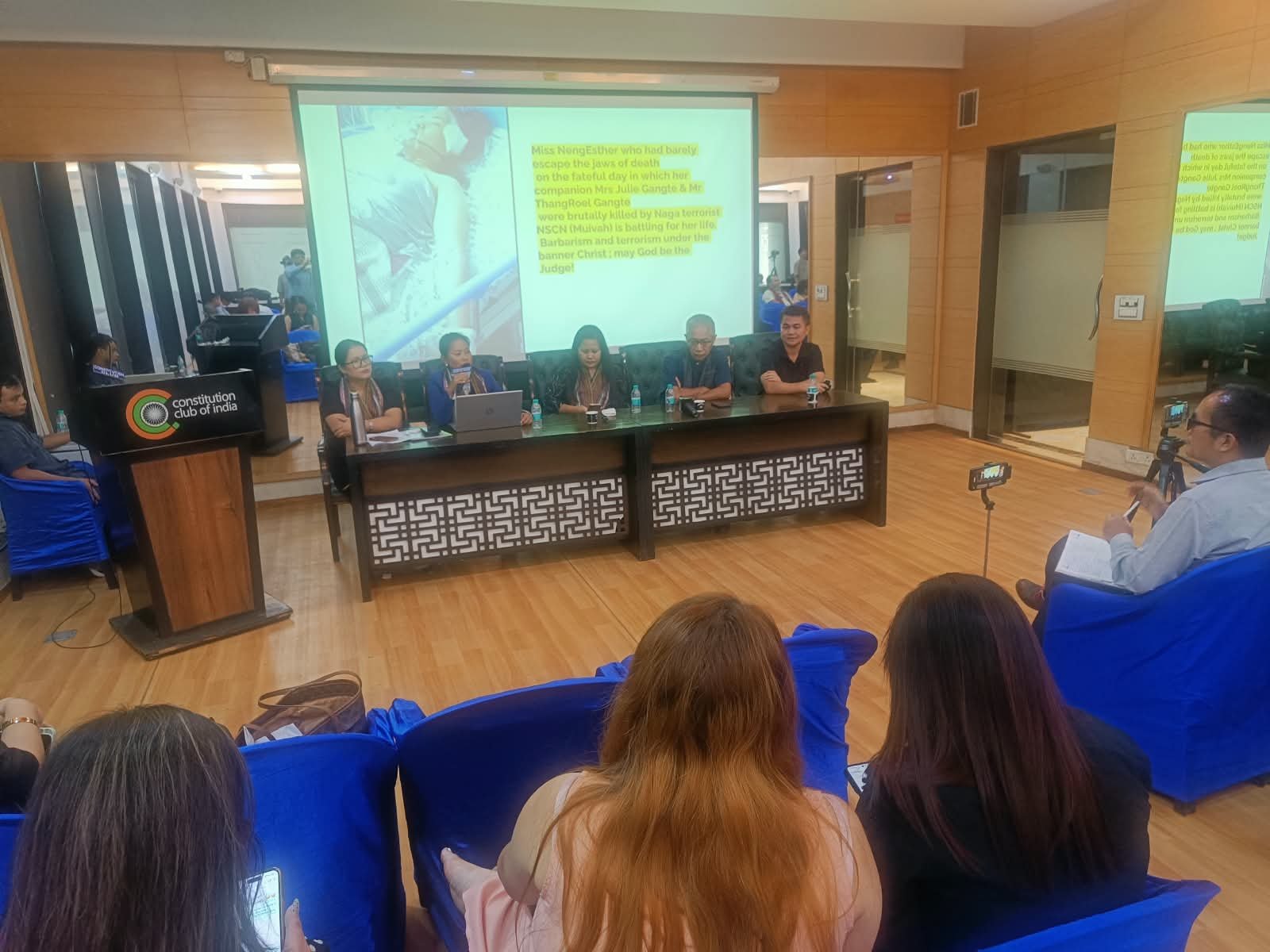
At a press conference in New Delhi, the Kuki-Zo Women’s Forum alleged a continuing security crisis in isolated Kuki-Zo settlements and called for arrests, a central probe and immediate protection for vulnerable civilians.
BY PC Bureau
New Delhi: The Kuki-Zo Women’s Forum, Delhi and NCR, has demanded the immediate re-imposition of President’s Rule in Manipur, alleging that the elected government has failed to protect isolated Kuki-Zo settlements from a series of deadly attacks.
At a press conference at the Constitution Club of India on Thursday, the Forum said 24 Kuki-Zo civilians had been killed since March 11, including seven women, two of them pregnant. It also cited the shooting of a child inside his home. Including two unborn children, the Forum put the overall toll at 26.
The Forum said the killings pointed to a wider security crisis in vulnerable hill settlements, where, it alleged, repeated condemnations by political leaders and civil society groups had not resulted in arrests or effective protection.
President’s Rule was imposed in Manipur on February 13, 2025, amid the ethnic conflict that began in May 2023. It was lifted on February 4, 2026, when a BJP-led government headed by Chief Minister Yumnam Khemchand Singh took office.
The Forum argued that the latest series of killings began with incidents in Ukhrul district in March and subsequently spread across parts of Tamenglong, Noney, Kangpokpi and Kamjong.
‘A political design behind the killings’
Mercy Khongsai, vice-president of the Kuki Students’ Organisation, Ukhrul, presented a chronology of killings that the Forum said demonstrated a continuing pattern rather than isolated incidents.
Khongsai said the violence had evolved from what she described as a local confrontation in Ukhrul into a wider conflict involving Tangkhul Naga groups and armed organisations.
“What started with a simple brawl in Ukhrul in February has now spread into a full-fledged conflict. Tangkhul Nagas and their militant organisations are doing this with a design. They want to rally all Naga tribes around themselves. Systematically, they are spreading the arc of violence across the hill districts,” she said.
Khongsai alleged that the attacks were part of a political design aimed at driving the Kuki-Zo population out of their ancestral villages.
“It is unfortunate that the entire state machinery and security forces have become silent spectators, while Tangkhul Nagas and NSCN (I-M) have been given a free hand to go after Kuki-Zo women and children,” she alleged.
She also questioned the deployment of security forces in the affected areas, saying even the Assam Rifles, which comes under the Defence Ministry, had to operate in coordination with the state police.
“The Assam Rifles also needs to work in coordination with the state police. It is anybody’s guess why the state police is acting this way and who is controlling them,” she said.
“That is why we suspect there is a political design behind these killings,” Khongsai added.
Six civilians killed in three days
The Forum’s chronology included the reported abduction and subsequent deaths of Thenkhogin Baite and Thangboimang Khongsai in March; the killings of Letlal Sitlhou and Paominlun Haolai in April; and the deaths of Rev. Vumthang Sitlhou, Pastor Paogoulen Sitlhou and Rev. Kaigoulun Lhouvum in May.
The Forum also cited the June 5 killings at Loibol Khullen of Jangminlal Haokip, Letkhongam Haokip and seven-month-pregnant Tinmary Haokip, along with her unborn child. Seven houses were also reported burnt.
More recently, Lhingzangai Singsit and her husband, Seineh Singsit, were killed in the September 13 attack at L. Tollen, while their young son Henminsang was shot and injured.
The same day, Thangvel alias Roel Gangte and his pregnant wife Julie Singson were killed at Longpi, while Nei Esther was critically injured.
On September 15, Phalneichong Sitlhou, a widow, and Kimjalhing Singson, a newly graduated nurse, were shot dead at Leisangphai in Tamenglong district while reportedly collecting firewood. Farmhouses were also burnt.
The Forum said six Kuki-Zo civilians had died within three days in the latest escalation.
Police accounts have generally described the assailants in the recent incidents as unidentified armed men. Kuki-Zo organisations have alleged the involvement of NSCN-IM cadres and ZUF-K, while Naga organisations have disputed or rejected those allegations. The identities and affiliations of the attackers remain subject to investigation.
READ: Manipur’s Shame: Shot Woman Carried 20 Km to Hospital on Foot, Slips Into Coma
‘Condemnation has not produced accountability’
Dr Robert Thongkholal Haokip, a professor at Jawaharlal Nehru University, said elected representatives, village authorities and community organisations had repeatedly condemned the killings and sought central security and NIA investigations.
He questioned why those demands had not resulted in visible arrests or security forces reaching vulnerable villages before attacks took place.
“Law and order is a state subject,” Haokip said, arguing that the presence of Kuki-Zo or Naga representatives in the government could not by itself resolve the security problem.
“There are enough forces on the ground to control the spectre of violence in Manipur. But somehow they are not being deployed effectively, and that’s costing Kuki-Zo people their lives and homes,” he said.
The Forum also questioned the existing peace-dialogue framework involving the Centre and Naga groups. It pointed out that NSCN-IM remains engaged in talks with the Government of India while Kuki-Zo organisations continue to allege attacks by its cadres or associated groups in Manipur.
The Forum said it wanted greater clarity on the mandate of the Centre’s Northeast interlocutor and on measures being taken to prevent armed-group activity from threatening civilians.
Women and children bear the brunt
Slyvia Hatpi Kipgen, spokesperson for the Kuki Women Union, Sadar Hills, highlighted the deaths of seven women on the Forum’s list.
They included Tinmary Haokip, who was seven months pregnant; Tingneichin Lhouvum; Hoineineng Lhoujem; Lhingzangai Singsit; Julie Singson, who was about two months pregnant; Phalneichong Sitlhou; and Kimjalhing Singson.
Kipgen also alleged that investigations into the violence had been selective and claimed that the NIA had issued summons to people who were elderly, children, pregnant women and even some who had died.
“The NIA investigation into various cases of violence is selectively targeting Kuki-Zo people. The agency has issued summons even to those who have died, people above 90, children below 15 and pregnant women. Do you think these people could be involved in any act of killing and violence?” she asked.
The allegation was made at the press conference and was not independently established by the Forum.
The Forum also raised concerns over children affected by the violence, particularly Henminsang Singsit, whose parents were killed at Tollen.
It demanded statutory protection, medical treatment and rehabilitation for affected children and said the continuing violence threatened to further depopulate vulnerable hill settlements.
Thousands of Kuki-Zo children have already spent years in relief camps following the wider conflict that began in May 2023, the Forum said.
‘Security vacuum’ in isolated villages
Retired IRS officer W.L. Hangshing described what he called a persistent security vacuum in isolated Kuki-Zo settlements.
He referred to reported abductions, attacks on homes, shootings of civilians returning from markets or working in fields, and the burning of farmhouses.
Hangshing also pointed to the September 13 attack at Tollen, which, according to the Forum and village authorities, occurred only a few hundred metres from Kaimai Police Station.
To a question, he said the NSCN (I-M) was targeting Kuki-Zo women and children to provoke “us” into retaliating in the same manner.
“We never raise a hand against women and children. That is cowardice. The NSCN (I-M) wants us to do that so that it can mobilise the entire Naga community behind it,” he said.
He argued that vulnerable villages could not be expected to protect themselves indefinitely and called for effective security deployment or, where that was not possible, planned evacuation of civilians facing immediate danger.
Eight demands
Forum convenor Chong Haokip listed eight demands:
- Immediate re-imposition of President’s Rule in Manipur.
- Identification, arrest and prosecution of those responsible for the reported killings and abductions.
- A central investigation into the series of killings, including application of the NIA standard cited by the Chief Minister after the Ukhrul killings.
- A public account of the mandate and functioning of the Centre’s Northeast interlocutor.
- Immediate security cover, or planned evacuation where security cannot be provided, for women, pregnant women, children and the elderly in vulnerable settlements.
- Statutory protection, medical treatment and rehabilitation for children affected by the violence.
- A public account by the Ministry of Home Affairs of the security forces deployed in the areas where the attacks occurred.
- Action by the National Commission for Women and the National Commission for Protection of Child Rights on the memoranda submitted by the Forum.
“We will not accept condolence tweets in place of protection,” the Forum said.