

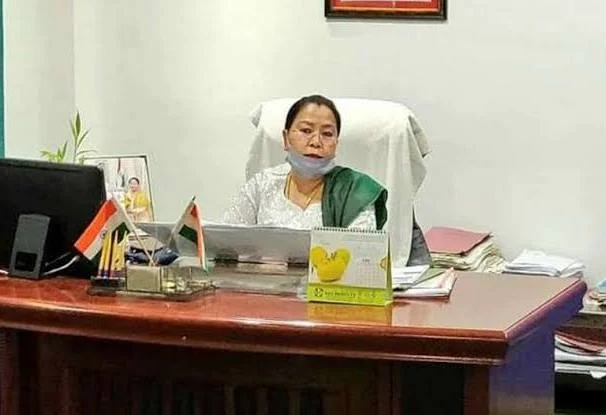
Nemcha Kipgen planned return to Imphal has raised fresh questions about the future of Kuki-Zo political resistance and the community’s collective stand against participation in the Manipur government.
By PC Bureau
October 19: Under pressure from Manipur Chief Minister Yumnam Khemchand Singh to stop working from Kangpokpi and resume her official duties in Imphal, Deputy Chief Minister Nemcha Kipgen has announced that she will travel to the state capital shortly, claiming that the decision is being taken “purely in the interest of peace”.
Kipgen made the announcement while addressing the closing ceremony of the third Inter-Kalapahar Sports Meet 2026 at Upper Kalapahar Football Ground in Kangpokpi district. Her proposed move comes more than three years after ethnic violence erupted in Manipur in May 2023, following which she has largely operated from Kangpokpi.
According to sources, Chief Minister Singh had firmly directed Kipgen to stop functioning from Kangpokpi and resume work from Imphal. Her planned shift would mark a significant change after a prolonged period during which many Kuki-Zo civilians and civil society organisations have largely stayed away from the state capital amid continuing security concerns.
Sources also said Kipgen had encouraged some Kuki-Zo civil society organisations in Kangpokpi to publicly appeal for her relocation to Imphal, apparently in an effort to minimise the risk of a backlash within her community. While some groups have made such appeals, several influential Kuki-Zo organisations have yet to publicly endorse the move.
Two days before Kipgen’s announcement, fellow Deputy Chief Minister Losii Dikho had said that the state government wanted her to return to Imphal and discharge her official responsibilities from there.
“Since Manipur is facing lots of problems, it is my sincere appeal to everyone to initiate all efforts to bring back normalcy and peace in the state,” Kipgen said. “Let us be peacemakers, for without peace there can be no development in the state and among communities.”
She stressed that lasting development depended on peaceful coexistence and urged communities to live together with mutual respect, love and understanding. She has also recently made similar appeals to Naga communities in her Kangpokpi Assembly constituency.
Peace appeals versus unresolved Kuki-Zo demands
Kipgen’s appeal for coexistence comes against the backdrop of a deep divide in Manipur and continuing questions over her position on the political demands raised by sections of her own Kuki-Zo community.
Since the outbreak of violence on May 3, 2023, Kuki-Zo organisations have pressed for a separate administration, including a Union Territory with a legislature. They have also demanded justice and accountability for victims of the conflict. Kuki-Zo groups have reported that nearly 275 members of the community have been killed, while allegations of sexual violence, attacks on civilians and other serious abuses remain central to their demands.
Since becoming Deputy Chief Minister, Kipgen has not publicly articulated support for these core demands in the statements cited here. Her public emphasis has instead been on peace, normalcy and coexistence within Manipur.
This contrast raises questions about the extent to which her position reflects the priorities of the wider Kuki-Zo community, many of whose organisations continue to insist that any return to normalcy must address their security concerns and political demands.
For many Kuki-Zo organisations, the question of returning to Imphal is inseparable from concerns about personal safety, political representation and the future administrative arrangement of the state. A decision by a senior Kuki-Zo leader to work from the capital could therefore carry implications far beyond the location of her office.
Kipgen, however, has framed her proposed move as an effort to promote peace, without publicly linking it to any specific political settlement of the conflict.
READ: Rahul Gandhi Holidays Abroad, CJP Leaders Behind Bars
Will Kipgens move encourage the Kuki-Zo community to return to Imphal?
One of the key questions is whether Kipgen’s relocation will be used to encourage members of the Kuki-Zo community to resume travelling to Imphal for medical treatment, education, official work and other essential needs.
Her decision could be presented as a confidence-building step, but it remains unclear whether it will persuade Kuki-Zo civilians and civil society organisations that continue to view a return to the capital as premature without credible security assurances and progress towards a political settlement.
It is equally uncertain whether her move will influence organisations that oppose normalisation without a resolution of the community’s political demands.
The Chief Minister’s reported directive has placed Kipgen in a politically sensitive position: she must comply with the government’s expectation that she work from Imphal while navigating the concerns of a community whose relationship with the state capital has been profoundly affected by the violence.
For now, Kipgen’s proposed return to Imphal marks a shift in her working arrangements under pressure from the Chief Minister. Whether it becomes a broader confidence-building measure, encourages Kuki-Zo civilians to return to the capital, or deepens divisions within the community will depend on the security arrangements, political engagement and concrete steps that follow.