


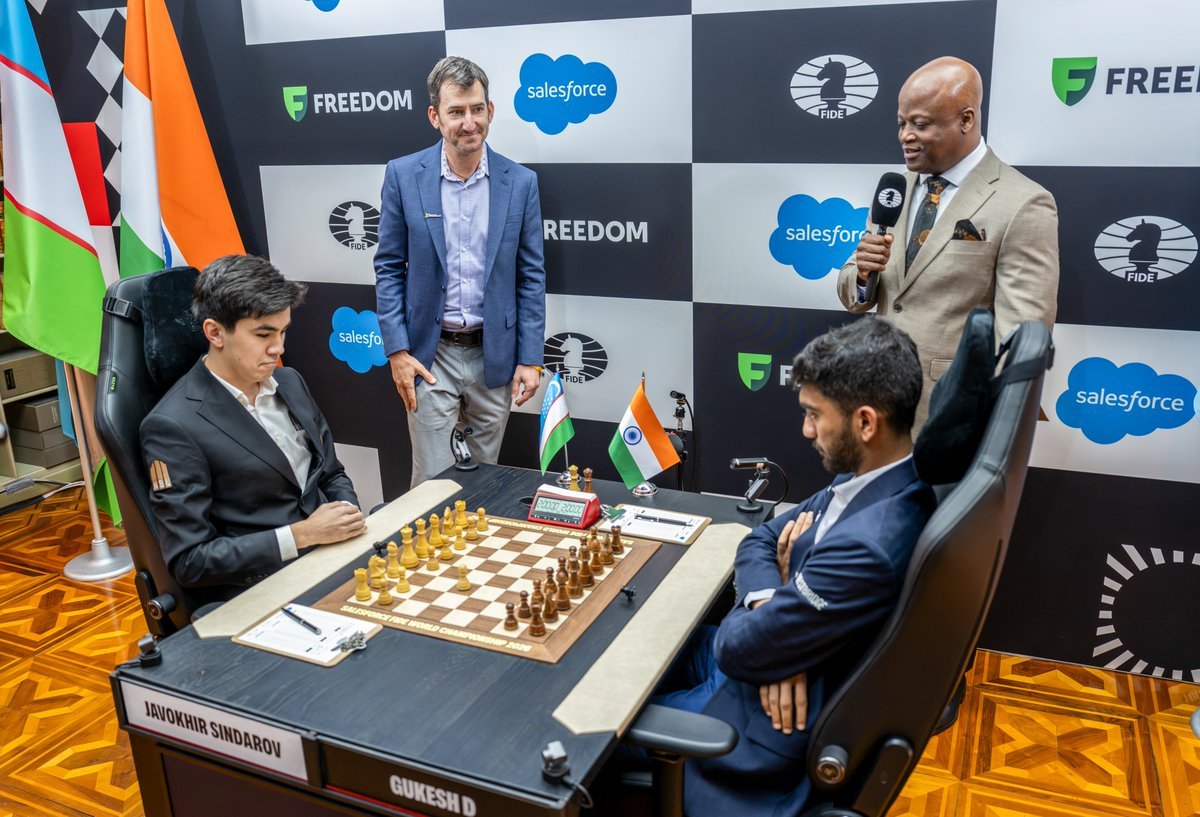
Neither player has managed to break the deadlock after four games. Gukesh and Sindarov now turn their attention to Sunday’s fifth encounter.
BY PC Bureau
November 28: World champion D Gukesh and challenger Javokhir Sindarov played out their fourth successive draw in the FIDE World Chess Championship match, with the game ending by threefold repetition after 34 moves on Saturday.
The result left the 14-game contest level at 2-2, with neither player yet able to establish a lead. But unlike the short second game, this was a serious opening duel in which Gukesh tried to use his preparation to put Sindarov under pressure. The Uzbek challenger, however, responded with precision and denied the Indian champion a lasting advantage.
Playing White, Gukesh opened with 1.e4 and Sindarov replied with the Petrov Defence, 1…e5 2.Nf3 Nf6. The choice itself was noteworthy. The Petrov is a sound and resilient defence, but it has not been a regular feature of Sindarov’s recent repertoire.
Gukesh opted for the relatively unusual 5.Be2, rather than the more familiar continuations. The move appeared to take Sindarov into less familiar territory. The challenger spent considerable time considering his response before choosing …Nc6.
Sindarov then played 6…a6, an important practical decision that sought to take Gukesh away from his preparation. The Indian responded with the striking 9.Qb1, a queen move that became the talking point of the game.
The idea was unusual, but not without purpose. Gukesh was looking to create pressure while retaining flexibility in the centre. The move prompted a fresh set of questions for Sindarov, who nevertheless found the necessary defensive resources.
Gukesh later defended his decision to play the queen move with a characteristically confident assessment: “Qb1 is so beautiful I just had to play it.” The remark captured the champion’s satisfaction with the idea, even though it did not translate into a concrete advantage.
The opening exchanges were followed by a period of careful manoeuvring. Sindarov gradually reduced White’s scope for active play and put pressure on Gukesh’s pawn structure. The Indian champion, in turn, avoided allowing the position to become uncomfortable.
Game 4 | Salesforce FIDE World Championship
◽️White: Gukesh D 🇮🇳
◾️Black: Javokhir Sindarov 🇺🇿
⚔️ Result: 0.5-0.5
♟ Match score: 2-2
↔️ Game length: 34 moves
📖 Opening: Petrov’s Defense
⚙️ Variation: Modern Attack
#GukeshSindarov https://t.co/xHdaAHHPMa— International Chess Federation (@FIDE_chess) November 28, 2026
READ: Rohtak Gang War: UP Woman Lured Four Men to Their Deaths
As the game progressed, a series of exchanges reduced the tension. The players reached a queen endgame in which neither could make meaningful progress without taking risks. Gukesh continued to look for possibilities, but Sindarov’s defence held.
The game eventually ended by threefold repetition after 34 moves, with Gukesh confirming the draw.
A small psychological victory for Gukesh?
The result was even, but the opening encounter offered Gukesh some encouragement. He had once again demonstrated the depth of his preparation and forced Sindarov to spend time solving unfamiliar problems early in the game.
For Sindarov, the more important takeaway was his ability to respond without allowing the surprise to disrupt his position. He had faced an unusual setup, spent time at critical moments and still reached an equal position.
The challenger’s performance was particularly significant because Gukesh had White and was looking to make the most of the initiative. Sindarov’s accurate handling of the position ensured that the champion could not turn his preparation into a tangible advantage.
The post-game discussion also brought attention to Gukesh’s 9.Qb1 idea. The Indian was clearly pleased with the concept, while Sindarov’s play on the board suggested that he had found a practical way to meet it. The challenger did not allow the novelty to dictate the course of the game.
The fourth draw means that the match has so far produced no decisive result. The first game ended in a 38-move draw, the second in a quick 20-move repetition, and the third was a much longer 60-move struggle. Saturday’s encounter added another carefully contested game to the sequence.
The balance of the match remains intact, but the opening battle is becoming increasingly important. Both camps are testing the depth of the other’s preparation, and neither player appears willing to take unnecessary risks.
Gukesh–Sindarov, Game 4: Complete moves
November 28, 2026 · Petrov Defence (C43) · 34 moves
1.  e4       e5
2.  Nf3      Nf6
3.  d4       Nxe4
4.  dxe5     d5
5.  Be2      Nc6
6.  O-O      a6
7.  Nc3      Be6
8.  Be3      Be7
9.  Qb1      Nxc3
10. bxc3     Qc8
11. a4       b6
12. h3       O-O
13. Re1      f6
14. exf6     Bxf6
15. Nd4      Nxd4
16. Bxd4     Qd7
17. a5       b5
18. Qb4      Bf5
19. Bf3      Bxd4
20. cxd4     Rae8
21. Rxe8     Rxe8
22. Re1      Rxe1+
23. Qxe1     Bxc2
24. Bxd5+    Kf8
25. Qb4+     Qe7
26. Qc3      Be4
27. Bxe4     Qxe4
28. Qxc7     Qxd4
29. g3       Qf6
30. Qc8+     Kf7
31. Qb7+     Kf8
32. Qc8+     Kf7
33. Qb7+     Kf8
34. Qc8+     ½–½
Why was the game drawn?
Gukesh gave repeated checks with his queen from c8 and b7. Sindarov’s king moved between f7 and f8. The same position occurred three times, allowing the players to agree to a draw by threefold repetition.
Three important moments to examine:
9.Qb1: Gukesh’s unusual queen manoeuvre, which was part of his preparation.
24.Bxd5+: Gukesh won a pawn and tried to create practical chances.
30.Qc8+: The beginning of the repeated checking sequence that ultimately forced the draw.
Game 5: Sindarov gets White
The players return to the board on Sunday, November 29, with Sindarov having the White pieces. The challenger will be looking to use that opportunity to put Gukesh under pressure, while the Indian will seek to carry forward the confidence gained from his opening preparation.
With ten classical games still scheduled, the match is far from entering a decisive phase. But the first four encounters have already shown that this contest may be decided as much by preparation and defensive accuracy as by the ability to seize an attacking opportunity.