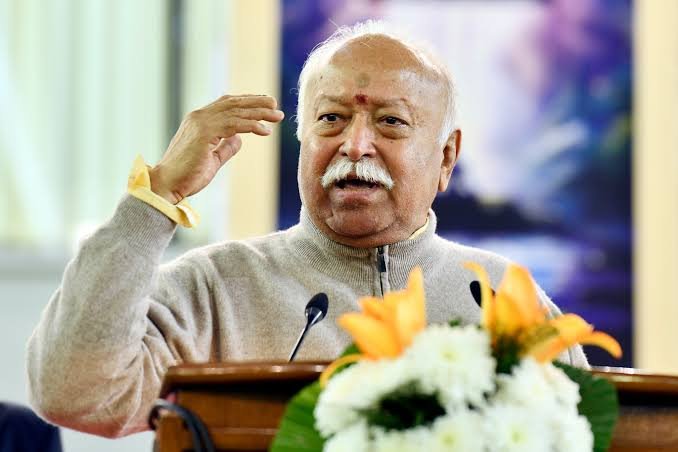
Marking the RSS centenary year, Mohan Bhagwat called for national unity rooted in India’s cultural identity, cautioning that political agitation driven by power and popularity could fuel hatred and undermine social harmony.
BY PC Bureau
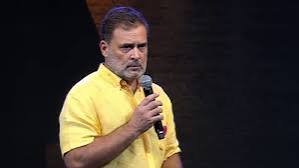
Nagpur, October 20, 2026: Rashtriya Swayamsevak Sangh (RSS) chief Mohan Bhagwat on Tuesday rejected the possibility of a “regime change” in India, warning against attempts to destabilise the country while asserting that protests in a democracy should focus on resolving problems rather than creating hostility and division.
Delivering his annual Vijayadashami address at Reshimbagh grounds in Nagpur, Bhagwat alleged that forces operating from abroad sought to undermine India’s social order, cultural values and national interests. He cited unrest in several countries as examples of what he described as attempts to disrupt established systems, arguing that India must remain alert to similar developments.
“Regime change will not happen in India,” Bhagwat declared, maintaining that the country had continued to advance through the collective strength and determination of its people.
His remarks came amid political controversies surrounding protests over electoral processes and demands for accountability from constitutional institutions. While acknowledging that demonstrations and public movements were an inevitable part of a developing democracy, the RSS chief cautioned against agitation driven by political ambition, popularity or the desire to spread animosity.
The address also marked the culmination of programmes associated with the RSS’s centenary year. Founded in 1925, the organisation completed 100 years in 2025. Former Vice-President Jagdeep Dhankhar attended Tuesday’s event as the chief guest, which began with the traditional shastra puja, or worship of weapons, and a floral tribute to RSS founder Keshav Baliram Hedgewar.
#Breaking: India is the “ultimate target” of the western regime change forces — RSS Chief Mohan Bhagwat in his annual Vijay Dashmi address
— points to events in France, Albania, Nepal & Bangladesh
— says these western forces want to change the regime & India remains the ultimate target
— Dhairrya Maheshwari (@dhairyam14) October 20, 2026
‘Protests Must Seek Solutions, Not Create Division’
Bhagwat argued that public movements should be guided by the objective of finding solutions rather than merely mobilising opposition or generating hostility. He said protesters, political leaders, governments and the administration all had a responsibility to ensure that their actions did not deepen social divisions.
According to the RSS chief, problems and disagreements were natural in a democracy, but their resolution required dialogue and mutual understanding. Movements, he suggested, should remain within the bounds of propriety and avoid becoming instruments for electoral gains or cheap popularity.
His comments offered a broader defence of political stability while drawing a distinction between legitimate democratic dissent and agitation that, in his assessment, could threaten social harmony.
Bhagwat also alleged that international efforts to engineer regime changes frequently served the interests of powerful actors seeking to install or sustain governments favourable to them. He contended that India’s growth, independent policies and increasingly confident younger generation had frustrated such designs.
National Unity at the Heart of Bhagwat Message
Returning to the RSS’s hundred-year journey, Bhagwat described svabodh—self-awareness rooted in India’s civilisational identity—as a central objective of the organisation’s work.
He connected this idea with the Constitution’s opening words, “We, the people of India”, arguing that a shared emotional bond was essential to holding together a country marked by differences of religion, language, caste, region and culture.
India’s unity, he said, did not require the elimination of diversity. Instead, the country’s historical and philosophical traditions had encouraged the acceptance and protection of different beliefs and ways of life.
Bhagwat invoked the Sanatan worldview to argue that while customs and social practices could evolve with changing circumstances, enduring values should remain intact. Attachments to individual communities, languages and sects were natural, he said, but they should not override a broader sense of national belonging.
He warned that narrow identities, excessive pride and the loss of collective purpose had contributed to India’s historical weaknesses. The answer, he argued, lay in strengthening social cohesion and organising society around shared responsibilities.
The RSS chief maintained that the challenges facing India today demanded sustained effort, just as the circumstances surrounding the organisation’s founding and the country’s independence had required determined collective action.
Bhagwat Cites Historical Reformers, Saints
Bhagwat also invoked the lives of several religious and social figures to underline his argument that cultural consciousness and social harmony had played a crucial role in India’s history.
He referred to Sant Ravidas, highlighting his message of devotion, social cohesion and commitment to svadharma. He also recalled Swami Shraddhanand, Swami Laxmanananda Saraswati, Mahatma Jyotirao Phule and Rajnarayan Basu, linking their contributions to education, social reform, religious identity and national awakening.
The RSS chief presented these examples as part of a broader argument that India’s civilisational traditions could provide a foundation for addressing contemporary social challenges.
READ: Reward for Switching Sides? A “Gift” for Yusuf Pathan In Gujarat
Warning Over Social Media, OTT Platforms and AI
Bhagwat raised concerns about the unchecked circulation of information through social media and over-the-top (OTT) platforms, warning that access to vast amounts of content without the ability to distinguish between responsible and harmful material could have serious consequences.
He called for greater awareness among young people, arguing that the ability to assess information critically was becoming increasingly important. He also highlighted the risks associated with artificial intelligence, particularly the creation and circulation of fake videos and other misleading content.
The RSS chief indicated that technology itself was not necessarily harmful, but irresponsible use and the absence of accountability could magnify its dangers. He called for a considered approach involving both government and society to address these concerns.
Drug addiction, particularly among young people, was another concern he highlighted. Bhagwat framed substance abuse as a wider social and national challenge rather than a problem confined to individual families.
Diversity and Cultural Identity
Bhagwat reiterated that India’s diversity must be accepted and protected, describing the country’s varied religious traditions, languages, castes, regions and cultural practices as integral to its identity.
He argued that unity should emerge from a shared emotional connection rather than the suppression of differences. India’s philosophical traditions, he maintained, offered a framework for accommodating diversity while preserving a common national bond.
He also emphasised Swadeshi and the RSS’s Panch Parivartan initiative, which promotes five areas of social transformation. These include social harmony, family values, environmental awareness, civic responsibility and self-reliance rooted in indigenous practices.
The address sought to connect the RSS’s organisational history with its vision of social change, presenting self-awareness and collective responsibility as essential to India’s future.
Centenary Year Ends, RSS Enters Its 101st Year
The Vijayadashami gathering marked the conclusion of the RSS’s centenary-year celebrations and the organisation’s transition into its 101st year. Founded by Keshav Baliram Hedgewar in Nagpur in 1925, the organisation has expanded into a nationwide network with a significant presence in India’s social and political landscape.
The programme at Reshimbagh included the traditional shastra puja and a tribute to Hedgewar. Former Vice-President Jagdeep Dhankhar attended the event, while Dainik Jagran editor-in-chief Sanjay Gupta was the chief guest, according to the RSS’s announcement reported before the programme.
Bhagwat’s address combined the organisation’s long-standing emphasis on cultural identity and national unity with commentary on protests, political stability, technology and social challenges. His rejection of the prospect of regime change and his call for restraint in democratic movements were among the most politically consequential elements of the speech.
Reporting note: The article reflects contemporary media accounts of the address. The full official transcript should be consulted before publishing extended direct quotations or attributing specific claims to Bhagwat.