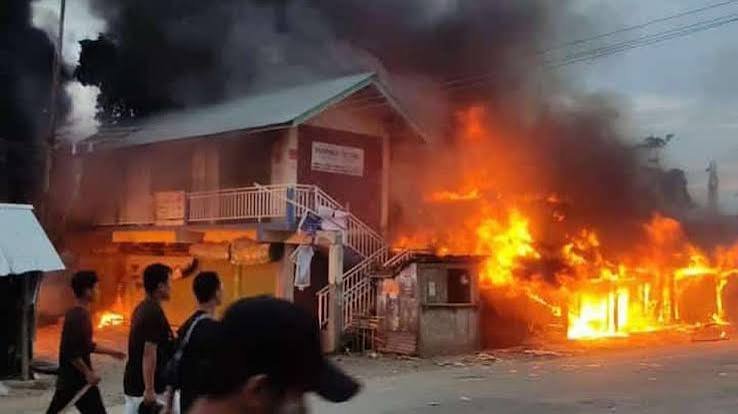
From thousands of FIRs to hundreds of chargesheets, Manipur’s justice process has moved slowly. More than three years on, investigations continue and the crucial stage of witness examination remains painfully limited.
BY Navin Upadhyay
More than three years after ethnic violence erupted in Manipur in May 2023, the criminal justice process remains weighed down by thousands of cases still under investigation and hundreds of prosecutions moving through the courts. Successive status reports placed before the Supreme Court in 2026 show that while chargesheets have steadily increased, the number of cases actually reaching the evidence stage remains small.
The latest figures are particularly revealing. In cases being investigated by Special Investigation Teams (SITs), 3,020 cases are spread across eight districts. In the separate CBI docket, 31 cases have been entrusted to the agency, many involving serious allegations including murder and sexual violence. Yet the transition from investigation to sustained trial remains slow.
The picture emerging from the Supreme Court’s monitoring is not of an absence of investigation, but of a wide gap between registering cases, filing chargesheets, examining witnesses and eventually delivering verdicts.

A mountain of cases, a trickle of trials
At the Supreme Court’s September 17, 2026 hearing, Additional Solicitor General Aishwarya Bhati informed the Bench that 42 SITs across eight districts were investigating 3,020 cases. Chargesheets had been filed in 302 cases, closure reports in 1,583, while 1,135 cases remained under investigation. The Court was told that trials had commenced in 33 cases.
That represented an increase from the position recorded on July 24, 2026, when the SITs had filed chargesheets in 301 cases, charges had been framed in 31 and trials had commenced in 10 cases. The status report also said that 2,924 witnesses were yet to be examined.
The position was different again in the Supreme Court’s May 27 order, when the SIT figures were not yet at the July level. The Court was continuing to monitor the investigations and the progress of prosecutions arising from the 2023 violence.
The progression is therefore measurable, but modest: by September, more than 1,100 SIT cases were still under investigation, while only 33 had reached the trial stage.
CBI cases: 978 witnesses, six examined
The CBI is handling a smaller but particularly serious segment of the Manipur docket. By September 17, the Court was told that the agency was investigating 31 cases. Final reports had been filed in 28 cases, including six closure reports, while three cases remained under investigation. Thirty-eight people had been arrested.
The most striking figure concerned witnesses.
Across the CBI cases, 978 witnesses had been cited, but only six had been examined by the time of the September hearing. Advocate Nizamuddin Pasha, appearing for victims, told the Court that cross-examination was under way but that the Special CBI Court in Guwahati was sitting only two days a week. The Bench discussed whether additional courts could be created to accelerate the proceedings.
That represented a change from the position recorded earlier in the year. On May 27, the CBI had reported chargesheets in 20 cases. There were 21 under-trial cases — 13 before the Special Judge for CBI and NIA cases in Guwahati and eight before the Chief Judicial Magistrate, Kamrup — and the Court recorded that trials had commenced in 16 cases and were proceeding at various stages.

By July 24, the CBI reported that chargesheets had been filed in 21 cases, while its status report also recorded continuing investigations and closure reports. The Court noted that the agency faced difficulties because witnesses had been displaced, some were reluctant to cooperate amid mistrust, language barriers complicated communication, internet shutdowns affected digital evidence and restrictions on movement hampered field investigations.
By September, however, the central concern had shifted increasingly from investigation to trial capacity and witness examination.
READ: Gen Z Effect? ABVP Holds DUSU, But Margins Shrink Sharply
Sexual-violence cases remain unfinished
The Supreme Court has been monitoring investigations into sexual violence arising from the Manipur conflict since 2023. The Court had directed that several sensitive cases be transferred out of Manipur, with proceedings being conducted in Guwahati.
The CBI’s docket includes cases involving allegations of sexual violence, including the May 4, 2023 case involving the stripping and alleged sexual assault of Kuki-Zo women. In that case, a Special CBI Court framed charges against six adult accused in January 2026. They pleaded not guilty and claimed trial.
The Supreme Court has simultaneously been concerned about victims and families receiving the basic documents needed to participate in prosecutions. In February 2026, the Court noted that victims and families in CBI cases were not necessarily aware that chargesheets had been filed and directed the Manipur and Assam legal-services authorities to provide legal aid counsel and facilitate access to the chargesheets.
Why the pace is so slow
The investigating agencies have identified several practical obstacles: displaced witnesses, reluctance to cooperate because of continuing mistrust, multiple local dialects, prolonged internet shutdowns affecting digital evidence and restrictions on movement.
The Supreme Court has acknowledged these difficulties but has also repeatedly pressed the agencies to complete investigations and move prosecutions forward.
On May 27, the Court recorded that 20 CBI chargesheets had been filed and that 16 of the 21 under-trial CBI matters had commenced trial. It also directed steps to ensure that victims and their families had legal representation and access to the chargesheets.

On July 24, the Court said pending investigations must be completed within a reasonable timeframe and tentatively proposed the creation of Special Courts so that trials could be conducted on a day-to-day basis once the investigations and chargesheets were complete.
By September, the Court was considering whether additional courts could ease the burden on the Special CBI Court in Guwahati.
Relief has moved faster than criminal justice
The judicial record also shows a different pace in the relief and rehabilitation process.
The Gita Mittal committee, appointed by the Supreme Court, has been monitoring issues involving internally displaced people, compensation, rehabilitation, housing, education and other forms of assistance.
But the progress of relief measures cannot be equated with the progress of criminal prosecutions. A family receiving compensation or housing assistance does not mean that the criminal case arising from the violence has reached a verdict.
That distinction is increasingly important as the conflict enters its fourth year.
What remains unresolved
Three years after the violence began, two parallel processes remain before the Supreme Court.
One concerns the criminal justice system: thousands of cases, hundreds of chargesheets, hundreds of accused and a huge body of witnesses still waiting to be examined.
The other concerns the survivors and displaced population: people who continue to require rehabilitation, security, medical care, compensation and access to justice.
The latest figures underline the gap between the two stages.
For the SIT cases, 1,135 investigations were still pending as of September 17. In the CBI cases, 978 witnesses had been cited but only six had been examined, according to the figures placed before the Supreme Court.
The Supreme Court has ordered investigations to be completed, pressed for additional courts and sought faster trials. But orders to accelerate the process are not themselves verdicts.
More than three years after the violence began, the Manipur criminal docket remains open — with thousands of investigations and prosecutions still to run their full course, and no completed judicial chapter for the victims whose cases remain before the courts.