Yemen’s Houthi movement claimed it launched ballistic and cruise missiles and drones at targets in Riyadh and Aramco facilities in Yanbu, although independent confirmation of the claims was not immediately available.
BY PC Bureau
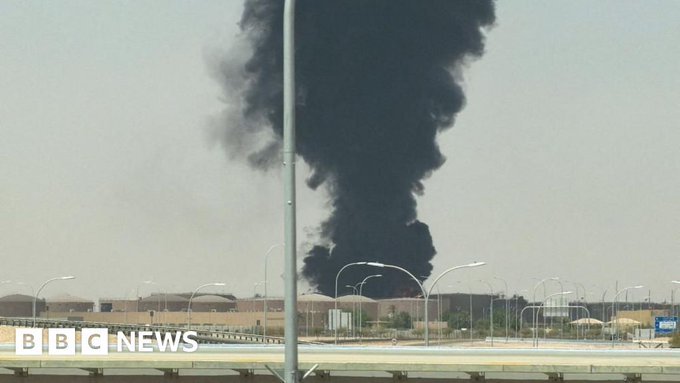
September 19: A large fire erupted at a fuel-storage facility near King Khalid International Airport in Riyadh on Saturday after Saudi authorities issued overnight warnings of a “hostile aerial threat”, with explosions heard across parts of the capital.
The incident came amid a sharp escalation in fighting between Saudi Arabia and Yemen’s Houthi movement. The Houthis later claimed that they had launched missile and drone operations targeting what they described as sensitive sites in Riyadh.
Saudi authorities, however, had not publicly confirmed that the fire was caused by a Houthi attack. The cause of the blaze, the extent of any damage and possible casualties remained unclear in the immediate aftermath.
Saudi Civil Defense issued the first mobile-phone warning shortly before 3 a.m. local time, telling residents that their area was under a hostile aerial threat and urging them to remain indoors. A second warning was issued later for Riyadh and nearby Al-Kharj. Authorities subsequently declared the danger over.
The alerts marked the first such warning for Riyadh since the latest escalation of fighting with the Houthis began in July, underscoring the growing reach of the conflict into the Saudi capital. Residents reported hearing several loud explosions during the night.
A large column of black smoke was later seen rising from the vicinity of King Khalid International Airport. Reuters footage and other images showed flames near fuel-storage tanks carrying the logo of Saudi state oil giant Saudi Aramco, while firefighters battled the blaze.
The airport, Riyadh’s main international aviation hub, experienced significant disruption. Flight-tracking service FlightRadar24 temporarily placed the airport at its highest disruption level, with delays and cancellations reported amid the security alert.
🚨🇸🇦 SAUDI just GOT HIT.
A strike landed on the fuel tanks next to King Khalid Airport, in Riyadh.
The city had air-raid warnings before dawn.
Civil Defense later sent an all-clear. Saudi has not named the attacker, but everyone is pointing at the Houthis.
The war left the… pic.twitter.com/2lD7nOpd4H
— Mario Nawfal (@MarioNawfal) September 19, 2026
Houthis Claim Missile and Drone Attack
Houthi military spokesman Yahya Saree later claimed that Yemeni forces had carried out two operations using ballistic and cruise missiles and drones.
According to Saree, the first operation targeted what the Houthis described as “sensitive sites” in Riyadh, while a second operation targeted Aramco facilities in Yanbu, the Red Sea industrial port that hosts major oil infrastructure.
Saree claimed the attacks caused major fires. The claims could not immediately be independently verified, and Saudi authorities had not publicly confirmed that the Riyadh fire resulted from a Houthi missile or drone strike.
The Houthi spokesman presented the attacks as retaliation for Saudi military operations in Yemen. The Houthis have accused Riyadh of carrying out hundreds of airstrikes against their positions in recent days.
The latest escalation follows a renewed breakdown of the fragile calm that had prevailed in Yemen since a UN-brokered truce largely halted large-scale fighting in 2022.
Escalation Across Saudi Arabia
The Riyadh alert was part of a broader series of warnings issued across Saudi Arabia. Civil Defense also issued alerts in areas including Jeddah, Yanbu, Taif and Khamis Mushayt amid a series of missile and drone attacks.
Saudi authorities said earlier this week that their air defences had intercepted a drone approaching the airspace around Mecca. The Houthis denied attempting to target the holy city. The accusation has further intensified tensions between Riyadh and the Houthi movement.
The attacks have also begun affecting Saudi energy infrastructure and transport routes. Saudi Arabia is particularly vulnerable because of the concentration of major oil facilities, pipelines, ports and export infrastructure across the kingdom.
The escalation has broader international implications because Saudi Arabia is the world’s leading oil exporter and the Red Sea and Bab el-Mandeb corridor are critical routes for global energy and commercial shipping.
The United Nations Security Council has condemned continued Houthi attacks on Saudi Arabia, including attacks affecting civilian and energy infrastructure, and called on countries to prevent the group from obtaining weapons, financing and military assistance.
READ: Three Years, 3,020 Cases, Just 33 Trials: The Long Wait for Justice in Manipur
Growing Risk to Energy Infrastructure
The fire near Riyadh airport is particularly significant because it occurred close to strategic fuel infrastructure serving the capital’s main international airport.
Saudi Arabia has invested heavily in air-defence systems to protect its cities and energy facilities after years of missile and drone attacks from Yemen. Saturday’s alerts nevertheless demonstrated that the renewed conflict is creating a new security challenge for the kingdom.
The immediate priority for Saudi authorities was to establish whether the fire was the result of an incoming weapon, falling debris from an interception, or another cause. No official assessment of the damage or casualties had been released at the time of the initial reports.
For Riyadh, the incident represents another indication that the renewed Yemen conflict is no longer confined to the battlefield. With missiles and drones increasingly threatening Saudi cities, airports and energy infrastructure, the latest escalation carries risks well beyond the borders of Yemen and Saudi Arabia.