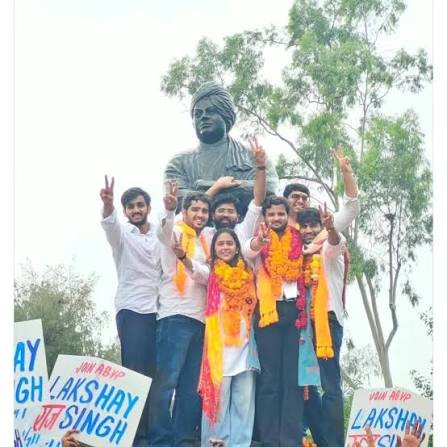
The ABVP’s presidential margin crashed from 16,176 votes in 2025 to just 2,053 this year, while its margins for Secretary and Joint Secretary also fell sharply.
BY PC Bureau
New Delhi/ September 26: The Akhil Bharatiya Vidyarthi Parishad (ABVP) has retained its dominance over the Delhi University Students’ Union, winning three of the four central posts for the second consecutive year. But the numbers tell a more complicated story.
Compared with 2025, the ABVP’s winning margins have narrowed dramatically, while the National Students’ Union of India (NSUI) substantially improved its presidential vote share. An independent candidate, former NSUI member Deepanshu Shokeen, also broke through to win the Vice-President’s post with a large margin.
The results raise a question that may be more significant than the simple three-one tally: is a more issue-driven, digitally connected Gen Z electorate beginning to change the nature of DUSU politics?
The answer cannot be established from one election alone. But the voting numbers provide several indications worth examining.
The ABVP retained three posts — but with much smaller margins
In 2025, ABVP’s Aryan Maan won the presidential election with 28,821 votes, defeating NSUI’s Joslyn Nandita Choudhary, who polled 12,645. The margin was more than 16,000 votes.
A year later, ABVP’s Yash Dabas retained the presidency with 24,576 votes, but his margin over NSUI’s Vijay Shankar Meena was only 2,053 votes. Meena secured 22,523 votes.
That represents a striking change. ABVP’s presidential vote total fell by more than 4,000, while the NSUI presidential candidate gained nearly 10,000 votes compared with the previous year’s NSUI candidate.
The change was not confined to the presidential race.
I’m sorry but two observations from the DUSU results:
1. A majority of students are against the present regime—but fractured, and hence it benefits the regime. But this is a silver lining. Those bagging positions must remember they are not kings or queens. The majority DID NOT… https://t.co/MvsW8a0me4
— Saurav Das (@SauravDassss) September 19, 2026
In 2025, ABVP’s Kunal Chaudhary won the Secretary’s post by a margin of roughly 14,000 votes. In 2026, Riya Chhawdi retained the post for ABVP, but with a substantially smaller margin.
The Joint Secretary contest was even closer. ABVP won the post again, but Lakshya Raj Singh’s margin was only 837 votes.
Thus, the headline result remained three ABVP victories, but the underlying contests became considerably tighter.
READ: DUSU 2026: ABVP Wins Three Posts, Independent Takes VP
VIDEO | DUSU election results 2026: ABVP winning candidates celebrate after securing three of the four contested posts at Delhi University.#DUSUUpdates
(Full video available on PTI Videos – https://t.co/d8jp61yd2p) pic.twitter.com/ykzlAm0GPX
— Press Trust of India (@PTI_News) September 19, 2026
The independent factor
The most striking development came in the Vice-President’s contest.
In 2025, NSUI’s Rahul Jhansla defeated ABVP’s Govind Tanwar to win the post. Jhansla polled 29,339 votes.
In 2026, however, former NSUI member Deepanshu Shokeen, contesting as an independent, won the same post with 30,615 votes. ABVP’s Ishu Maurya received 16,910 votes and NSUI’s Vir Chatrath 4,313.
Shokeen’s victory is significant because it complicates the traditional ABVP-versus-NSUI binary. An independent candidate was able to secure the Vice-President’s position despite the organisational strength of the two principal student groups.
That may be particularly relevant to an electorate increasingly exposed to social media campaigns, individual personalities and issue-based mobilisation.
Has Gen Z changed the DUSU voter?
The 2026 campaign itself offered evidence of changing political priorities.
Reporting from the campaign trail showed students focusing heavily on hostel shortages, accommodation costs, safety, transport, campus infrastructure and accountability, alongside the traditional ideological contest between ABVP and NSUI. Social media, reels and other digital campaigning also assumed a greater role.
The election was also shaped by the recent Satya Niketan PG building collapse, in which seven people, including five DU students, were killed. Student safety and accommodation therefore became particularly prominent campaign issues.
There is also an interesting contrast between the campaign rhetoric and the result. Just before polling, outgoing DUSU president Aryan Maan had publicly claimed that Gen Z supported ABVP and predicted a four-post victory.
The final result was different from that projection: ABVP won three posts, but an independent candidate took the fourth, while the presidential race went down to a margin of just 2,053 votes.
From organisation to issues?
The 2025 election was widely attributed to ABVP’s strong organisational network, year-round campus presence and social-media campaign.
The 2026 result suggests that organisational machinery continues to matter. But it also suggests that it may no longer be sufficient by itself to produce the kind of large margins seen last year.
For the first time in this two-year comparison, the question is less about whether ABVP can win and more about how it wins.
It still holds three of the four central posts. But the presidential margin has collapsed, the Secretary and Joint Secretary contests have tightened, and an independent candidate has taken the Vice-President’s post.
That is not proof of a “Gen Z wave” against ABVP. It is, however, evidence of a more competitive and potentially more issue-driven DUSU electorate — one in which students appear willing to look beyond the traditional organisational labels.
The real significance of the 2026 election may therefore lie not in the three-one tally, but in the margins behind it.