The contrasting pace of enforcement has triggered fresh allegations of selective policing in Manipur, with Kuki groups questioning why arrests followed the Chawangkining arson while the perpetrators of recent Kuki-Zo killings remain unidentified.
BY PC Bureau
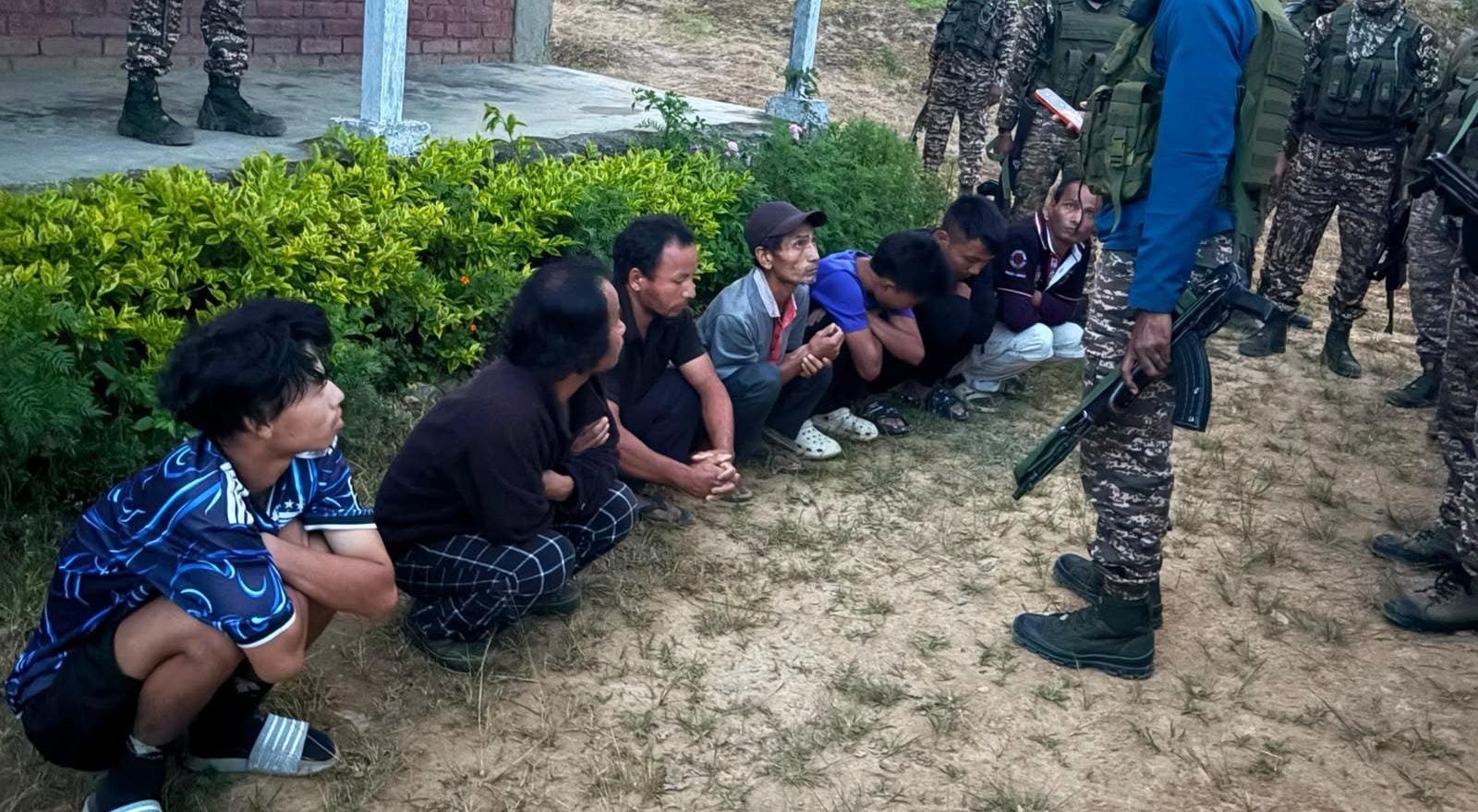
September 19: Six Kuki men have been arrested in connection with the burning of houses in a Naga village in Manipur, even as no arrests have been made in the killings of at least six Kuki-Zo civilians over the past week.
The contrasting pace of police action has revived allegations of unequal law enforcement in a state where competing communities have repeatedly accused security forces and the administration of applying different standards to violence committed by rival groups.
The six Kuki-Zo civilians were killed in three attacks between September 13 and 15 in Tamenglong and Noney districts. The victims included Lhingzangai Singsit and her husband Seineh Singsit at L. Tollen, Julie Singson and Thangvel alias Roel Gangte at Longpi, and Phalneichong alias Chonga Sitlhou and Kimjalhing alias Kimneo Singson at Leisangphai. A young boy was also injured in the L. Tollen attack. Reports have described the assailants as unidentified.
Manipur: CRPF CoBRA personnel apprehended 6 suspected cadres near Chawangkining following an overnight attack that damaged houses in a Liangmai Naga village. Following the apprehending of the suspected cadres,angry agitators erupted in intense backlash,blocking key roads with (1) pic.twitter.com/mDaTvm91iR
Manipur: CRPF CoBRA personnel apprehended 6 suspected cadres near Chawangkining following an overnight attack that damaged houses in a Liangmai Naga village. Following the apprehending of the suspected cadres,angry agitators erupted in intense backlash,blocking key roads with (1) pic.twitter.com/mDaTvm91iR
Kuki organisations have alleged that Naga armed groups, including NSCN-IM and ZUF-linked elements, were responsible for some of the attacks. Those allegations have not been established through a public police finding or judicial determination.
Within hours of the September 15 killings, Chawangkining, a Liangmai Naga village in Kangpokpi, came under sustained firing. Two houses were burnt during the overnight attack and an exchange of fire with CRPF personnel. Village authorities alleged that Kuki armed groups were responsible.
The subsequent arrests have therefore created a stark contrast for Kuki groups: six men have been taken into custody over the burning of houses, while the perpetrators of six recent killings of Kuki-Zo civilians remain publicly unidentified.
Following the arrest, women, Kuki village volunteers and other armed individuals from Kangpokpi town reportedly took to the streets in protest. The protesters allegedly obstructed the movement of central security forces, pelted stone, and set tyres on fire, disrupting normal traffic and movement of security froces in the area.
Breaking News ⚡
As per the social media reports, CRPF #Cobra personnel have arrested six Kuki militants near Chawangkining Village in Kangpokpi District, #Manipur.
Following the report, Kuki Men & women volunteers and armed militants from Kangpokpi town mobilised to a large… pic.twitter.com/NwRQGICcrg
— 📍SHANGH CHE🚭 (@JosephNaga1986) September 19, 2026
Earlier Questions Over Unequal Enforcement
The latest controversy is not occurring in isolation.
Human-rights investigations have previously documented allegations that Manipur police failed to act against members of Meitei vigilante groups accused of violence against Kuki-Zo civilians. Amnesty International reported in 2024 that it had documented at least 32 incidents involving alleged gender-based violence by members of Arambai Tenggol and Meitei Lippun, while saying members of the groups had not faced prosecution for those alleged acts at the time of its report. It also documented cases in which Kuki complainants allegedly faced obstacles in getting complaints registered.
Human Rights Watch, in a 2025 assessment, similarly reported allegations of police bias in favour of Meitei vigilante groups and cited delays in investigations into serious crimes. It referred specifically to the May 2023 case in which two Kuki men were killed and two women were sexually assaulted after a mob intercepted them. Six people were arrested in that case, but HRW said more than a year later there had been no charges against police officers or members of Meitei vigilante groups implicated in the incident. The Manipur police have denied allegations of bias.
The Supreme Court had also expressed concern in 2023 about the slow pace of investigations in Manipur, including delays in recording statements, conducting medical examinations and making arrests even in cases involving serious offences.
There have, however, also been arrests of Kuki suspects in cases involving violence against other communities. In July 2026, an NIA-led team arrested two persons in connection with the killing of six Naga civilians whose bodies had been recovered in June. The arrests followed an investigation involving the NIA, Manipur Police and CRPF.
Similarly, security forces arrested eight suspected Kuki Liberation Army cadres in a September 7 operation at an alleged KLA camp in Kangpokpi and recovered seven automatic weapons, according to Manipur Police.
These cases complicate any blanket claim that enforcement has been directed against only one community. But they do not resolve the question now being raised over the September killings: why have no perpetrators been publicly identified or arrested in the six recent Kuki-Zo civilian deaths?
READ: Three Years, 3,020 Cases, Just 33 Trials: The Long Wait for Justice in Manipur
The Question of Village Volunteers
The issue is also connected to the contentious status of village volunteers.
Village defence groups emerged on both sides after the outbreak of ethnic violence in May 2023. Kuki-Zo groups have repeatedly argued that their village volunteers are necessary for protecting isolated settlements, while authorities and critics have raised concerns about the involvement of some armed volunteers in violence.
On September 7, Chief Minister Yumnam Khemchand Singh told the Manipur Assembly that village volunteers in the hills and valley, as well as Arambai Tenggol, were not banned organisations and that police action was based on individual criminal acts rather than membership.
That position makes the legal basis for the latest arrests particularly important. If the five Kuki men have been arrested because investigators possess specific evidence linking them to the Chawangkining arson, the case should proceed on that evidence. If they were detained merely because they belong to a village-defence structure, questions would arise over the principle the Chief Minister himself articulated in the Assembly.
What the State Needs to Establish
The immediate issue is therefore not whether one community’s narrative should be accepted over another’s. It is whether the same standard of criminal investigation is being applied to killings, arson and attacks on civilians regardless of the identity of the victims or suspects.
For the five arrested men, the authorities should make public the FIR, sections invoked and the evidence linking them to the Chawangkining attack. For the six Kuki-Zo deaths, investigators should disclose whether FIRs have been registered, whether suspects have been identified, and what investigative steps have been taken.
The difference between the two cases is now impossible to ignore: five arrests have followed the burning of Naga houses, while six Kuki-Zo civilian killings over three days remain without a publicly identified accused.
In a state already fractured by allegations of institutional bias, the credibility of the investigation will depend not merely on how many arrests are made, but on whether the law is seen to move with the same urgency when the victims belong to different communities.