



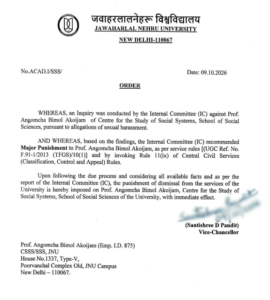
New Delhi, October 9, 2026: Jawaharlal Nehru University has dismissed Professor Angomcha Bimol Akoijam, a Congress Mo from Inner Manipur, from service with immediate effect after an Internal Committee inquiry into allegations of sexual harassment.
The order, dated October 9 and signed by Vice-Chancellor Santishree D Pandit, says the committee inquired into the allegations against Akoijam, a faculty member at the Centre for the Study of Social Systems in the School of Social Sciences. Based on its findings, the committee recommended major punishment under applicable service rules, including UGC reference F.91-1/2013 (TFGS)/10(1) and Rule 11(ix) of the Central Civil Services (Classification, Control and Appeal) Rules.
“Upon following the due process and considering all available facts and as per the report of the Internal Committee (IC), the punishment of dismissal from the services of the University is hereby imposed on Prof. Angomcha Bimol Akoijam… with immediate effect,” the order states. It lists his employee ID as 875 and is addressed to him at a Type-V residence in Poorvanchal Complex on the JNU campus.
READ: Students Pulled off Trains, Homes Raided; CJP Says Govt Is at War with Its Own People
Akoijam is a social and political psychologist, public intellectual and filmmaker from Manipur’s Meitei community, and has taught at JNU for years, with interests in identity, conflict, minority rights and gender relations.
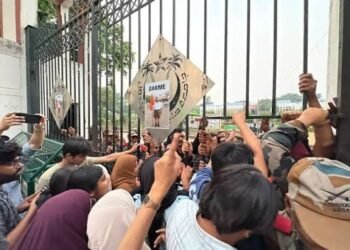
The dismissal follows complaints that, according to reports, were filed by 11 women students in May 2026. Those accounts have described inappropriate remarks, advances at gatherings and conduct during academic interactions; one allegation reportedly linked marks to sexual favours. The Delhi Commission for Women had sought a report from the university in September after students said their complaint to the vice-chancellor had not drawn adequate action. Campus protests, including by the ABVP, had also drawn attention to the case.
When the allegations surfaced, Akoijam denied them, calling media reports unverified and a “media trial,” and said he had nothing to hide and would pursue legal remedies. The university order does not set out the committee’s detailed findings. There was no immediate response from him or the Congress to Friday’s dismissal. The order ends his university service; it does not, by itself, affect his membership of Parliament.
The inquiry found nine allegations by students against the professor to be true. He is also a Congress MP and was later sacked by JNU over the sexual harassment charges.
Allegation 1
He repeatedly asked female students about their personal dating history, including during class. In one instance, he asked a student what she had done on Valentine’s Day.
Allegation 2
Similar questions were put during vivas: “Do you have a boyfriend? What activities do you do with your boyfriend?” “What is your opinion on affairs?” and “What is your opinion on someone my age liking someone your age?”
Allegation 3
He asked students the meaning of terms such as “quickie,” which he explained as “quick sexual intercourse that can be done on top of a table,” using hand gestures. The panel found him guilty of using sexually explicit language and described the remarks as “sexually coloured.”
Allegation 4
Female students were asked to hold his hand on multiple occasions. Even after they showed hesitation, he pinched them without consent, including in class. The panel said the evidence established that he asked female students to hold his hand and made physical contact, including pinching, despite signs of unwillingness, and that this crossed personal and professional boundaries.
Allegation 5
Without prior notice, he showed Lust Stories, whose opening scene depicts sexual intercourse. He did not name the film or warn students of its explicit content, and some felt extremely uncomfortable. The panel did not treat the film itself as inherently inappropriate, but said students were not adequately informed of its sexually explicit nature, creating an intimidating, offensive and hostile learning environment.
Allegation 6
Some female students said they felt uncomfortable because he came unnecessarily close only to them. His jokes were often sexist, and he mocked regional groups such as Biharis and Bengalis. The panel found him guilty of making female students uncomfortable through physical proximity.
Allegation 7
He openly admitted to drinking with students at his residence, maintaining informal friendships with former students beyond professional limits, and, in his own words, engaging in “illegal stuff.” The panel held that this conduct crossed professional boundaries.
Allegation 8
Vivas were unstructured and uneven. Some were held in his office and some at his residence; some lasted five minutes, others 30 minutes to an hour. Female students were mostly kept longer than male students. On one day a viva at his residence with female students present continued until 11:40 pm. A third person was not consistently present—sometimes it was only him, sometimes his personal assistant was there. The panel said the evidence showed vivas were held in materially different settings, including his office and residence, with large variation in length and without the consistent presence of a third person.
Allegation 9
He admitted, in a mocking tone, to “making female students cry” during vivas, said he “keeps tissue boxes” for them, and compared them to Kangana Ranaut and other actresses in a way that suggested they were crybabies. The panel treated these statements as corroborative when read with the other evidence.
The JNU committee said the conduct showed a recurring pattern of inappropriate personal interactions and recommended a “major punishment” under the service rules




Comments 1