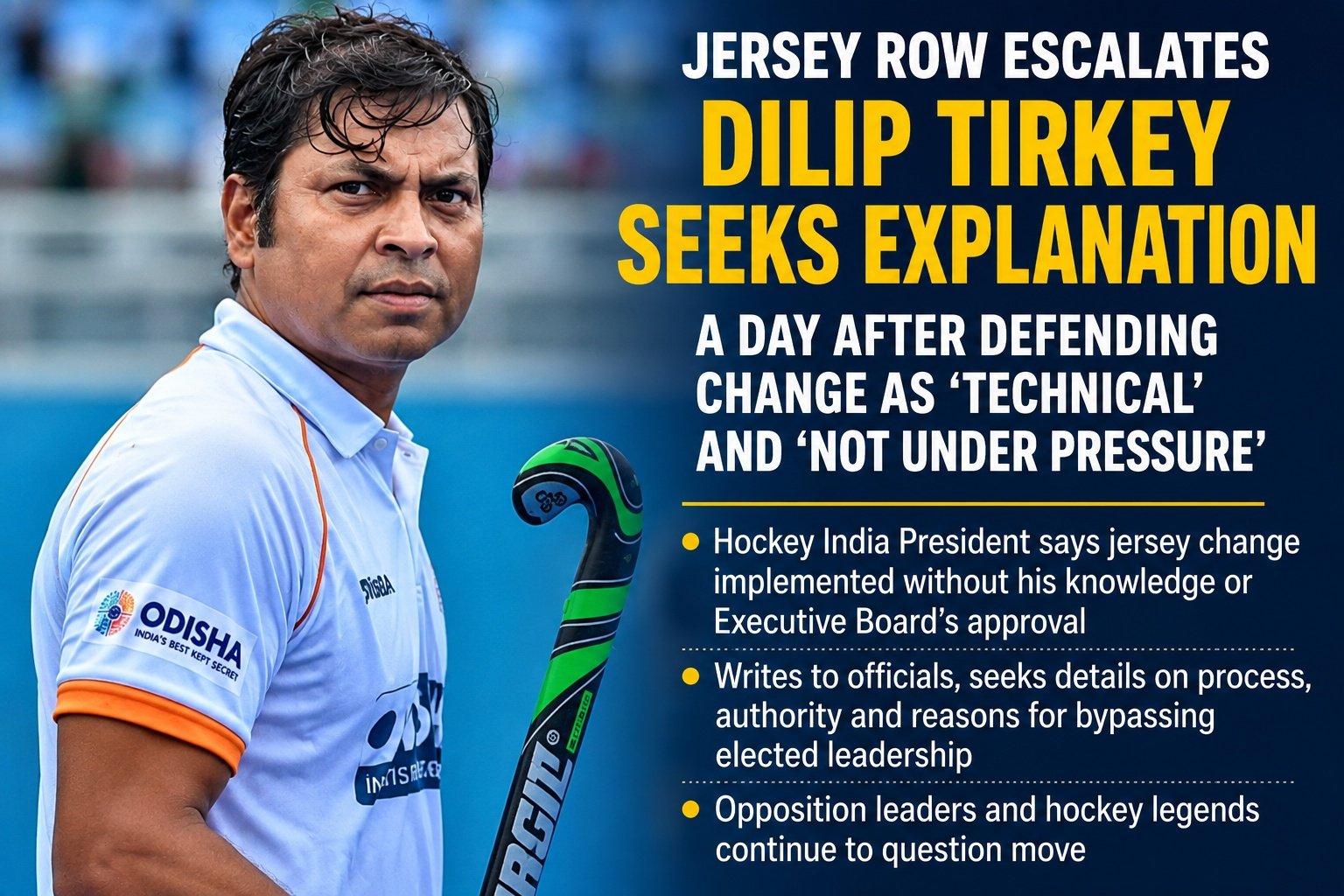
Dilip Tirkey has sought a written explanation from Hockey India officials, while political leaders and former hockey captains have criticised the move, saying India’s iconic blue jersey should not have been replaced.
BY PC Bureau
New Delhi: Just a day after publicly defending Hockey India’s decision to replace the Indian hockey team’s traditional blue jersey with saffron, insisting the move was made on technical grounds and “not under any pressure,” Hockey India President Dilip Tirkey has questioned the process behind the decision. In communications to federation officials, Tirkey said the jersey change was implemented without his knowledge or the approval of the Executive Board, shifting the focus from the colour of the kit to questions of transparency and governance within Hockey India.
Tirkey, in an email communications addressed to Executive Board members and senior officials, has reportedly ought a detailed explanation of how and under whose authority the decision was approved, stressing that a change involving the national team’s identity should not have been made without consultation.
“I wish to bring to your attention the recent change in the colour of the Indian national team’s jersey. This decision appears to have been taken and implemented without being placed before the Executive Board for discussion and without my prior knowledge,” Tirkey wrote.
The Hockey India chief clarified that his objection was not to the saffron jersey itself but to the manner in which the decision was taken.
“My concern is not with the choice of saffron itself. However, a decision of this significance, involving the identity and representation of our national team, should ideally have been discussed with the elected leadership and the Executive Board before implementation,” he said.
Tirkey also pointed out that the issue had generated widespread public debate and political commentary, making it essential for Hockey India to provide a clear account of the process followed.
“The matter has since attracted considerable media attention and, unfortunately, political interpretation in certain quarters. With the World Cup approaching, I have publicly clarified that the change was purely a sporting decision so that the focus remains on the team and its preparations,” he wrote.
He further disclosed that the Odisha government had sought an explanation from him regarding the controversy.
“I have also been asked by the Government of Odisha to provide clarification regarding this matter. I therefore request the concerned Hockey India officials to provide me with a written clarification at the earliest, outlining the basis for the decision, the process followed, and the circumstances under which the change was approved and implemented.”
In a subsequent communication, Tirkey reportedly asked officials five specific questions, seeking details on who authorised the change, under what powers it was approved, and why neither the President nor the Executive Board was informed before the decision was announced publicly.
The disclosures have fuelled fresh questions over Hockey India’s internal functioning, with attention now focused on whether established governance procedures were bypassed in approving a decision affecting one of the country’s most recognisable sporting symbols.
A day earlier, Tirkey had appealed against attempts to politicise the issue, insisting that the jersey change was based solely on technical considerations and recommendations from players and coaches.
Speaking to news agency ANI ahead of the World Cup, which begins on August 15 in Belgium and the Netherlands, Tirkey said the colour change was recommended by players and coaches to improve visibility on the blue artificial turfs used in international hockey.
According to Tirkey, the traditional blue jersey blended with the blue playing surface, making it difficult for players to identify teammates quickly during matches.
“It’s a technical choice, not a political one,” Tirkey said, stressing that the decision was made solely to enhance on-field performance.
Tirkey said the proposal originated from the Indian teams themselves.
“The players, captains, coaches and support staff felt that wearing blue on a blue turf affected visibility. After considering different options, including yellow and orange, the players opted for orange, which is also one of the colours of India’s national flag,” he explained.
Not the First Jersey Change
The Hockey India chief noted that India’s national teams have worn different colours at previous major tournaments, dismissing suggestions that the latest change was unprecedented.
- 2014: Yellow jersey
- 2018: Sky blue jersey
- 2026: Saffron-orange jersey
Open to Review After the World Cup
Tirkey said the saffron jersey is not necessarily a permanent change. Hockey India will review the decision after the World Cup based on feedback from players and coaching staff.
“Our priority is the players’ comfort and performance. Once the tournament is over, we will assess the feedback and take an appropriate decision,” he said.
The jersey change has sparked a political controversy, with opposition leaders and several former India hockey captains questioning the decision. Hockey India, however, maintains that the move is based entirely on technical requirements aimed at improving visibility and performance on blue hockey turfs.
READ: Hockey India Sheds Iconic Blue Kit for Saffron, Sparks Row
READ: The State of TV News: Falling Revenues, ‘Godi Media’ Tag, and Crisis of Trust (Part 2)
🚨 Breaking
Jersey row escalates. Mails from Hockey India president Dilip Tirkey now out in the public domain. Says he wasn’t kept in the loop when the decision was made.
What’s the way ahead?#HockeyIndia #TeamIndiaJersey pic.twitter.com/SFUiJpC35c
— RevSportz Global (@RevSportzGlobal) July 31, 2026
Reactions and Backlash
The jersey change has triggered sharp political and sporting reactions, with Opposition leaders and former India captains questioning both the decision and the process behind it.
Former Odisha Chief Minister and Biju Janata Dal (BJD) president Naveen Patnaik alleged that the move was influenced by political considerations, saying Hockey India’s decision had hurt the sentiments of hockey lovers. Referring to Odisha’s long-standing association with Indian hockey through sponsorship and the hosting of major international tournaments, Patnaik claimed the change appeared to have been taken “under BJP pressure” and urged that sports should remain free from political influence.
Congress leader Priyanka Gandhi Vadra also criticised the move, saying the country’s sporting identity should not be altered for political symbolism. She argued that the Indian hockey team’s traditional blue jersey represented decades of sporting excellence and belonged to every Indian, not to any political ideology.
Former India captain and Olympian Viren Rasquinha described replacing the iconic blue jersey as “embarrassing,” saying blue has long been synonymous with Indian sport and should have been retained. He maintained that while alternate kits are common in international sport, there was little justification for abandoning the national team’s traditional colour.
The criticism was echoed by former captains Dhanraj Pillay and Pargat Singh, who said the blue jersey has become an integral part of India’s sporting identity over the decades. They argued that changing such an iconic symbol ahead of the World Cup was unnecessary and risked diluting a tradition associated with generations of Indian hockey players.
Despite the backlash, Hockey India has defended the decision, saying the change was recommended by players and coaches to improve visibility on blue artificial turfs and that saffron, being one of the colours of the Indian national flag, also carries symbolic significance.