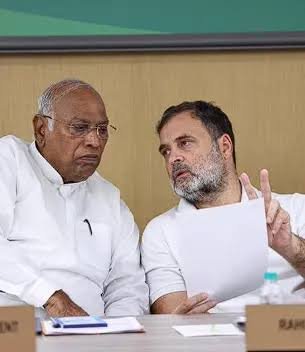
Two young CJP leaders spent their Navratri festivities behind bars, yet Rahul Gandhi offered not a word of solace. Nor did he criticize the extension of their custody. His silence has sharpened questions about whether Congress is reluctant to support a challenger even at the cost of waking Opposition to the Modi government.
BY Navin Upadhyay
October 20: : Leader of the Opposition Rahul Gandhi found the words to say that waving the Tricolor was not a crime. But when Saurav Das and Ashutosh Ranka, co-convenors of the Cockroach Janta Party (CJP), saw their judicial custody extended for waving the tricolor at the “de-notified” Jantar Mantar, he had nothing more to say. Nor did he criticize the arrests and detention of Abhijeet Dipke and Neha Bora. The contrast raises a question: does Congress support a cause only until standing by those who lead it begins to threaten its own political space?
The party’s handling of CJP follows a familiar pattern: protecting organizational control at the cost of joint action. Student wings stay at a distance; arrests draw little public protest, and solidarity remains limited even when the demands overlap. The result is fragmented opposition at a time when coordinated action matters.
On October 16, CJP activists gathered at Connaught Place for the “Lehra Do Tiranga” protest. Congress’s student wing, NSUI, and the Youth Congress kept away from the gathering, holding separate programmes instead. There was no forceful, coordinated response from the party when Dipke was placed under preventive arrest over an alleged breach of a peace bond, or when Neha Bora was detained and later released. Neither arrest produced a joint campaign by Congress and CJP demanding accountability.
VIDEO | Delhi: CJP leaders Saurav Das and Ashutosh Ranka’s judicial custody extended by two days.
CJP legal head Ratna Singh says, “I think SEM (Special Executive Magistrate) courts should be abolished because the system is compromised. They have rejected the sureties. Advocates have pointed out that the verification process for a surety cannot be a valid ground for remanding someone to judicial custody. There is no apprehension, no threat, and there was no call to action from our side, yet they were still sent to two days of judicial custody. The authorities show no regard for personal liberty or an individual’s past record; they simply seek an excuse, and we have just witnessed the kind of excuse they have offered today. I feel that while this entire system is designed to crush us, it will not succeed. The youth of this country is watching. They see how those in power are misusing the law to suppress voices, stifle these young people and prevent them from coming together to raise their concerns. I believe the authorities fail to realise that all of this is only making these individuals stronger and more powerful. They will eventually push back, and the government will be forced to provide an answer.”
(Full video available on PTI Videos – https://t.co/bIyFWTfmBd)
— Press Trust of India (@PTI_News) October 19, 2026
The silence became harder to ignore when a magistrate extended the judicial custody of Das and Ranka by two days after rejecting their sureties. The two CJP co-convenors had been remanded over their alleged entry into the de-notified Jantar Mantar site and the waving of the national flag. Rahul’s earlier post had declared that waving the Tricolour was not a crime. Yet when the two activists remained behind bars, he did not think it fit to demand their release or challenge the extension of custody.
Two young leaders were forced to spend their Navratri festivities behind bars over what was a case of mere trespass. Nothing could be more condemnable in a democracy. Yet Rahul Gandhi, the Leader of the Opposition in the Lok Sabha, has remained silent.
This silence can hardly be dismissed as accidental. It appears to be a calculated choice: do not allow CJP to grow, even if keeping it at arm’s length weakens the wider opposition movement against the Modi government and Chief Election Commissioner Gyanesh Kumar.
READ: Chargesheet Details Killing of Manipuri Musician: Broken Ribs, Ruptured Spleen
That gap between a general statement and support for the people facing detention is central to the Congress problem. A declaration of principle costs little. Standing up for those arrested while acting on that principle is a different matter.
The pattern recalls the events that preceded Nitish Kumar’s exit from the INDIA bloc. In the run-up to the 2024 general election, Congress’s approach to opposition coordination was shaped by its own calculations about seats, leadership and political credit. It resisted arrangements that might have elevated Nitish to a central role in the alliance. JD(U) leaders later criticised what they saw as Congress’s immaturity and preference for its own interests. Nitish left the bloc and returned to the NDA, altering the opposition’s electoral arithmetic.
The circumstances are different, but the underlying concern is similar. Congress appears reluctant to share political space with a new, informal, youth-led group that can mobilise people independently of established party structures.
Congress Keeps Distance from CJP
CJP’s protests have put pressure on the government over issues including examination irregularities and the Special Intensive Revision of electoral rolls. Congress has its own stake in these questions. Yet its leaders have largely kept their distance from CJP-led platforms, even when their stated positions overlap. The party has preferred to retain control of its own messaging rather than build a sustained common campaign.
There may be organizational and political reasons for Congress’s caution. CJP is not a conventional ally, and cooperation does not require unconditional endorsement of every action by its members. But there is a difference between maintaining political independence and remaining conspicuously silent when activists are detained, and their custody extended.
Rahul Gandhi’s silence over Das and Ranka is especially striking because his earlier statement gave the party an opening to turn a general principle into a concrete demand. His failure to follow through leaves the impression that Congress is willing to endorse the cause without standing firmly beside those who have made it their own. The same question hangs over the arrests and detention of Dipke and Bora.
Opposition unity cannot be built through statements alone. It requires a willingness to defend civil liberties across organizational boundaries, to appear on the same platforms, and to share credit when others lead a movement. If Congress continues to treat independent mobilization as a threat to its primacy, it risks repeating the political miscalculation that helped drive Nitish away.
That is the danger of a second Nitish moment: Congress may preserve its control over the opposition’s political space while weakening the very forces it needs to challenge the government. And when activists are in custody, silence is not a substitute for solidarity.