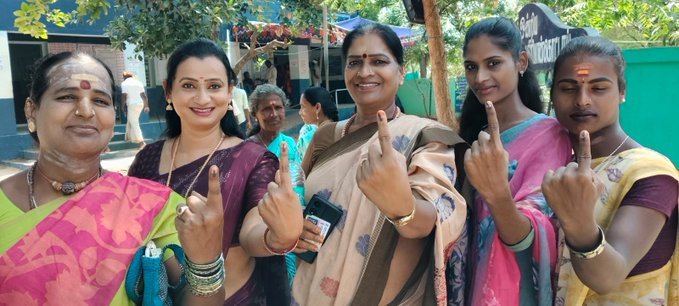
Tamil Nadu recorded nearly 85% polling in a three-cornered contest involving the DMK, AIADMK-BJP alliance, and Vijay’s new party. In West Bengal, Phase 1 polling crossed 92%, with a fierce contest between the All India Trinamool Congress and the Bharatiya Janata Party.
BY PC Bureau
April 23, 2026 — Voters turned out in record numbers across Tamil Nadu and West Bengal on Wednesday, marking a historic day in two politically crucial states where the Bharatiya Janata Party (BJP) has traditionally struggled to secure state-level dominance.
Polling for all 234 Assembly constituencies in Tamil Nadu and the first phase of elections in West Bengal witnessed unprecedented participation, with both states recording their highest-ever voter turnout.
Historic Voter Turnout
According to provisional figures, Tamil Nadu recorded a turnout of 84.98%, while West Bengal registered an extraordinary 92.14% in Phase 1 alone.
These numbers surpass previous records by a wide margin. Tamil Nadu’s earlier highest turnout stood at 78.3% during the 2011 Assembly elections, while West Bengal’s previous peak of 84.7% was also recorded in 2011.
Election officials and observers attributed the surge to heightened political mobilisation, aggressive campaigning by parties, improved voter awareness initiatives, and controversies surrounding electoral rolls that may have further energised the electorate.
General Elections to Legislative Assemblies and bye-elections 2026#TamilNadu (84.69%) and #WestBengal (Phase-I) (91.78%) record highest-ever poll participation since Independence
Read more : https://t.co/VTBMzHvamP pic.twitter.com/jYGAbAvgRu
— Election Commission of India (@ECISVEEP) April 23, 2026
READ: Ladakh LG Unveils Major Tourism Reforms to Boost Investment
Tamil Nadu: High-Stakes Three-Way Contest
In Tamil Nadu, the election unfolded as a triangular contest involving major political forces and a high-profile new entrant.
The ruling Dravida Munnetra Kazhagam (DMK), led by Chief Minister M. K. Stalin, headed the Secular Progressive Alliance (SPA). The party campaigned on its “Dravidian Model” of governance, focusing on welfare schemes, social justice, economic growth, and secular politics.
Challenging the DMK was the All India Anna Dravida Munnetra Kazhagam (AIADMK), led by Edappadi K. Palaniswami, in alliance with the BJP. The coalition promised corruption-free governance, administrative transparency, and an end to what it described as “family rule.”
Adding a new dimension to the contest was actor-turned-politician Vijay, who made his electoral debut with his party, Tamilaga Vetri Kazhagam. His entry drew significant attention, particularly among younger voters seeking an alternative to established parties.
More than 5.73 crore voters cast their ballots across over 75,000 polling stations, with districts such as Karur reporting particularly high turnout levels.
West Bengal: Intense Battle in Phase 1
In West Bengal, polling was conducted for 152 of the 294 Assembly constituencies across 16 districts in the first phase. The remaining seats will go to polls on April 29.
The contest remains primarily between the ruling All India Trinamool Congress (TMC) and the BJP, with the Left Front and Congress alliance also attempting to regain lost ground.
Several constituencies reported turnout figures exceeding 94% by evening, reflecting intense political engagement and mobilisation at the grassroots level.
Key Dates and What Lies Ahead
- Voting: April 23 (Tamil Nadu & West Bengal Phase 1), April 29 (West Bengal Phase 2)
- Counting of Votes: May 4, 2026
The results are expected to have far-reaching implications for regional and national politics. In Tamil Nadu, the outcome will test the strength of Dravidian parties and the impact of new political entrants, while in West Bengal, it will indicate whether the BJP can expand its footprint in eastern India against a strong regional force.
Political analysts note that high voter turnout can signal either strong anti-incumbency sentiment or a robust defence of the ruling government. With both possibilities in play, the final verdict on May 4 is expected to provide critical insights into voter mood and the evolving political landscape.