The poll panel said SIR notices for unmapped or logically discrepant entries will generally be handled through home visits by BLOs, with hearings only in exceptional cases, while special enrolment drives will target voters left out of the revision.
BY PC Bureau
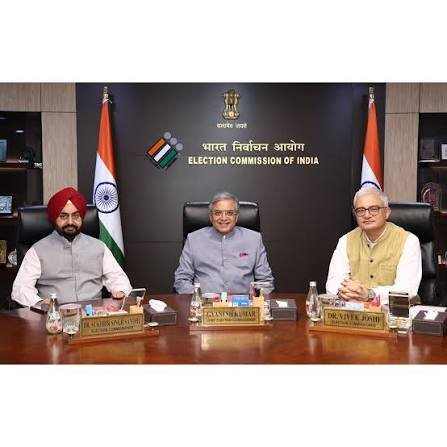
NEW DELHI/ September 26 — Chief Election Commissioner Gyanesh Kumar and Election Commissioners Sukhbir Singh Sandhu and Vivek Joshi met on Saturday as the Election Commission of India sought to address questions over reported differences within the three-member poll panel on the Special Intensive Revision (SIR) of electoral rolls.
The full Commission met at 3 pm on September 26 and subsequently issued a detailed press note setting out a series of decisions and clarifications on the SIR process, Form 6, access to the ECINet electoral database, field-level hearings and the internal administration of the Commission.
The note, signed by Deputy Director P. Pawan and issued with the approval of the full Commission, comes days after The Indian Express reported that Sandhu and Joshi had recorded objections on at least 14 occasions over a 10-month period to decisions involving SIR, changes to Form 6, access to electoral-roll systems and allocation of work. The Election Commission has maintained that differing views and observations are part of institutional deliberation and that final decisions of the Commission were unanimous.
What is the Special Intensive Revision?
The Special Intensive Revision, or SIR, is a comprehensive exercise to verify and update electoral rolls. Unlike routine or summary revisions, it involves a more intensive verification of existing electors, including efforts to identify voters whose records cannot be matched with earlier electoral rolls, duplicate or otherwise questionable entries, and people who may no longer be eligible to remain on the rolls.
During the exercise, electoral records are examined against previous rolls and other available information. Where an elector’s present record is flagged as “unmapped” or as having a logical discrepancy, the Election Commission can seek verification and supporting documents.
The process does not mean that every person receiving a notice is automatically deleted. The elector is given an opportunity to establish eligibility, after which the Electoral Registration Officer (ERO), the statutory authority responsible for maintaining the roll in the constituency, takes a decision.
The ECI has also said that people left out of the rolls during SIR, including first-time voters, can apply for inclusion through the continuous updation process.
Home visits instead of routine office hearings
On Saturday, the Commission said that where notices have been issued during the ongoing SIR for unmapped entries or logical discrepancies, Booth Level Officers (BLOs) will visit the concerned households to collect documents and upload them on ECINet for consideration by the ERO.
Such electors need not ordinarily be called to the ERO or Assistant Electoral Registration Officer’s office.
Hearings will be held only in exceptional circumstances and, wherever possible, online. An adult member of the family may also appear on behalf of the elector.
The Commission directed that online hearing facilities be strengthened.
District Election Officers were also asked to establish help desks and special camps for people in night shelters, labourers, poor and homeless persons and other groups who may face difficulties in completing the verification process.
A meeting of the Election Commission of India was held today, 26 September 2026, at 3:00 PM at Nirvachan Sadan, New Delhi.
Chief Election Commissioner Shri Gyanesh Kumar and Election Commissioners Dr. Sukhbir Singh Sandhu and Dr. Vivek Joshi were present in today’s meeting.… pic.twitter.com/WZoqEIXVJq
— Election Commission of India (@ECISVEEP) September 26, 2026
Form 6 controversy
The Commission said the declaration attached to Form 6 for SIR has been upheld by the Supreme Court.
Form 6 is the application used for inclusion of a person’s name in the electoral roll. For the non-SIR period, the Commission said the forms prescribed under the Registration of Electors Rules, 1960, would continue to be used.
The clarification addresses one of the issues reportedly raised internally by Sandhu and Joshi over changes connected with Form 6. Media reports had said the two commissioners questioned the legality of a SIR-specific declaration without a corresponding amendment to the statutory rules.
ECINet access to be reviewed
On concerns over the extent to which field officers could access electoral databases through ECINet, the Commission said officers have “role-based access” according to their statutory powers.
It said a committee headed by a Senior Deputy Election Commissioner and including an independent expert from an IIT or IIIT would review ECINet for compliance with the relevant Acts and Rules and submit its report to the Commission.
The Commission said upgrades had already been carried out on the basis of inputs from State Chief Electoral Officers. Any additional flexibility considered necessary for field officers would be made operational.
It also directed that proposed new IT modules and portals first be discussed by the Committee of Officers before being placed before the full Commission for approval.
Delhi and Maharashtra get more time
On a request from the Delhi Chief Electoral Officer, the Commission extended the deadline for filing claims and objections during the SIR to October 30, 2026, while the deadline for disposal of notices, claims and objections was extended to November 30.
For Maharashtra, the corresponding deadlines were extended to October 12 and November 10, respectively.
What happens to voters left out of SIR?
The Commission said SIR has already been completed in 20 States and Union Territories, including Bihar and West Bengal.
However, exclusion during the revision does not permanently close the door to enrolment. Anyone left out during SIR or subsequently, including first-time voters, can apply to the concerned ERO under the continuous updation mechanism.
The Commission directed Chief Electoral Officers, District Election Officers and EROs to immediately launch special enrolment drives.
In Goa, where concerns were raised after 97 eligible voters were left out of the final roll, the Commission said the Chief Electoral Officer had ordered house-to-house verification. Eighty-one of the 97 voters had already filed Form 6, it said.
READ: Why Do Thousands Rot in Indian Jails Under UAPA While Van Dyke Walks Out?
READ: ECI in Damage-control Mode: From Goa’s 97 Voters to Gen Z Camps
Cabinet Secretary letter
The Commission also addressed questions surrounding a letter sent to the Cabinet Secretary, one of the issues highlighted in reports about internal differences.
It said the letter “was not related to any policy matter of the Commission or IT division” but concerned the functioning of an officer on deputation to the ECI.
The Commission further said work-redistribution orders issued by the officer concerned were not implemented after the intervention of the two Election Commissioners.
It also rejected any suggestion that oversight of the IT division by the Deputy Election Commissioner had actually been withdrawn.
SIR orders were unanimous, says EC
On the larger SIR exercise, the Commission said its June 24, 2025 order covering all States and Union Territories was issued with the unanimous approval of the Commission. The exercise began with Bihar and was subsequently extended to West Bengal and 30 other States and Union Territories.
The Commission said the Supreme Court upheld the order on May 27, 2026.
It added that schedules for 12 States and Union Territories issued on October 27, 2025, and for another 19 States and Union Territories issued on May 14, 2026, were also approved unanimously.
The final number of electors will be known only after the completion of the exercise in the remaining 12 Phase-III States and Union Territories.
Internal functioning
The Commission also announced several administrative measures. Agendas for Commission meetings are to be circulated in advance and minutes issued thereafter. Annual Performance Appraisal Reports of officers are to be completed by December 31 each year, while foreign travel by officers will require Commission approval.
It also directed that instructions issued by the Election Commissioners be “meticulously complied with”.
The latest clarification follows several days of political criticism of the poll panel after reports of the internal objections surfaced. Opposition parties have questioned the functioning of the Commission and demanded action against CEC Gyanesh Kumar, while the ECI has maintained that internal observations do not amount to institutional dissent and that its final decisions, including those concerning SIR, were taken unanimously.
The Saturday note concluded that it was issued on the basis of decisions taken at the full Commission meeting on September 26 and had the approval of all three members.