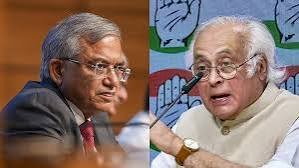
Jairam Ramesh has raised six objections to the EC’s response, including the Goa voter controversy, the legal basis of the additional Form 6 declaration and the decision to extend deadlines only in Delhi and Maharashtra.
BY PC Bureau
September 26: The Congress has sharply criticised the Election Commission’s latest clarification on the Special Intensive Revision (SIR) of electoral rolls, calling it “wishy-washy” and accusing the poll panel of going into “damage control mode” without addressing what the party says are fundamental questions over the revision exercise.
Congress general secretary Jairam Ramesh said the Commission’s latest statement did not directly rebut several media reports about the SIR process and, in his assessment, sidestepped questions concerning the enrolment of first-time, or “Gen Z”, voters. He alleged that the Commission’s credibility, impartiality and decision-making process had come under scrutiny.
Ramesh listed six objections to the Commission’s response.
First, he argued that the EC had not directly denied the findings reported in the media but had instead sought to minimise their significance.
Second, he pointed to the controversy over 97 voters in Goa whose names were not included in the final electoral roll after the SIR process. Ramesh said the episode amounted to voters first being left out and subsequently having to seek restoration. The Goa CEO’s office has said the 97 cases were processed separately through house-to-house visits by Booth Level Officers, with many subsequently enrolled and the remaining cases being processed.
Third, Ramesh rejected the Commission’s reliance on the Supreme Court’s May 27, 2026 judgment as an answer to the wider controversy. He argued that the judgment could not, by itself, settle questions concerning individual deletions, alleged procedural errors or the burden imposed on voters and families during the exercise.
The Commission, however, has maintained that the nationwide SIR was unanimously approved and that the exercise has legal backing. It has cited Section 21(3) of the Representation of the People Act, 1950, and the Supreme Court’s May 27 judgment upholding the legal basis of the exercise.
Fourth, Ramesh questioned why the deadlines for claims and objections had been extended in Delhi and Maharashtra, but not in other states where SIR-related issues have also been raised. The Commission on Saturday extended the relevant deadlines in the two states while saying that SIR had already been completed in 20 states and Union Territories.
Fifth, Ramesh dismissed the proposed involvement of IIT/IIIT experts in reviewing the ECINet system as inadequate. He argued that the central issue was not merely technical functioning of the portal but what Congress described as the concentration of electoral-roll functions and restrictions on field-level officials.
The Election Commission is in damage control mode after it has already caused massive damage to our democracy. It has just issued a wishy-washy Press Note that raises further questions on its intent, integrity, impartiality and credibility. Here is a response to that bogus Press… pic.twitter.com/CwTMC0Uwrs
— Jairam Ramesh (@Jairam_Ramesh) September 26, 2026
The EC has rejected the premise that statutory powers have been transferred from Electoral Registration Officers to ECINet. It has maintained that EROs continue to exercise their statutory powers and that ECINet is a digital platform supporting the electoral-roll process. The Commission has nevertheless announced a committee, including an independent IIT/IIIT expert, to review the system for legal compliance.
Sixth, Ramesh said the Commission had still not satisfactorily explained the controversy over the additional declaration linked to Form 6, the application used for enrolment of new voters.
The issue became contentious after a new declaration appeared on the online voter-registration system, asking applicants whether their own name, or that of a parent or grandparent, appeared in the electoral roll from the previous SIR. Two Election Commissioners, Sukhbir Singh Sandhu and Vivek Joshi, were reported to have raised objections to the change, including questions about the legal procedure for altering a statutory form.
The Commission has disputed the description of the move as a change to Form 6. It says Form 6 itself was not altered, and that an additional declaration, referred to as Annexure D, was introduced alongside the existing form under the SIR process. The EC has said the declaration was part of the SIR orders approved by the Commission.
READ: EC’s Second Clarification in Three Days as Wishy-Washy as First; Key Questions Remain Unanswered
The dispute therefore centres not only on what information voters were asked to provide, but also on the legal and administrative route through which the additional declaration was incorporated into the online process.
Ramesh has continued the Congress’s broader “vote chori” allegation, accusing Chief Election Commissioner Gyanesh Kumar of unilateral decision-making, bias against the Opposition and creating obstacles for young voters. He has demanded an immediate suspension of SIR and said that, in his view, “nothing short of the CEC’s resignation or prosecution will suffice.” These are political allegations by the Congress and have not been established as findings against the CEC.
The Congress’s latest attack follows reports that Sandhu and Joshi recorded objections on several SIR-related decisions over a period of months. The Indian Express reported that the two commissioners had raised objections at least 14 times over 10 months, including over Form 6, access to electoral-roll systems and other administrative decisions.
The Election Commission has repeatedly rejected the suggestion of a formal institutional rift. In its first clarification on September 23, it said differing views, written observations and internal checks were normal within a multi-member constitutional body and maintained that final decisions had been taken unanimously.
Its latest clarification on Saturday followed a full Commission meeting and went further into the operational aspects of SIR. The EC said Booth Level Officers would visit the homes of voters who receive notices to collect documents, while hearings would be held only in exceptional cases and preferably online. It also announced special assistance for vulnerable groups, including people in night shelters, labourers, the poor and homeless.
The Commission said first-time and left-out voters can continue to apply through continuous updation after completion of SIR in 20 states and Union Territories. It also extended claim-and-objection deadlines in Delhi and Maharashtra and announced a technical review of ECINet involving an IIT/IIIT expert.
Meanwhile, the political confrontation has widened beyond the SIR process itself. Leader of the Opposition Rahul Gandhi has separately questioned the Election Commission over a claim attributed to former Kerala chief secretary Jiji Thomson concerning Gyanesh Kumar’s earlier career. Gandhi cited Thomson’s allegation that Kumar had asked him to contest an election on a BJP ticket and offered him a ministerial position. Gandhi subsequently used the allegation to question Kumar’s impartiality as CEC. The allegation remains a claim attributed to Thomson and has not been independently established in the material reviewed for this report.
The latest exchange leaves two parallel narratives in place. The Commission says the SIR process and its key decisions were unanimously approved, legally grounded and being adjusted to make the exercise easier for voters. The Congress argues that this does not answer the specific questions raised over Form 6, ECINet, the Goa voters and the reported objections by two Election Commissioners.
The central dispute is therefore no longer simply over whether SIR has been approved by the Commission, but over how particular decisions were taken, how they were implemented, and whether the Commission’s explanations adequately address the objections that have emerged from within the poll panel itself.