Senior BJP leader Samrat Choudhary has emerged as the frontrunner, though other names remain in contention. Kumar’s exit ends an era defined by development initiatives, coalition shifts, and his central role in shaping Bihar’s political landscape.
BY Navin Upadhyay
Patna, April 14, 2026 — In a landmark moment for Bihar politics, veteran leader Nitish Kumar on Tuesday stepped down as Chief Minister, bringing to an end a political era that dominated the state for nearly two decades and reshaped its governance narrative.
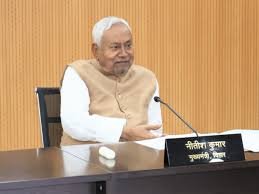
Kumar, 75, submitted his resignation to Governor Syed Ata Hasnain after chairing what is widely seen as his final cabinet meeting. The move follows his recent election to the Rajya Sabha, marking his transition to national politics.
Having already resigned from the Bihar Legislative Council on March 30, Kumar’s exit clears the path for the NDA to elect a new leader. A new Chief Minister is expected to be sworn in as early as April 15.
Succession Race: BJP Set to Take the Helm
With Nitish Kumar stepping aside, the spotlight has firmly shifted to the leadership question — and for the first time in Bihar’s history, the Bharatiya Janata Party is poised to occupy the Chief Minister’s post.
Senior BJP leader Samrat Choudhary has emerged as the frontrunner. Currently serving as Deputy Chief Minister and state BJP president, Choudhary is seen as a strong organisational leader with deep roots in OBC politics — a key factor in Bihar’s caste-driven electoral landscape. Choudhary also enjoys the blessing of Nitish Kumar.
Party insiders suggest that the final call will likely balance caste equations, administrative experience, and political messaging ahead of upcoming electoral battles. The BJP is keen to consolidate its independent identity in Bihar while maintaining alliance cohesion with the Janata Dal (United).
Nitish Kumar’s name plaque has been removed from his official residence and all the luggage is being shifted to 7, circular road in Patna to make way for new Bihar CM
Aisa hoga kabhi socha tha ji? pic.twitter.com/HB4vTMbwRL
— With Love Bihar (@WithLoveBihar) April 11, 2026
READ: US-Iran Eye Fresh Talks as Ceasefire Deadline Nears
A Carefully Managed Transition
Union ministers, including Shivraj Singh Chouhan, have reached Patna to oversee the transition, underlining the importance the BJP leadership attaches to a smooth handover.
A BJP legislature party meeting, followed by an NDA meeting, is scheduled to formally elect the new leader. Senior leaders have emphasised that the change is part of a planned transition rather than a political rupture.
Prime Minister Narendra Modi and Home Minister Amit Shah are expected to attend the swearing-in ceremony, signalling the significance of the moment for the party.
End of an Era in Bihar Politics
Nitish Kumar first became Chief Minister in 2005, ending 15 years of rule by Lalu Prasad Yadav and Rabri Devi. Over the next 20 years, he served a record 10 terms, emerging as the central figure in Bihar’s governance.
His tenure saw major improvements in infrastructure, law and order, and social welfare schemes — particularly initiatives focused on women’s empowerment and rural connectivity — earning him the title “Sushasan Babu.”
Yet, his political journey was also marked by frequent alliance shifts between the NDA and the Rashtriya Janata Dal-Congress bloc. Critics dubbed him “Paltu Kumar,” while supporters viewed his pragmatism as a necessity in Bihar’s complex political terrain.
Opposition Attacks, JD(U) Uncertainty
Opposition leader Tejashwi Yadav described the resignation as a “forced exit,” alleging pressure from the BJP and calling it a betrayal of the people’s mandate.
Within the JD(U), Kumar’s departure has triggered unease. The party, long defined by his leadership, now faces questions about its relevance and future direction. There is growing speculation about a generational shift, with Kumar’s son Nishant Kumar occasionally mentioned in political circles, though he has so far stayed away from active politics.
Nitish Kumar’s exit marks a structural shift in Bihar politics. For the BJP, it represents a long-awaited opportunity to lead the state government directly. For the JD(U), it raises existential questions about leadership and identity.
For Bihar itself, the transition comes at a critical juncture. The new leadership will need to sustain development momentum while managing the state’s complex caste dynamics and coalition pressures.
As Nitish Kumar moves to the national stage via the Rajya Sabha, the state enters uncharted territory — one where his shadow will remain large, even as a new political chapter begins.