
The Village Volunteers’ stark message — “Tengnoupal is not Kangpokpi” — has intensified scrutiny of Deputy CM Nemcha Kipgen, with many questioning her silence during the Chief Minister’s recent visit and her stance on buffer zone violations.
By PC Bureau
April 15, 2026
Manipur Deputy Chief Minister Nemcha Kipgen is facing mounting backlash from within the Kuki-Zo community, with her silence during Chief Minister Yumnam Khemchand Singh’s recent visit to Kangpokpi now emerging as a central flashpoint in the deepening hill tensions.
What began as opposition to the Chief Minister’s reported plan to visit Tengnoupal has increasingly turned into a pointed critique of Kipgen’s political stance — with civil society groups and local organisations openly questioning her commitment to the Kuki-Zo cause.
The sharpest message came from the Village Volunteers, Eastern Zone (VVEZ), Kuki-Zo-Gam, whose April 13 statement went beyond opposing the visit and appeared to directly undercut Kipgen’s political standing in the hills.
Read: Trump Signals Fresh US-Iran Talks in Pakistan Within Days
“Tengnoupal is not Kangpokpi,” the VVEZ declared, in what many observers interpret as a clear rebuke of the Deputy Chief Minister. The statement underscored that, unlike Kangpokpi — where the Chief Minister recently visited — the people of Tengnoupal would not tolerate any perceived attempts to breach buffer zones or assert authority without addressing core political demands.
“The Kuki people here stand firmly united, and any attempt at intimidation or coercion will be met with resolute resistance,” the group warned, signalling that the political ground Kipgen commands in Kangpokpi does not extend unquestioned across the hill districts.
The remark has since resonated widely, amplifying criticism that Kipgen failed to assert herself during the Kangpokpi visit — a moment many in her community viewed as a test of leadership on the sensitive issue of buffer zones separating hill and valley areas.
Adding to the pressure, all office bearers of the Committee on Tribal Unity (COTU) have resigned, citing the alleged breach of the buffer zone during the Chief Minister’s visit and the Deputy Chief Minister’s silence. The resignations mark a significant escalation, reflecting growing dissatisfaction within influential Kuki-Zo civil society circles.
Further intensifying the controversy, the Kuki History & Identity Protection Committee (KHIPC) has levelled serious allegations against Kipgen and her husband, Semtinthang Kipgen. In a strongly worded statement dated April 11, the group accused the couple of fostering a climate of “intimidation” and “authoritarian control” in Kangpokpi — claims that remain unverified.
Semtinthang Kipgen, chief of the Kuki National Front — an armed group under a Suspension of Operations (SoO) agreement with the Centre — is widely regarded as an influential figure with a significant armed cadre base, adding another layer of complexity to the political discourse surrounding the Deputy Chief Minister.
The KHIPC alleged a “pattern of intimidation, arbitrary decrees, and abuse of authority,” and warned against what it described as governance being run “as a personal fiefdom.” It further argued that such actions undermine traditional institutions and erode collective decision-making within the community.
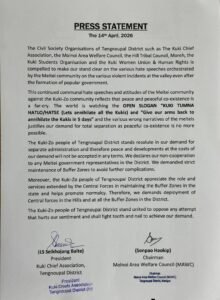
Meanwhile, opposition to the Chief Minister’s proposed Tengnoupal visit continues to harden. On April 14, several civil society organisations — including the Kuki Chief Association, Molnoi Area Welfare Council, Hill Tribal Council (Moreh), Kuki Students’ Organisation, and Kuki Women Union & Human Rights — issued a joint statement rejecting the visit and reiterating their demand for a separate administrative arrangement in the form of a Union Territory with a legislature.
The groups declared non-cooperation with the state government and called for strict enforcement of buffer zones, arguing that prevailing conditions make peaceful coexistence untenable.
As tensions persist along the fragile hill-valley divide, the focus has increasingly shifted from the Chief Minister’s movements to the political credibility of Deputy Chief Minister Nemcha Kipgen herself. The repeated invocation of “Tengnoupal is not Kangpokpi” has come to symbolise a broader sentiment — that her leadership is being openly tested, and in some quarters, found wanting.