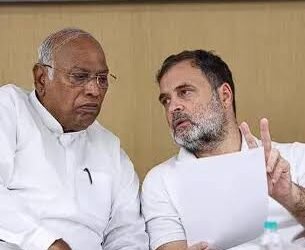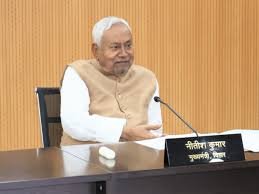
Even a small shift in vote share away from NDA after Nitish Kumar’s exit could significantly alter Bihar’s electoral outcomes, giving the Rashtriya Janata Dal a real opening. The BJP faces a leadership challenge, with figures like Samrat Choudhary yet to establish a pan-Bihar appeal across caste groups.
BY Navin Upadhyay
April 14, 2026: The exit of Nitish Kumar from the helm of Bihar politics marks more than the end of a long political chapter—it fundamentally reshapes the state’s electoral landscape and poses a serious structural challenge for the National Democratic Alliance (NDA).
For nearly two decades, Nitish Kumar was not just the face of governance in Bihar but the pivot around which coalition politics revolved. His exit removes a stabilising force that held together diverse social coalitions, managed contradictions within alliances, and ensured a degree of electoral predictability.
Now, that equilibrium is at risk.
READ: US-Iran Eye Fresh Talks as Ceasefire Deadline Nears
VIDEO | Bihar Minister Shravan Kumar says, “The political decision that has been taken, we all have to stand by it. Working with Nitish Kumar ji for a long time, we have gained knowledge, learned a lot, understood parliamentary traditions, and gained experience in different… pic.twitter.com/0hFP6XZhL0
— Press Trust of India (@PTI_News) April 14, 2026
Even a Small Vote Shift Could Be Decisive
In a state like Bihar, where elections are often decided by narrow margins, even a 3–5% shift in vote share can dramatically alter outcomes. Nitish Kumar’s personal credibility and cross-caste appeal played a crucial role in delivering that margin to the NDA.
With his departure, the NDA risks losing a slice of its support base—particularly among women and Extremely Backward Classes (EBCs). Even a marginal erosion in these segments could open the door for the opposition, especially the Rashtriya Janata Dal (RJD), to stage a comeback.
For the first time in years, the opposition senses a real opportunity.
The Nitish Social Coalition Begins to Fragment
Nitish Kumar’s biggest political achievement was the creation of a durable social coalition that cut across caste lines.
His governance model—focused on welfare delivery, prohibition, and women-centric schemes—helped him build a loyal female voter base. Simultaneously, his outreach to EBCs broke the traditional dominance of larger OBC groups and brought smaller backward castes into the NDA fold.
This coalition was not organically BJP’s—it was Nitish’s.
With him stepping away, this support base becomes fluid. The question is no longer whether the NDA can retain it entirely, but how much of it it can hold on to.
RJD Eyes Expansion Beyond MY Formula
For years, the RJD’s core strength lay in its MY (Muslim-Yadav) combination. While formidable, this base had limits.
Now, with the NDA’s EBC support potentially weakening, the RJD under Tejashwi Yadav sees an opening to expand beyond its traditional base. The party has already begun attempts to reach out to non-Yadav OBCs and Extremely Backward Classes—segments that were largely consolidated by Nitish Kumar.
If even a portion of these groups shifts, it could significantly alter Bihar’s political arithmetic.
This is perhaps the first time in recent years that the RJD has a realistic pathway to broaden its social coalition rather than rely solely on its core vote bank.
BJP’s Leadership Dilemma
For the Bharatiya Janata Party, Nitish Kumar’s exit creates a vacuum that is not easy to fill.
Unlike other states, Bihar has not seen the emergence of a BJP leader with a clear, pan-state appeal cutting across caste lines. Leaders like Samrat Choudhary may be frontrunners for the Chief Minister’s post, but their acceptability remains uneven.
Choudhary’s shifting political affiliations—from the Congress to the RJD and then the BJP—have raised questions among sections of the cadre. His political lineage, with his father having served under RJD governments, further complicates his positioning as a core BJP figure.
This creates a perception challenge: can he represent continuity, credibility, and stability in the way Nitish Kumar did?
Caste Arithmetic Under Strain
Bihar’s politics is ultimately about caste coalitions, and Nitish Kumar was a master at managing them.
His presence allowed the NDA to balance upper castes, non-Yadav OBCs, EBCs, and women voters into a winning combination. Without him, this balance becomes fragile.
The BJP will now have to rebuild this coalition from scratch, ensuring that EBCs do not drift away while also maintaining its traditional support base. This is a far more complex task than simply transferring leadership.
Any miscalculation could lead to fragmentation—something the opposition will be keen to exploit.
JD(U)’s Uncertain Future
Nitish Kumar’s exit also raises existential questions for the Janata Dal (United) (JD(U)).
The party has long been synonymous with its leader. Without him at the helm in Bihar, its organisational strength and electoral relevance could weaken over time. While it remains part of the NDA, its ability to independently mobilise voters is likely to diminish.
This could, in the long run, shift the balance of power within the alliance decisively in favour of the BJP—but not without short-term risks.
A Defining Political Moment
The transition from a Nitish-led NDA to a BJP-led government marks a structural shift in Bihar’s politics.
For the BJP, it is an opportunity to assert dominance in a key Hindi heartland state. But it is also a high-risk moment, where even a small electoral slide could have outsized consequences.
For the RJD, it is the first genuine opening in years to expand beyond its traditional base and challenge the NDA on new social terrain.
And for Bihar, it signals the beginning of a new political phase—one where the absence of Nitish Kumar will be felt not just in governance, but in the very structure of electoral politics.
The coming elections will reveal whether the NDA can hold together without its longest-serving anchor—or whether Bihar is headed for another political realignment.