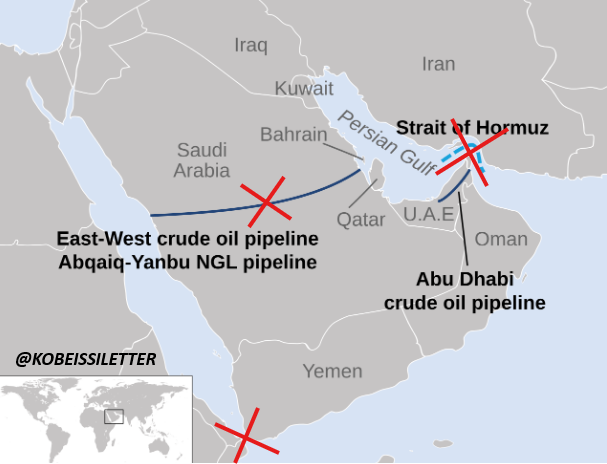
September 15, 2026: Oil prices rose furthr on Tuesday, September 15, as markets weighed the risk of further disruptions to crude supplies from West Asia, with a key Saudi pipeline still offline following last week’s attacks.
Brent crude moved above $107 a barrel after gaining 1% on Monday, while West Texas Intermediate hovered around $103.
The immediate focus remained on the prolonged shutdown of Saudi Arabia’s East-West pipeline, which carries crude across the kingdom to the Red Sea and provides an alternative to shipping oil through the Strait of Hormuz.
The Associated Press reported on Monday, citing two regional officials, that repairs could take weeks. US Energy Secretary Chris Wright, however, struck a more optimistic note, saying he expected the pipeline to resume operations soon.
Saudi Arabia has responded to the disruption by increasing crude shipments through the Strait of Hormuz, Bloomberg reported. Oil flows through the strategic waterway had already risen in early September compared with August, and Riyadh is seeking to increase them further.
The move underscores the growing vulnerability of global energy supplies to developments around Hormuz, through which a significant share of the world’s oil trade passes.
Meanwhile, diplomatic efforts to ease tensions between Washington and Tehran showed little progress. Mohsen Rezaee of Iran’s Supreme National Security Council said on X that Tehran would not negotiate with Washington until its demands were met, shortly after US President Donald Trump said Iran wanted an agreement “quickly and badly.”
Brent has risen about 76% in 2026 as the US-Iran confrontation has expanded, disrupting traffic through Hormuz and forcing the shutdown of oil fields. The energy shock has added to inflationary pressures already generated by the Russia-Ukraine war, while the US 10-year Treasury yield has climbed above 5%, its highest level since 2023.
Trump and Ukrainian President Volodymyr Zelenskyy also differed over attacks on energy infrastructure. Trump said Moscow and Kyiv had agreed to stop striking energy facilities, but Zelenskyy denied that such an agreement existed.
Tensions remained high elsewhere in the region. US forces continued to restrict access to Iranian ports, while Iran’s Islamic Revolutionary Guard Corps Navy claimed that a tanker had struck mines in a restricted area of the Strait of Hormuz. US Central Command rejected the claim as false.
Coalition officials also said Houthi missiles and drones struck civilian areas in Khamis Mushait, Abha and Taif on Monday.
READ: NSCN-IM Accuses Centre of Using Kuki Groups as ‘Proxy Forces’ in Manipur
THE OIL CRISIS IS MOVING FROM HORMUZ TO THE WHOLE EXPORT SYSTEM
Saudi Arabia’s East-West pipeline was the main escape valve around Hormuz. Now it is shut too.
If the pipeline stays shut, Saudi Arabia may eventually have to cut production because crude has nowhere to go and… https://t.co/hDPLAylXln
— Art Berman (@aeberman12) September 15, 2026
Geopolitical impact
The latest oil shock is becoming more than an energy-market story. It is beginning to reshape the strategic calculations of the major powers.
1. Hormuz is becoming the central pressure point.
Saudi Arabia’s decision to increase shipments through Hormuz highlights the dilemma facing Gulf producers. The East-West pipeline provides an alternative route, but its continued shutdown means Riyadh is once again more exposed to the security of the strait. Any prolonged disruption there could produce a far larger global supply shock.
2. Iran gains leverage—but also faces greater pressure.
For Tehran, the vulnerability of global oil supplies provides powerful geopolitical leverage. But prolonged disruption could provoke a much stronger international response, particularly from the US, China and major Asian energy importers. Iran therefore faces a difficult calculation: use energy pressure to extract concessions, or avoid actions that could trigger a broader military confrontation.
3. Saudi Arabia’s strategic dilemma is deepening.
Riyadh has invested heavily in reducing its dependence on Hormuz, including the East-West pipeline. The current disruption demonstrates that alternative infrastructure can itself become a target. Saudi Arabia may consequently accelerate investment in pipelines, storage, Red Sea export capacity and other routes that reduce its exposure to regional conflict.
4. China becomes increasingly important.
China is among the countries most exposed to a prolonged disruption of Gulf oil supplies. Beijing therefore has a stronger incentive than before to push for de-escalation between Washington and Tehran. The energy crisis could give China additional diplomatic space in West Asia while simultaneously increasing its strategic dependence on Gulf producers.
5. Russia could benefit economically, but strategically the picture is complicated.
Higher oil prices provide Moscow with additional export revenue at a time when the Russia-Ukraine war continues. But a prolonged Middle East crisis could also divert US and European attention, military resources and diplomatic bandwidth away from Ukraine—something that could work to Russia’s advantage.
6. Washington faces an inflation-security dilemma.
The rise in crude prices threatens to feed directly into US inflation and borrowing costs. If oil remains above $100 for an extended period, the Federal Reserve could face renewed pressure to keep monetary policy tight even as geopolitical risks rise. That would complicate the US administration’s economic agenda.
7. The Gulf states are being forced to rethink security guarantees.
If oil infrastructure and alternative export routes can be attacked despite the presence of substantial US military power in the region, Gulf governments may increasingly question whether existing security arrangements provide sufficient protection. That could accelerate their efforts to diversify strategic partnerships rather than rely exclusively on Washington.
8. India faces a particularly uncomfortable equation.
India is highly exposed to higher international crude prices because of its dependence on imported oil. A prolonged price surge would put pressure on inflation, the current account and the rupee, while increasing the cost of transport and imported goods. At the same time, New Delhi has strategic relationships with both Washington and Tehran and has a strong interest in keeping Gulf shipping lanes open.
The larger danger is therefore not simply $107 oil. It is the possibility that energy infrastructure, shipping lanes and diplomatic negotiations become interconnected fronts in the same geopolitical confrontation.
If the Saudi pipeline remains offline for weeks while tensions around Hormuz continue, the market may begin pricing not a temporary supply disruption but a structural risk to the global energy system. That would turn West Asia’s military crisis into a much broader challenge for inflation, trade, financial markets and the strategic balance among the US, China, Russia, Iran and the Gulf states.