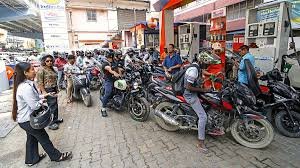
Crude oil markets are cooling off after months of turmoil in the Middle East, with prices sliding back to where they stood before the Iran conflict erupted. For India, a country that imports the overwhelming majority of the crude it burns, this should be unambiguously good news. Yet anyone who has watched this cycle before knows the real question isn’t whether global oil has gotten cheaper—it has—but whether that relief will ever show up at the neighbourhood petrol pump.
By Tuesday morning, Brent crude, the benchmark India tracks most closely, had slipped to around $72.54 a barrel, continuing a decline that saw prices drop over 10% just last week. The catalyst is a fragile but real thaw in US-Iran tensions: an interim truce has paused four months of conflict, and shipping traffic through the Strait of Hormuz—the corridor carrying roughly a fifth of the world’s oil—has rebounded to its highest levels since fighting began in February. Goldman Sachs reckons Gulf exports could be back near pre-war levels by early July if the trend holds, though Tehran’s denial of formal talks with Washington is a reminder that this calm could still unravel.
For ordinary Indians, the math on paper looks favourable. The country imports close to 85-88% of its crude needs, so every dollar shaved off the price tag saves the exchequer hundreds of millions of dollars a year, eases pressure on the rupee, narrows the current account deficit, and shrinks the subsidy bill the government might otherwise carry. Industries that run on fuel—aviation, logistics, chemicals, manufacturing—stand to gain from lower input costs too, which in theory should filter down into prices for everything from flight tickets to food.
In practice, Indian consumers have learned not to hold their breath. Retail petrol and diesel prices in this country were decoupled long ago from a simple pass-through of international crude rates. What actually lands on the price board at your local pump is shaped by central and state taxes that make up a hefty chunk of the final cost, refining and distribution costs, the marketing strategy of state oil companies, the rupee-dollar exchange rate, and—perhaps most decisively—deliberate decisions by the Centre on excise duty. Historically, when crude prices fall, oil marketing companies tend to use the window to rebuild margins eroded during the expensive months, rather than rushing to lower prices at the pump.
Crude war premium has round-tripped: WTI $69–$70, Brent ~$72, Indian Basket $68.86/bbl—back to February levels despite Iran/Hormuz risk.
Indian Basket is now below Feb’s $69.01/bbl after peaking at $114.48 in April; Urals is back below $60. Crude is consolidating, but products… pic.twitter.com/LiMcRELzmE
— kautious (@kautiousCo) June 30, 2026
READ: Pune Court Awards Death Penalty to Bhimrao Kamble in Nasrapur Child Rape-Murder Case
That pattern looks set to repeat. With the Indian crude basket now averaging $68.86 a barrel—down sharply from March’s peak of $157.04—public sector retailers are reportedly earning comfortable margins on petrol even as diesel stays under pressure. Meanwhile, pump prices for the average consumer have barely moved. The asymmetry is consistent: when crude rises, hikes reach consumers within weeks; when it falls, the benefit is delayed, watered down, or simply absorbed elsewhere.
There is a silver lining, even if it’s indirect. Even without a cut at the pump, cheaper crude can ease costs further down the chain. Diesel feeds into freight and logistics, which in turn shape the price of food and consumer goods, so falling fuel costs for commercial transport could nudge down inflation more broadly. Lower energy costs may also help industrial margins, indirectly supporting growth even if your two-wheeler tank doesn’t get any cheaper to fill.
That leaves the government holding the real decision. It can pass on lower prices directly to consumers, hold prices steady and pocket the difference through excise collections, or let oil companies use the cushion to recover losses from the conflict months. With state elections and fiscal considerations both in the mix, that choice will be as political as it is economic.
So while the headline trend is encouraging—cheaper oil, calmer markets, a more stable rupee—the experience of the average Indian consumer will hinge not on what happens in Brent futures, but on what New Delhi decides to do with the savings. If recent history is any guide, the gains are far more likely to show up in government revenue and oil company balance sheets than in the price you pay the next time you fill up.