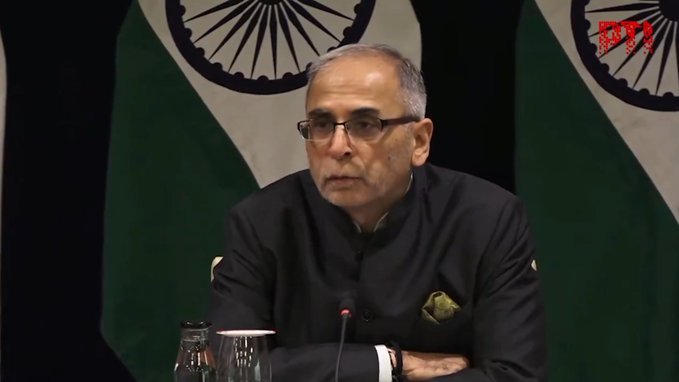
Ambassador Vinay Mohan Kwatra has pushed back against concerns raised by US lawmakers, arguing that India’s foreign funding regulations apply equally to organisations regardless of religion or ideology.
By PC Bureau
Washington: India has rejected claims that its proposed amendments to the foreign funding law are aimed at churches, religious organisations or civil society groups, arguing that the legislation is intended to tighten transparency and accountability in the handling of overseas contributions.
The government’s defence of the proposed Foreign Contribution (Regulation) Amendment Bill, 2026 came amid criticism in the United States, including from some members of Congress who have expressed concern that the changes could affect Christian organisations and other faith-based charities operating in India.
India’s Ambassador to the US, Vinay Mohan Kwatra, sought to address those concerns through a detailed “Myth vs Reality” series posted on X, outlining what he described as widespread misconceptions about the proposed legislation.
There are many misunderstandings in the media and in civil society about the proposed Foreign Contribution (Regulation) Amendment Bill(FCRA), 2026.
Here is the Myth vs. Reality check.— Amb Vinay Mohan Kwatra (@AmbVMKwatra) August 10, 2026
“There are many misunderstandings in the media and in civil society about the proposed Foreign Contribution (Regulation) Amendment Bill (FCRA), 2026,” Kwatra said while introducing the fact-check.
Government says FCRA is not a ban on foreign funding
Rejecting the argument that the proposed legislation would effectively shut off overseas funding to Indian civil society, Kwatra said the FCRA does not prohibit organisations from receiving legitimate foreign donations, research grants or humanitarian assistance.
Instead, he said, organisations receiving such funds are required to register, follow prescribed procedures for receiving the money and account for how the funds are used.
Myth: FCRA has adversely impacted the working of NGOs and charitable organization and the new amendment would further restrict their ability to operate in India.
Truth: In reality, foreign money inflows into India have been rising, not falling. Foreign contributions to…
— Amb Vinay Mohan Kwatra (@AmbVMKwatra) August 10, 2026
Thousands of organisations registered under the FCRA continue to receive overseas contributions for activities ranging from healthcare and education to disaster relief, research and humanitarian assistance.
READ: Manipur: Kuki Body Opposes Proposed India-Myanmar Land Swap
According to figures cited by Kwatra, foreign contributions received by registered organisations increased from around $1.2 billion in 2010-11 to $2.67 billion in 2024-25.
India has more than three million NGOs, but only about 14,450 organisations currently hold FCRA registration, meaning the overwhelming majority of NGOs are not covered by the foreign contribution law.
“FCRA does not stop anyone from accepting foreign charity, research grants, or humanitarian aid,” Kwatra said, stressing that the law requires organisations to register, receive funds through the prescribed mechanism and report their utilisation.
Myth: FCRA has adversely impacted the working of NGOs and charitable organization and the new amendment would further restrict their ability to operate in India.
Truth: In reality, foreign money inflows into India have been rising, not falling. Foreign contributions to…
— Amb Vinay Mohan Kwatra (@AmbVMKwatra) August 10, 2026
India says proposed changes are part of an existing framework
Kwatra also sought to place the 2026 legislation in the context of the evolution of India’s foreign funding regulations.
The first FCRA was enacted in 1976, before being replaced by a new framework in 2010. The law was subsequently amended in 2016, 2018 and 2020.
According to the ambassador, the latest Bill and accompanying rules represent another stage in that process, with the government seeking greater transparency, stronger administrative oversight and clearer procedures for handling foreign contributions.
Myth: FCRA has adversely impacted the working of NGOs and charitable organization and the new amendment would further restrict their ability to operate in India.
Truth: In reality, foreign money inflows into India have been rising, not falling. Foreign contributions to…
— Amb Vinay Mohan Kwatra (@AmbVMKwatra) August 10, 2026
He argued that regulation of overseas funding is not unique to India and that governments routinely impose safeguards on foreign financial flows, particularly where national security and public accountability are concerned.
Dispute over NGO and religious property
One of the most contentious aspects of the proposed legislation concerns the treatment of assets associated with organisations whose FCRA registration is cancelled or surrendered.
Kwatra rejected claims that the proposed provisions would allow the government to arbitrarily take over the property of NGOs, churches, hospitals, schools or other religious and charitable institutions.
Myth: FCRA specifically targets a particular religion or community
Truth: Nothing could be farther from it. The Act applies uniformly to all organisations regardless of religion, community or ideology. Faith-based welfare activities, including religious education, maintenance of…
— Amb Vinay Mohan Kwatra (@AmbVMKwatra) August 10, 2026
He said the existing law already provides for foreign contributions and assets created from such contributions to vest with a state government authority when an organisation’s registration is cancelled or surrendered.
The proposed legislation, he said, would create a designated authority to oversee and safeguard such assets and provide a mechanism through which they could be restored if the organisation subsequently regains its FCRA registration.
“If the organisation restores its registration, all assets and unused funds are returned in full,” Kwatra said.
The proposed framework also provides specific safeguards for places of worship. Property associated with a place of worship and created by an association whose registration has been cancelled would be transferred to another FCRA-registered organisation belonging to the same faith, according to the ambassador’s explanation.
‘The law does not target any religion’
Kwatra also rejected allegations that the FCRA changes were directed at Christians or any other particular religious community.
“The Act applies uniformly to all organisations regardless of religion, community, or ideology,” he said.
According to the Indian position, organisations involved in faith-based welfare activities, religious education, charitable work and maintenance of places of worship can continue to receive foreign contributions provided they comply with the applicable legal requirements.
The ambassador argued that portraying the proposed amendments as an attack on a particular community therefore misrepresents the scope of the legislation.
India points to foreign funding laws in other countries
New Delhi has also challenged the suggestion that India is adopting an exceptional approach to foreign funding.
Kwatra cited legislation in several Western democracies, including the US Foreign Agents Registration Act of 1938 and the Foreign Account Tax Compliance Act of 2010.
He also pointed to measures adopted in Australia in 2018 and Canada in 2024, as well as the UK’s foreign influence-related framework that took effect in July 2025. Discussions on similar measures, he said, have also taken place within the European Union.
The broader argument from New Delhi is that regulation of foreign financial flows is a common feature of modern governance and that India’s FCRA framework should be viewed in that context.
Bill introduced in Lok Sabha
The Foreign Contribution (Regulation) Amendment Bill, 2026, was introduced in the Lok Sabha on March 25.
Among its provisions is a framework for the vesting, supervision, management and disposal of foreign contributions and assets connected with them through a designated authority. The framework envisages arrangements for both temporary and permanent management of such assets.
The legislation has nevertheless attracted criticism from civil society organisations and some foreign observers, particularly over the extent of government oversight and the potential consequences for organisations whose registrations are cancelled.
US lawmakers raise concerns
The debate has spilled into US politics, with lawmakers from both parties expressing concern over the possible impact of the proposed amendments on religious and civil society organisations.
James Risch, chairman of the US Senate Foreign Relations Committee, has raised concerns about the legislation and its potential implications for Christian organisations.
Republican Congressman Riley Moore has gone further, arguing that the proposed provisions could facilitate government takeovers of churches and religious charities and describing the legislation as an attack on Christians.
New Delhi has rejected such criticism, maintaining that legislative decisions concerning India’s domestic regulatory framework fall within the jurisdiction of Parliament.
External Affairs Ministry spokesperson Randhir Jaiswal has also pointed out that foreign funding is regulated in numerous countries, including the United States.
The FCRA regulates the receipt and utilisation of foreign contributions by individuals, associations and companies in India. Organisations covered by the law must obtain registration or prior permission and comply with prescribed banking, accounting and disclosure requirements.
The controversy over the 2026 amendments therefore centres on a larger question: whether the proposed changes represent a necessary strengthening of financial oversight or an expansion of state control over organisations dependent on overseas funding. While the government insists that the objective is transparency and accountability, critics remain concerned about the scope of the powers being proposed.