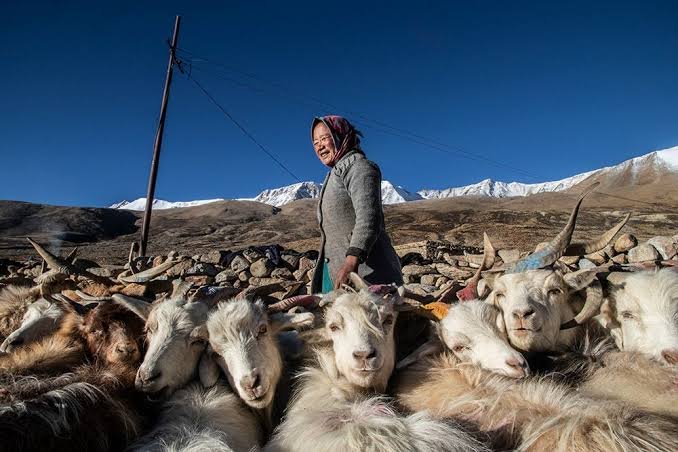
The Ladakh administration has also announced an ₹8 crore revolving fund to speed up payments to Pashmina growers, ensuring that 50% of the payment is made immediately and the balance within two months instead of the earlier eight-to-10-month wait.
BY PC Bureau
August 9, 2026: More than 1,200 nomadic Pashmina herders in Ladakh’s Changthang region received a major financial boost on Sunday, with Lieutenant Governor Vinai Kumar Saxena disbursing ₹1.10 crore in production-linked incentives at the Changthang Nomadic Festival 2026 at Korzok, on the shores of Tso Moriri.
The payment marks the first implementation of a 25 per cent production-based incentive scheme for Pashmina herders in Ladakh. The scheme was approved at the inaugural meeting of the Ladakh Pashmina Development Board on July 5 and is aimed at increasing production, improving household incomes and making pastoral livelihoods more sustainable.
The incentives were transferred through the Direct Benefit Transfer (DBT) system, primarily benefiting herders from Samad, Kharnak and Korzok, among the region’s major Pashmina-producing villages.
Samad received around ₹44 lakh, while Kharnak and Korzok received approximately ₹28 lakh and ₹23 lakh, respectively.
Pashmina Production Shows Sharp Increase
The administration said the incentive programme was already beginning to have an impact on production.
Raw Pashmina collection in Ladakh had reached 19 metric tonnes by July 2026, compared with 16 metric tonnes during the whole of 2025.
Saxena said the increase demonstrated the potential of targeted financial support combined with improved production practices.
He urged herders to use the incentives strategically to strengthen the entire Pashmina production chain.
READ: Mamata Faces Violent Protest, Mud and Stones Hurled at Her Vehicle
READ: Soren Govt Mulls Scrapping JPSC Exam as Student Protest Enters Day 15
Under the suggested utilisation pattern, 60 per cent of the incentive should go towards scientific breeding of Pashmina goats, 20 per cent towards modern combing equipment and basic infrastructure, and the remaining 20 per cent towards household requirements.
The objective, he said, was to ensure that the additional income translated into long-term improvements in both livestock productivity and household financial security.
₹8 Crore Revolving Fund to Speed Up Payments
In another major measure aimed at supporting Pashmina producers, the Lieutenant Governor announced an ₹8 crore revolving fund for the All Changthang Pashmina Growers Marketing Cooperative Society.
The cooperative operates the dehairing plant in Leh and plays a key role in processing raw Pashmina before it enters the wider value chain.
The new fund is expected to address one of the major problems faced by producers — delayed payments.
Under the new arrangement, 50 per cent of the payment will be made immediately to producers, with the remaining amount to be cleared within two months.
The administration said the system would replace the previous payment cycle, under which herders sometimes waited eight to 10 months to receive the full amount.
Faster payments, officials said, would improve cash flow for nomadic households and reduce financial uncertainty among producers.
#Ladakh | Changthang District Administration, in collaboration with the Department of Handlooms & Handicrafts, Leh, celebrated National Handloom Day at Lukung village on the banks of Pangong Lake.
The event featured a Tiranga Rally, with local artisans and weavers carrying a… pic.twitter.com/CXj2aPX3mB
— Argus News (@ArgusNews_in) August 7, 2026
Focus on Productivity and Quality
Saxena also called for a substantial increase in the productivity of Pashmina goats.
The average fibre yield is currently around 200 grams per goat, and the administration has set a target of increasing it to at least 350 grams per goat.
He also called for expanding the Pashmina goat population from approximately two lakh to four lakh within three years.
Alongside increasing production, Saxena stressed the importance of improving the quality and cleanliness of raw Pashmina.
Better sorting, handling and combing practices, he said, could reduce wastage and help producers obtain higher prices for their fibre.
The focus, therefore, is not simply on producing more Pashmina but on improving the quality of the fibre and increasing the share of its final economic value that reaches the pastoral communities producing it.
Pashmina and Changpa Heritage
Describing Ladakh Pashmina as a “timeless heritage,” Saxena said the Changpa community had preserved and developed the pastoral tradition over generations.
He said Pashmina represented not only an important economic activity but also the cultural identity and traditional way of life of Ladakh’s nomadic communities.
“Pashmina is not merely a product; it is a part of Ladakh’s cultural identity and the livelihood of thousands of our pastoral families. Our objective is to ensure that those who have preserved this heritage for generations receive a greater share of its economic value,” he said.
The 25 per cent production incentive and the new revolving fund, he added, were intended to strengthen the Pashmina value chain and improve returns to nomadic producers.
Changthang Festival Draws International Visitors
The Changthang Nomadic Festival has also grown significantly in recent years, attracting more than 10,000 visitors this year, including a substantial number of foreign tourists.
Held at Korzok near Tso Moriri, the festival provides a platform for showcasing the cultural traditions and pastoral heritage of the Changpa community.
What began as a largely local celebration has evolved into an event with an international audience, featuring traditional handicrafts, music, dance, cuisine, livestock and aspects of the Changpa way of life.
Saxena said the festival was helping introduce Ladakh’s pastoral traditions to visitors from across India and abroad while creating opportunities for local communities to benefit from cultural and tourism-related activities.
The administration’s latest initiatives seek to connect that growing visibility with greater economic returns for the communities that sustain Ladakh’s distinctive Pashmina tradition.
With higher production targets, faster payments, improved processing and direct financial incentives now being introduced, the government is attempting to transform Pashmina from a traditional livelihood into a more sustainable and commercially rewarding source of income for Changthang’s nomadic herders.