Opposing reports of a possible 1.4-square-mile territorial exchange, the Kuki body has demanded transparency and consultation with local communities before any border agreement is finalised.
By PC Bureau
August 10, 2026: The Kuki Inpi Chandel has opposed any proposal to exchange territory along the undemarcated stretch of the India-Myanmar border in Chandel district, warning that any such move could affect ancestral lands, divide communities and disrupt the lives of border residents.
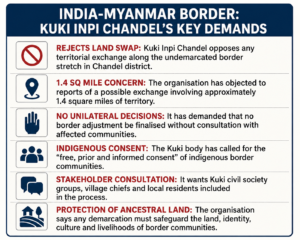
In a press release issued on August 6, the apex Kuki traditional body said it was “dismayed” by reports of bilateral discussions between India and Myanmar aimed at resolving outstanding border demarcation issues, particularly the stretch between Border Pillars 65 and 68 in the Chakpikarong area adjoining Myanmar’s Kabaw Valley.
The organisation said decisions concerning the border could not be treated merely as a technical matter between the two governments because they directly affect communities that have lived in the area for generations.
“The border villages in Chandel, particularly in the Chakpikarong area, constitute the ancestral lands of the Kuki people,” the organisation said, asserting that any demarcation or territorial adjustment without the consent of affected indigenous communities would be unacceptable.
The Kuki Inpi Chandel also criticised what it described as the lack of consultation with local civil society organisations, village chiefs and residents. It said the proposed changes could have consequences for homes, agricultural land, traditional village boundaries and sites of cultural significance.
READ: Kuki Inpi Manipur Spurns Normalcy Bid, Reaffirms UT Demand
Opposition to reported 1.4-square-mile exchange
The organisation specifically rejected reports of a possible exchange involving around 1.4 square miles of territory along an approximately 2.8-km undemarcated stretch of the border.
It argued that the area has been inhabited by Kuki communities for generations and warned that altering the existing territorial arrangement could displace families and split communities living along the frontier.
“Any decision regarding demarcation or territorial exchange without the free, prior and informed consent of the indigenous communities residing there is unacceptable,” the organisation said.
The Kuki body called on the Centre and the Manipur government to stop any unilateral process and establish a transparent consultation mechanism involving Kuki Inpi Chandel, other Kuki civil society organisations, village authorities and other affected stakeholders.
It also urged the Ministry of External Affairs to take into account the historical and cultural ties of border communities while conducting negotiations with Myanmar.
Border talks trigger concern in Manipur
The Kuki Inpi Chandel’s statement comes amid renewed attention to the unresolved portions of the India-Myanmar boundary in Manipur.
The organisation referred to an August 4 Ministry of External Affairs communication concerning efforts by India and Myanmar to address outstanding border demarcation issues. Several stretches of the roughly 1,600-km India-Myanmar border remain unresolved or inadequately demarcated, making the issue particularly sensitive in the Northeast.
Chandel, which shares a long international boundary with Myanmar, is especially significant in this context. The district has also remained affected by Manipur’s wider ethnic tensions and security concerns.
The Kuki organisation said the border issue must be approached with sensitivity to the rights and interests of communities living along the frontier rather than being determined solely through government-to-government negotiations.
“KICdl stands firmly with the people of the border villages,” the statement said, adding that the organisation would not remain silent over decisions concerning their “land, identity and future.”
The appeal was signed by Shokhogin Mate, General Secretary of the Kuki Inpi Chandel, and issued from the organisation’s administrative office at Chahkap village in Chandel district.
The organisation also called on Kuki communities and other concerned citizens to remain united and vigilant as the India-Myanmar discussions proceed.
The opposition adds another layer to the politically sensitive border negotiations, where New Delhi’s efforts to settle the international boundary with Myanmar intersect with competing claims, traditional landholding patterns and the concerns of indigenous communities living along the frontier.