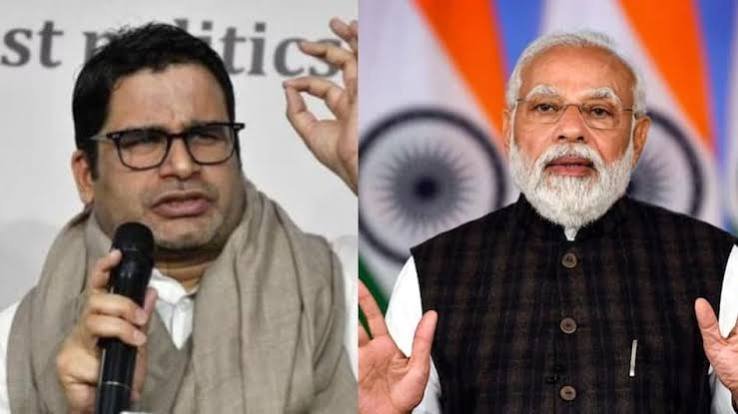
The Bankipur bypoll has emerged as one of Bihar’s biggest political upsets, with the BJP’s vote share crashing by nearly 28 percentage points and Prashant Kishor ending the party’s three-decade dominance in the constituency.
By Navin Upadhyay
PATNA: Every election throws up winners and losers. Some, however, reshape the political landscape. The 2026 Bankipur Assembly bypoll appears to belong to the latter category. More than Prashant Kishor’s impressive electoral debut, it is the extraordinary collapse in the BJP’s vote share and the simultaneous disintegration of the RJD’s support base that make the result one of the most significant political developments in Bihar in recent years.
The numbers are staggering. In the 2025 Assembly elections, BJP national president Nitin Nabin had won Bankipur with 98,299 votes, securing 62.66 percent of the vote and defeating the RJD candidate by more than 51,000 votes. Less than a year later, after Nabin vacated the seat following his election to the Rajya Sabha, the BJP’s vote share crashed to around 34 percent, a decline of nearly 28 percentage points. Prashant Kishor, contesting his first election on a Jan Suraaj Party ticket, secured close to 49 percent of the vote to win comfortably, while the RJD’s vote share also collapsed from nearly 30 percent to around 11 percent.
Electoral swings of this magnitude are rare, particularly in an urban constituency that had been considered one of the BJP’s safest seats for nearly three decades. Since 1995, Bankipur—earlier known as Patna West—had become synonymous with the BJP. It was represented first by Kishore Prasad Sinha and later by his son Nitin Nabin, who transformed it into one of the party’s most reliable urban bastions. Election after election, the BJP consistently secured between 59 and 72 percent of the vote. The bypoll has not merely dented that dominance; it has shattered the perception that Bankipur was politically impregnable.
What makes the result even more remarkable is that the BJP was not defeated by the RJD or the Congress, but by a party that had failed to make any significant electoral impact in the 2025 Assembly elections. Jan Suraaj’s rise from political obscurity to capturing nearly half the votes within a year suggests that the electorate was actively looking for a credible alternative rather than simply voting against the incumbent.
The verdict also exposes the limitations of Bihar’s traditional caste arithmetic. For more than three decades, elections in the state have largely been analysed through the prism of caste coalitions. Political parties have built their strategies around carefully calibrated combinations of Yadavs, Muslims, upper castes, Kurmis, Kushwahas, Dalits and Extremely Backward Classes. The assumption has been that elections are won by assembling the right social coalition rather than by persuading voters across communities.
Bankipur appears to challenge that conventional wisdom.
Prashant Kishor did not possess the demographic advantages that typically underpin electoral success in Bihar. He belongs to the Brahmin community, which constitutes only a small percentage of the constituency’s electorate. He could not have won on the strength of caste consolidation alone. His victory necessarily required support cutting across communities—upper castes, sections of OBCs, Dalits, urban professionals, young voters and, quite possibly, sections of Muslims and traditional RJD supporters.
This is perhaps the most important political message emerging from the bypoll. It suggests that caste remains relevant, but it may no longer be sufficient when voters are presented with a credible alternative capable of winning.
Congratulations, Prashant Kishor ji,
Prashant Kishor wins Bankipur – his first ever electoral contest, on BJP national president Nitin Nabin’s own seat.
After 30 years, BJP loses it.
Post Gen-Z movement, the cracks are showing.A recent survey found 2 in 5 NDA voters unhappy… pic.twitter.com/KehVFblgGx
— YSR (@ysathishreddy) August 3, 2026
Kishor’s campaign consciously avoided conventional identity politics. Instead of appealing to caste loyalties, he repeatedly spoke about education, employment, migration, corruption and governance. He argued that Bihar had spent thirty-five years debating caste while neglecting development. That message appears to have resonated with an electorate increasingly frustrated by unemployment, repeated examination paper leaks, poor infrastructure and the migration of young people in search of opportunities.
Equally significant is what the verdict says about the RJD. The party did not merely lose the election; it virtually disappeared from the contest. Its vote share fell by almost two-thirds, indicating that anti-BJP voters no longer automatically view the RJD as the principal opposition force. A substantial section appears to have concluded that if the objective is to defeat the BJP, Jan Suraaj currently offers a more credible vehicle than the traditional Mahagathbandhan.
This has potentially far-reaching implications for the Congress.
For years, the Congress has played a subordinate role within the RJD-led alliance in Bihar. Yet the Bankipur result may encourage its leadership to reassess that strategy. Historically, the Congress drew support from upper castes, Muslims and Dalits before Mandal politics reshaped Bihar’s electoral landscape. While that coalition has largely fragmented, the social constituencies still exist.
Muslim voters, in particular, have often voted strategically rather than emotionally. Their overriding objective has generally been to support whichever candidate or alliance appears best placed to defeat the BJP. For years, that role was performed by the RJD. However, if Jan Suraaj demonstrates that it can emerge as the principal challenger in more constituencies, many Muslim voters could begin shifting towards a Congress-Jan Suraaj alliance—not because of ideological affinity, but because of electoral pragmatism. The same logic could apply to sections of upper-caste voters dissatisfied with the BJP, non-Yadav OBCs uncomfortable with the RJD, Dalits seeking a new political platform, and young voters whose concerns revolve around jobs rather than caste identities.
READ: Will Samrat Choudhary Survive After BJP’s Bankipur Debacle?
This does not mean caste politics has disappeared from Bihar. Far from it. Social identities continue to shape political behaviour across much of the state. But Bankipur suggests that when voters believe there is a viable third option capable of defeating both established blocs, the rigidity of caste equations begins to weaken. In other words, caste may determine political preferences, but credibility and winnability can increasingly determine voting decisions.
For the BJP, the defeat raises uncomfortable questions. Was the party’s dominance in Bankipur built more around Nitin Nabin’s personal popularity than organisational strength? Has urban anti-incumbency begun to surface? Is the government under Chief Minister Samrat Choudhary facing greater dissatisfaction than previously recognised? The answers will shape the BJP’s strategy ahead of the Assembly elections.
For the RJD, the challenge is even more existential. If Jan Suraaj continues attracting anti-BJP voters, particularly in urban constituencies, the party risks losing its position as the natural pole of opposition politics in Bihar.
For Prashant Kishor, the victory represents more than a personal triumph. It validates his belief that Bihar’s electorate is willing to reward governance-based politics over traditional identity-based mobilisation. His real challenge now lies in proving that Bankipur was not an isolated success but the beginning of a broader political transformation.
The Bankipur bypoll may ultimately be remembered less for the BJP’s 28-point collapse than for what that collapse signifies. It has demonstrated that even the safest political fortress can fall when voters believe they have a credible alternative. More importantly, it has reopened a question that many believed Bihar had settled long ago: Can governance finally compete with caste as the principal determinant of electoral politics? The answer may not come from one bypoll alone, but Bankipur has ensured that the question can no longer be ignored.