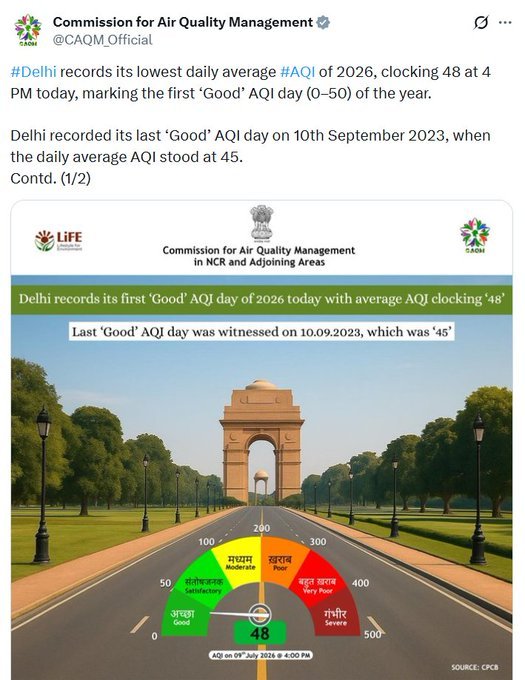
After nearly three years of hazardous air, Delhi recorded its first “Good” Air Quality Index (AQI) as relentless monsoon showers washed pollutants from the atmosphere, giving millions of residents a rare breath of fresh air.
BY PC Burfeau
New Delhi, July 10: For a city that has become synonymous with hazardous smog and toxic winters, Thursday offered an almost unbelievable sight—clear skies, fresh air, and an Air Quality Index (AQI) officially rated as “Good” for the first time in nearly three years.
After years of battling some of the world’s worst air pollution, residents woke up to a rare 48-hour window of clean air as relentless monsoon showers transformed Delhi’s atmosphere. The Central Pollution Control Board (CPCB) recorded the city’s AQI at 48, improving from 59 the previous day and pushing it into the coveted “Good” category—the cleanest rating on India’s AQI scale.
The achievement, though largely driven by nature, has rekindled hopes that cleaner air is possible in the national capital, even if only temporarily.
A Rare Milestone
Crossing below the AQI mark of 50 is more significant than it may appear. Under the CPCB’s air quality classification, an AQI between 0 and 50 is considered “Good,” posing little or no health risk even to sensitive groups.
According to official records, this is the first time since September 10, 2023, that Delhi has enjoyed “Good” air quality. The previous instance came after widespread rainfall coincided with stringent restrictions imposed during the G20 Summit, when traffic was curtailed and several pollution-generating activities were temporarily suspended.
The latest improvement, however, has been brought about almost entirely by the monsoon.
Commission for Air Quality Management (@CAQM_Official) posts: “#Delhi records its lowest daily average #AQI of 2026, clocking 48 at 4 PM today, marking the first ‘Good’ AQI day (0–50) of the year. Delhi recorded its last ‘Good’ AQI day on 10th September 2023, when the daily… pic.twitter.com/5RM89Tza3L
— Press Trust of India (@PTI_News) July 9, 2026
How the Monsoon Cleans Delhi’s Air
Meteorologists describe the process as “wet deposition.” As rain falls, water droplets capture suspended pollutants—including fine particulate matter (PM2.5 and PM10), dust, soot, and other airborne contaminants—and carry them to the ground.
Heavy showers also suppress dust rising from roads, construction sites, and open land while strong monsoon winds disperse the pollutants that remain in the atmosphere.
The combined effect can dramatically improve air quality within hours, explaining how Delhi’s AQI dropped into the “Good” category after continuous rainfall.
An Exception Rather Than the Rule
Despite Thursday’s remarkable improvement, experts caution that truly clean-air days remain exceptionally rare in Delhi.
Since India’s AQI monitoring system was introduced in 2015, the capital has recorded only around 15 days with air quality classified as “Good”—an average of little more than one such day each year. Some years passed without a single day meeting that benchmark.
Most of these rare clean-air episodes have followed heavy monsoon rainfall or extraordinary reductions in emissions, such as those witnessed during the nationwide COVID-19 lockdown in 2020.
The latest episode therefore highlights both the city’s environmental vulnerability and the atmosphere’s remarkable ability to recover when pollution sources are temporarily suppressed.
READ: World at a Crossroads: How Wars and Shifting Alliances Are Reshaping Global Politics
Weather Makes All the Difference
Delhi’s air pollution is shaped not only by emissions but also by seasonal weather patterns.
During winter, cold temperatures, calm winds, and atmospheric inversion trap pollutants close to the ground, creating the dense smog that has become synonymous with the capital.
The monsoon brings exactly the opposite conditions. Frequent rainfall washes pollutants from the air, humidity prevents dust from becoming airborne, and stronger winds disperse emissions over a much wider area.
As a result, Delhi’s air quality can improve dramatically within a day or two, only to deteriorate again once dry conditions return.
Clean Air Wasn’t Uniform Across the City
Although the city’s overall AQI entered the “Good” category, pollution levels still varied considerably across different neighbourhoods.
The Dr Karni Singh Shooting Range recorded one of the cleanest readings with an AQI of 23, while Jahangirpuri remained in the Moderate category with an AQI of 102, illustrating how local traffic, industrial activity, and construction can continue to affect air quality even during favourable weather.
Experts Warn Against Complacency
Environmental experts stress that the dramatic improvement should not be mistaken for a permanent solution.
Anumita Roychowdhury, Executive Director at the Centre for Science and Environment (CSE), says the monsoon’s cleansing effect is undeniable but temporary. Lasting improvements, she argues, will require sustained efforts to reduce emissions from vehicles, industries, construction activities, waste burning, thermal power plants, and other major pollution sources.
Former CPCB scientist Dipankar Saha echoes the same view, noting that the monsoon naturally delivers the cleanest air of the year, but once the rains recede, pollution levels are likely to climb again unless structural measures are implemented.
A Glimpse of What Could Be
For millions of Delhi residents, Thursday was more than just another rainy day. It was a reminder of what the city can feel like when the skies are clear, visibility stretches for kilometres, and stepping outdoors no longer means inhaling hazardous air.
The brief spell of clean air demonstrated that Delhi’s atmosphere can recover surprisingly quickly when pollutants are removed. The challenge for policymakers now is to ensure that clean air becomes the norm rather than a fleeting gift delivered by the monsoon.
As the rains eventually fade, the real test will begin: whether sustained environmental policies can preserve the fresh air that nature has temporarily restored.