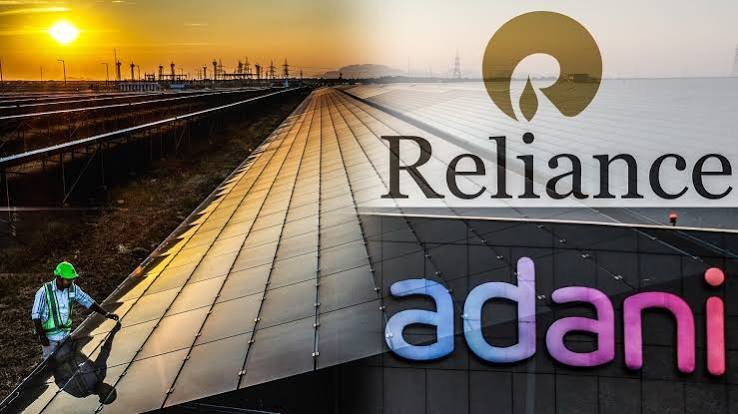
The appointments are largely documented, but do they prove a quid pro quo? The Adani-Reliance controversy puts post-retirement corporate roles under scrutiny.
BY Navin Upadhyay
NEW DELHI/ September 9 : Two separate posts on X highlighting former bureaucrats, regulators, diplomats and public-sector chiefs who later moved into the boardrooms of Adani Group and Reliance Industries have reignited a contentious debate over India’s corporate governance, regulatory integrity and the so-called “revolving door” between public office and private corporate power.
The posts have drawn attention to a long list of senior officials who, after holding influential positions in government, regulators and state-owned enterprises, went on to serve as directors, advisers or executives across companies linked to the two corporate groups.
One of the posts, focused largely on the Adani Group, describes the appointments in stark terms, calling them an “institutional design of corruption” and a “reward system”. A separate post highlighting appointments involving Reliance has similarly questioned the movement of senior public officials into corporate positions.
A review of company filings and contemporaneous news reports indicates that many of the appointments cited in the two posts are part of the public record. However, the appointments themselves do not establish that any official favoured a company while in government, breached applicable rules or received a corporate position in return for a policy decision.
The distinction is crucial: a documented move from government to a corporate board is a fact; proving that the appointment was a reward for an official favour requires separate evidence.
READ: AI Could Wipe Out Humanity Earlier Than We Think, Warns Researcher
Former officials across Adani’s corporate empire
The Adani compilation lists more than 20 former bureaucrats, diplomats, regulators, tax officials and PSU chiefs associated at various times with Adani Enterprises, Adani Ports & SEZ (APSEZ), Adani Power, Adani Energy Solutions, Adani Total Gas and NDTV.
Among the most prominent names is Upendra Kumar Sinha, who served as chairman of the Securities and Exchange Board of India (SEBI) from 2011 to 2017. He became Non-Executive Independent Chairman of NDTV in March 2023, following the Adani Group’s acquisition of the broadcaster.
Raminder Singh Gujral, a former Union Finance Secretary, Revenue Secretary and chairman of the National Highways Authority of India (NHAI), served as an independent director of Adani Power from 2015 to 2022 and is currently associated with Adani Green Energy.
Dinesh Kumar Mittal, former Secretary in the Department of Financial Services and a former WTO chief negotiator, was appointed Non-Executive Independent Director of NDTV in June 2023.
Narendra Mairpady, former CMD of Indian Overseas Bank and Executive Director of Bank of India, served as an independent director of Adani Enterprises until November 2023.
रिटायरमेंट के अगले दिन अडानी बोर्ड में बैठ जाना – ये संयोग नहीं, भ्रष्टाचार की संस्थागत डिजाइन है। पावर, पोर्ट, होम, फाइनेंस और SEBI जैसी संवेदनशील कुर्सियाँ संभालने वाले नौकरशाह आज “इंडिपेंडेंट डायरेक्टर” बन मोटी फीस बटोर रहे हैं। क्या सरकारी कुर्सी पर बैठकर अडानी को दी गईं… https://t.co/2wCHucmE3P pic.twitter.com/KsjCC2ARph
— Ajay Kumar Khemka (@AjayKumarKhemka) September 9, 2026
Energy, ports and infrastructure
The compilation also highlights several former officials who held influential positions in India’s energy and infrastructure sectors.
P.K. Pujari, former Union Power Secretary and later chairman of the Central Electricity Regulatory Commission (CERC), joined the Adani Ports board as an independent director in August 2024.
Niraj Bansal, a former Commissioner of Income Tax and former chairman of Jawaharlal Nehru Port Trust (JNPT), took voluntary retirement in 2021, joined Adani in 2022 and subsequently became CEO–Ports at APSEZ.
V. Subramanian, former Secretary in the Ministry of New and Renewable Energy, was appointed an independent director of Adani Enterprises in 2016 and remained on the board until August 2026.
Rajkumar Beniwal, Vice-Chairman and CEO of the Gujarat Maritime Board, served as the GMB nominee director on the Adani Ports board from 2023 until January 2026.
Deepak Amitabh, former CMD of PTC India, joined Adani Power as CEO–Energy Sales in 2021 before moving into an adviser role in business development in 2023.
ICP Keshri, a former Madhya Pradesh-cadre IAS officer, has also been associated with the group as an adviser on infrastructure and energy.
Former Home, diplomatic and state officials
The list extends beyond economic and infrastructure ministries.
G.K. Pillai, former Union Home Secretary, served as an independent director of Adani Ports. His tenure ended on August 8, 2024, after completion of his term.
Meera Shankar, former Indian Ambassador to the United States and Germany, served as an independent director of Adani Energy Solutions from June 2015 until June 30, 2025, when her tenure ended on completion of term.
Vijaylaxmi Joshi, a 1980-batch Gujarat-cadre IAS officer and former Secretary of the Ministry of Panchayati Raj, joined the Adani Enterprises board as an independent director in December 2016.
Chandra Iyengar, former Additional Chief Secretary (Home) of Maharashtra and former chairperson of the Maharashtra Electricity Regulatory Commission, has held independent directorships across Adani Total Gas, Adani Power and Adani Energy Solutions.
K. Jairaj, a former senior Karnataka administrator associated with energy and urban infrastructure, served on the Adani Energy Solutions board from 2015 until June 2025.
Sunil Kumar, former Chief Secretary of Chhattisgarh, served as an Additional Non-Executive Independent Director of NDTV between December 2022 and March 2023.
Aman Kumar Singh, formerly Principal Secretary to the Chhattisgarh Chief Minister, joined the NDTV board in December 2022 and resigned in April 2023 amid an Economic Offences Wing inquiry.
The list also includes M.V. Bhanumathi, a former Director General of Income Tax (Investigation), Mumbai. She retired in May 2022 and was appointed an Additional Director, Non-Executive Independent, of Adani Ports on February 28, 2024.
Shashi Shanker, former chairman and managing director of ONGC, was appointed an independent director of Adani Total Gas in May 2022.
Sushil Kumar Roongta, former chairman of Steel Authority of India Limited (SAIL), served as an independent director of Adani Power until November 2025.
Dr Amiya Chandra, a former Commerce Ministry and PMO official who also served as Additional Director General at the Directorate General of Foreign Trade, was briefly an independent director of Adani Energy Solutions in 2025.
The Reliance connection
THE POST-RETIREMENT REVOLVING DOOR: PUBLIC OFFICE → PRIVATE POWER
A striking pattern deserves public scrutiny: several senior officials from India’s public institutions have moved into Reliance-linked positions after retirement.
The documented examples include Arundhati… pic.twitter.com/lPLcGHWMIc
— Ashok Dadhwal (@ashokdadhwal196) September 8, 2026
The second viral post focuses on former senior officials who subsequently took up positions with Reliance Industries and its group companies.
Arundhati Bhattacharya, who retired as SBI chairperson in 2017, joined the Reliance Industries board as an independent director in October 2018.
Sanjiv Singh, who retired as chairman of Indian Oil Corporation on June 30, 2020, joined Reliance as Group President roughly two months later. The short interval attracted questions at the time over cooling-off provisions applicable to PSU chiefs moving to private companies.
Rajiv Mehrishi, former Comptroller and Auditor General, was appointed an independent director of Jio Financial Services in July 2023.
M.K. Jain, who retired as RBI Deputy Governor in June 2023, was reported in 2025 to have joined Reliance as an adviser on financial-services strategy.
K.V. Chowdary, former CBDT chairman and Central Vigilance Commissioner until June 2019, subsequently served on the Reliance Industries board as an independent director.
As with the Adani-related appointments, the timing of the moves varies considerably. Some occurred years after retirement or departure from public office, while others took place within a relatively short period.
What the law says about the cooling-off period
The disclosures have revived the long-standing debate over post-retirement employment rules for senior government officials.
Under applicable service and pension rules, senior civil servants are generally required to observe a one-year cooling-off period before accepting commercial employment, unless they obtain the required government sanction or waiver.
Additional restrictions apply to certain public-sector executives, particularly where the prospective employer has had business dealings with the organisation from which the official retired.
The Central Vigilance Commission has described taking private employment without observing applicable cooling-off requirements as serious misconduct. Governments have, however, granted exemptions or permissions in individual cases.
Independent directorships after retirement are not inherently illegal. Listed companies are required to maintain prescribed numbers of independent directors, and retired civil servants, regulators and public-sector executives can offer expertise in governance, regulation and administration.
But critics argue that legality is only one part of the issue.
The larger concern is whether a former official joining a company operating in a sector he or she previously regulated or oversaw could create a conflict of interest, the appearance of influence-peddling or a perception of regulatory capture.
How widespread is the revolving door?
The phenomenon is not confined to Adani or Reliance.
A 2021 analysis found that at least 225 retired central government officials had joined the boards of private listed companies since 2009, including 155 IAS officers.
That suggests the movement of senior officials into corporate boardrooms is part of a much broader trend in India’s business and administrative ecosystem.
Corporations often argue that former bureaucrats and regulators bring valuable institutional knowledge, policy understanding and regulatory expertise. Critics counter that precisely this expertise can make them particularly valuable to companies that operate in highly regulated sectors.
The question becomes more sensitive when the company has substantial dealings with the government or operates in areas such as power, ports, energy, infrastructure, finance, taxation or media.
What the X posts prove — and what they do not
The two posts have highlighted a genuine feature of Indian corporate life: former senior public officials do move into powerful private-sector boardrooms.
The underlying appointments cited in the posts can, in many cases, be verified through corporate filings and public records.
But the leap from those appointments to an allegation of corruption is much larger.
A board appointment, by itself, cannot establish that an official took a particular decision in government in anticipation of a corporate position or that a company subsequently rewarded that official for favourable treatment.
The timing of appointments also needs to be examined individually.
Vijaylaxmi Joshi joined Adani Enterprises in 2016, years after her secretary-level government roles. Bhanumathi joined Adani Ports in February 2024, around 21 months after retiring in May 2022. Pillai’s association with Adani Ports began years after he left the Home Ministry in 2011 and ended in 2024. Meera Shankar’s tenure at Adani Energy Solutions ran from 2015 to mid-2025.
Other cases, particularly Sanjiv Singh’s move to Reliance roughly two months after leaving IOC, raise more immediate questions about the adequacy and enforcement of cooling-off safeguards.
But even a short gap does not by itself establish wrongdoing.
To determine whether any appointment involved a conflict of interest or quid pro quo, the relevant government decisions, corporate interests, timing of the appointment, permissions granted and disclosures would all need to be examined.
The bigger governance question
The debate is therefore not simply about whether former bureaucrats should be allowed to join corporate boards.
It is about whether India’s existing safeguards are strong enough to prevent conflicts of interest — and whether they are sufficient to maintain public confidence in the neutrality of regulators and senior administrators.
The revolving door can have legitimate reasons. A retired regulator may bring valuable knowledge to a corporate board; a former secretary may possess expertise that a company needs; and an independent director can provide oversight rather than management.
But the same expertise can create an uncomfortable perception when the official moves quickly from regulating an industry to serving a company within it.
That perception matters.
Public institutions depend not only on decisions being lawful but also on citizens believing that those decisions were taken without the expectation of private reward.
The Adani and Reliance lists have therefore opened a debate that extends beyond either corporate group.
The real question is whether India needs stronger cooling-off rules, greater disclosure of post-retirement appointments and tighter scrutiny of potential conflicts of interest involving senior public officials.
The viral posts may be political compilations, and their broader allegations require evidence. But the underlying issue they have put back into the spotlight is real: when the revolving door between government and corporate India turns too quickly, even legitimate appointments can raise questions about who served whom — the public, or the private sector.