The Gampum operation has exposed competing claims over what constitutes an authorised camp under the SoO pact, reviving questions over the status of NSCN (I-M) camps in Manipur.
BY Navin Upadhyay
September 9: The raid on a suspected Kuki Liberation Army (KLA) camp in Kangpokpi has reopened an old and politically sensitive question in Manipur: why are security forces moving decisively against one armed camp while camps associated with the NSCN-IM have continued to exist in the state despite the Union government’s long-standing position that its ceasefire arrangement with the Naga outfit does not extend to Manipur?
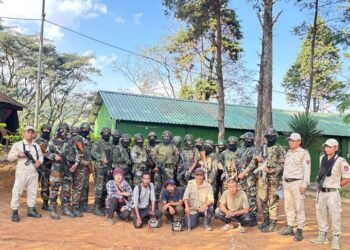
The question has acquired fresh urgency following the September 7 operation at Gampum village under Saikul police station, where a joint team of Manipur Police, CRPF CoBRA, Rapid Action Force and Mahila personnel raided what authorities described as an unauthorised KLA camp. Eight suspected cadres were apprehended and seven automatic weapons recovered, according to Manipur Police. The camp was subsequently locked and sealed.
The operation, however, has been challenged by Kuki civil society organisations, which dispute the official characterisation of the camp as “unauthorised”.
Kuki Inpi Manipur (KIM) said the eight men belonged to the Kuki Liberation Organisation/Kuki Liberation Army, a signatory to the 2008 Suspension of Operations (SoO) agreement with the Centre and the Manipur government. KIM has claimed that the camp and the weapons were covered by the SoO framework and demanded an independent inquiry, the release of the eight men and the return of the seized weapons.
Local Kuki bodies, including Kuki Inpi Saikul Gamkai, have similarly maintained that Gampum was a designated SoO camp and questioned whether any alleged violation of the agreement was first brought before the Joint Monitoring Group.
There is, therefore, a crucial distinction at the heart of the controversy: the government calls the site an unauthorised camp; Kuki groups say it was a recognised SoO camp. Publicly available official statements have so far not provided a detailed explanation of the camp’s status under the monitoring mechanism.
READ: Manipur: Kuki Body Warns Against ‘Blockade’, Threatens Counter-Action
READ: Adani, Reliance: Where Retired Babus Find a Corporate Haven
The NSCN-IM question
The Gampum operation has inevitably revived comparisons with the presence of NSCN-IM camps in Naga-inhabited areas of Manipur.
This is not a new controversy. In May 2020, the then Manipur Chief Secretary J. Suresh Babu wrote to the Union Home Ministry seeking the removal of what the state described as “unauthorised” NSCN-IM camps from Manipur. The letter specifically argued that the Indo-Naga ceasefire did not extend to Manipur and asked the Centre to direct security forces to curb NSCN-IM activity and shift the camps to Nagaland.
The state’s complaint followed reports of civil society groups visiting NSCN-IM camps and distributing relief materials to cadres at sites including the Huthrong Brigade Camp in Senapati and the Ashiho Chaomai Battalion in Chandel.
The NSCN-IM rejected the Manipur government’s interpretation. The outfit has consistently maintained that the Indo-Naga ceasefire and the political dialogue cover “all Naga territories”, rather than being restricted to Nagaland.
That competing interpretation is at the core of the dispute.
The Union government’s position has historically been that the ceasefire was not an acceptance of the NSCN-IM’s territorial claims beyond Nagaland. A 2001 communication from former interlocutor K. Padmanabhaiah explicitly said the government had not agreed to extend the ceasefire to “all Naga areas” and that the arrangement should not be interpreted as recognition of a claim to Greater Nagaland.
🇮🇳⚡️ Indian security forces reportedly conducted an operation against the Kuki Liberation Army (KLA) in Gampum, Kangpokpi District, Manipur, resulting in the seizure of a suspected KLA camp.
Eight suspected KLA members were reportedly detained, and seven automatic weapons were… pic.twitter.com/ZEXfiwJkp5
— Mr. Guardian (@MrGGuardian) September 9, 2026
Camps that became a political flashpoint
Over the years, reports have identified NSCN-IM facilities in several Naga-inhabited districts of Manipur, including Ukhrul, Senapati, Tamenglong and Chandel.
The issue became particularly contentious after the 2001 extension of the Naga ceasefire without territorial limits triggered massive protests in Manipur. The protests, popularly remembered as the Great June Uprising, left 18 people dead and became a defining moment in the state’s opposition to any expansion of the ceasefire into Manipur.
For many in Manipur, therefore, the territorial scope of the Naga ceasefire is not merely a technical issue. It is tied directly to the state’s territorial integrity and to a long-standing fear that an arrangement negotiated with an armed group could acquire implications beyond the state in which the ceasefire was originally understood to operate.
That history explains why the existence of NSCN-IM camps in Manipur has remained politically sensitive even when the security forces have not acted against every reported location.
The uncomfortable comparison
The Gampum raid raises a straightforward question: what constitutes an authorised or unauthorised armed camp in Manipur, and is the same standard being applied to every insurgent group?
The answer is complicated by the different agreements governing the groups.
The KLA is part of the Kuki-Zomi militant groups covered by the SoO arrangement involving the Centre, the Manipur government and the signatory groups. The NSCN-IM, meanwhile, is engaged in a separate, long-running political dialogue with New Delhi under the Indo-Naga peace process.
But different agreements need not mean different standards of territorial enforcement.
If a camp is operating in Manipur, the government should be able to clearly establish its legal or negotiated status, the conditions under which it is permitted to function, who monitors it, what weapons its cadres may possess and what action follows an alleged violation.
That transparency is particularly important in a state where competing communities already accuse security forces of selective enforcement.
The Gampum operation itself establishes that security forces are prepared to act against camps they regard as unauthorised. What remains unclear is whether the same principle is being applied consistently across the state’s competing armed groups.
That is the larger issue exposed by the raid.
The controversy is therefore not simply about eight detained KLA cadres or seven recovered weapons. It is about whether Manipur has one transparent and uniformly enforced framework for armed camps—or different rules for different insurgent organisations.
Until the Centre and the state publicly clarify the status of such camps, the authority of ceasefire and SoO monitoring mechanisms, and the consequences of alleged violations, every operation against one group is likely to invite the same question:
Why here—and why not there
LIST of NSCN (IM) Camps in Manipur
The Government of Manipur has repeatedly maintained that the Indo-Naga ceasefire with the NSCN (IM) does not extend to Manipur and has, at various points, described NSCN (IM) camps in the state as unauthorised. In May 2020, then Chief Secretary J. Suresh Babu formally asked the Union Home Ministry to have such camps removed from Manipur and relocated to Nagaland.
However, the status of individual camps has changed over time. Some were described as designated camps, some as unauthorised camps, while others were subsequently vacated. Therefore, the following should not be described as a list of nine camps currently operating in Manipur. It is a list of camps or camp locations that have been reported, documented or cited in connection with NSCN (IM) activity in the state.
1. Khangkhui-Shirui, Ukhrul
The Khangkhui-Shirui forest area has a particularly significant history. In a February 6, 2007 letter, then Chairman of the Ceasefire Monitoring Group Lt Gen (retd) R.V. Kulkarni referred to the approval of the area as an NSCN (IM) designated camp. NSCN (IM) subsequently stated that the camp was vacated in 2009.
Status: Historical designated camp; should not be presented as currently operating without fresh evidence.
2. Huthrong Brigade Camp, near Oklong, Senapati
Huthrong Brigade Camp was specifically identified in the Manipur government’s May 2020 communication to the MHA. The government objected to the presence of the camp and cited reports of civil society organisations distributing relief material to NSCN (IM) cadres there on May 8, 2020.
Status: Documented NSCN (IM) camp in government correspondence in 2020; current status requires fresh verification.
3. Ashiho Chaomai Battalion Camp, Chandel
The Ashiho Chaomai Battalion was another camp specifically cited by the Manipur government in its 2020 letter to the MHA. The letter referred to relief distribution at the site on May 13, 2020 and described the camps as unauthorised.
Status: Documented camp in 2020; current status requires fresh verification.
4. NP Battalion Camp, Piulong (Buning), Tamenglong
The NP Battalion camp at Piulong (Buning), near Tamei, has been reported in earlier accounts of NSCN (IM) camps in Manipur. A 2012 report described it as an NSCN (IM) designated camp and reported security-force activity around the site.
Status: Historically documented; current status requires verification.
5. AC Battalion Camp, Chandel
The AC Battalion camp in Chandel also appears in earlier reporting on NSCN (IM) camps in Manipur. A 2012 account reported heightened security-force activity around the camp.
Status: Historically documented; current status requires verification.
6. Kishumung Battalion Camp, Ukhrul
The Kishumung Battalion camp in Ukhrul appears in earlier reporting on NSCN (IM) positions in Manipur. A 2012 report identified it among the camps around which security forces had increased activity.
Status: Historically documented; current status requires verification.
7. Chatric Camp, Kamjong
Chatric was reported as an NSCN (IM) camp in earlier years. According to an NSCN (IM) account published in 2019, an understanding had been reached with the Assam Rifles concerning the camp and it was subsequently vacated.
Status: Historical camp; reported vacated.
8. Grihang Camp, Ukhrul
Grihang was also cited in NSCN (IM) accounts as an earlier camp in Ukhrul. The group said an understanding had been reached with the Assam Rifles in 2010 concerning camps at Chatric and Grihang.
Status: Historical camp; reported vacated.
9. Sihai Khunou/Khamasom, Ukhrul
This case is particularly well documented because it resulted in a direct standoff with the Assam Rifles in April 2019.
Security forces said aerial reconnaissance had detected temporary structures in the Sihai Khunou/Khamasom area and subsequently described the location as an unauthorised NSCN (IM) camp in violation of ceasefire ground rules.
The NSCN (IM) disputed the interpretation of the ceasefire rules and defended its presence. Following intervention through the Ceasefire Monitoring Group, the cadres vacated the site during the night of April 30-May 1, 2019.
Status: Temporary/unauthorised camp in 2019; vacated.