With retaliatory violence, alleged arson attacks, and competing narratives deepening mistrust, pressure is mounting on the Central and Manipur governments to ensure accountability, reopen highways, and prevent further escalation in one of India’s most fragile conflict zones.
BY PC Bureau
July 2026 — Six weeks after the United Naga Council (UNC) and affiliated Naga organisations imposed an indefinite economic blockade along National Highway-2 (NH-2) and other key roads, Manipur’s already fragile security situation has evolved into a complex three-cornered ethnic confrontation involving Naga, Kuki-Zo, and Meitei communities.
The Manipur government has come under increasing criticism for failing to break the prolonged impasse, even as thousands of people face a deepening humanitarian crisis. Residents in the affected areas are struggling to access essential commodities, with severe shortages of food, medicines, fuel, and other daily necessities placing growing hardship on vulnerable communities.
What began as a protest demanding justice for the abduction Naga civilians has now developed into a prolonged humanitarian and political crisis. The blockade has severely disrupted the movement of essential commodities into Kuki-Zo-majority areas, particularly Kangpokpi district, resulting in acute shortages of food, medicines, fuel, and other daily necessities. At the same time, both Naga and Kuki-Zo organisations have accused the Manipur government and security forces of failing to address their grievances impartially.
The continuing blockade has underscored the widening ethnic fault lines in Manipur, where violence that initially centred on the Meitei-Kuki conflict has increasingly drawn Naga groups into the state’s volatile security landscape.
Trigger: Abduction and Killing of Six Naga Civilians
The present Naga-Kuki-Zo confrontation traces its origins to a series of violent incidents that unfolded in the last four months , transforming long-standing tensions into an open conflict.
The crisis escalated on May 13, 2026, when three Kuki-Zo tribal church leaders were abducted and killed by suspected Naga militants. The killings sparked outrage across Kuki-Zo communities and triggered retaliatory actions in several parts of Manipur’s hill districts.
In the hours that followed, members of both the Naga and Kuki-Zo communities allegedly abducted civilians from each other’s areas, resulting in a tense hostage standoff. Through negotiations and community interventions, most of the captives were eventually released.
🆘️I naively assumed that the massive deployment of LAW ENFORCEMENT AGENCIES, including 3 senior MPS officers & central forces “on special duty” at Namdilong were tasked with dismantling the economic blockade.
Boy, was I mistaken, from the looks of it, they were “specially… https://t.co/MSIlkRhgFy pic.twitter.com/08rK8N0Rjh— J Shakur (@JShakurB) July 2, 2026
However, six Liangmai Naga civilians, who had been abducted from Leilon Vaiphei village in Kangpokpi district, remained missing. Weeks later, around June 10, their mutilated bodies were recovered from areas under Kuki-Zo control, sending shockwaves across Naga-inhabited regions.
The discovery of the bodies triggered widespread protests among Naga organisations. The United Naga Council (UNC) decided to continue with the indefinite economic blockade along National Highway-2 and other key roads, demanding justice for the six slain civilians and action against those responsible.
Since then, relations between the two communities have deteriorated sharply. Kuki-Zo organisations allege that suspected Naga militants have carried out repeated retaliatory attacks on Kuki villages, including the burning of dozens of homes in several villages and the targeted killing of Kuki civilians in Noney, Kamjong and adjoining hill districts.
Naga organisations, meanwhile, maintain that their blockade is a peaceful democratic protest aimed at securing justice for the six murdered civilians and have denied targeting innocent civilians. They have also accused the government of failing to hold those responsible for the killings accountable and of adopting a selective approach in responding to ethnic violence.
The competing narratives have further deepened mistrust between the two communities, with each side accusing the other of initiating the cycle of violence while demanding stronger action from the government.
READ: Suspected NSCN-IM Militants Torch Kuki Village in Fresh Violence
Kuki-Zo Areas Face Mounting Humanitarian Pressure
The blockade has had its greatest impact on Kangpokpi district, where the majority of residents belong to the Kuki-Zo community.
With supply vehicles unable to move freely through Naga-controlled areas, prices of essential commodities have risen sharply. Local residents report increasing difficulty in accessing food, cooking gas, fuel, medicines, and other basic necessities.
Community leaders say the prolonged disruption has pushed many families into hardship.
Janghaolun Haokip, Information and Publicity Secretary of Kuki Inpi Manipur (KIM) described the worsening situation:
“We have nothing to feed our people. A bag of rice which usually costs ₹1,500 is costing us ₹3,500 now.”
As shortages worsened, public demonstrations intensified.
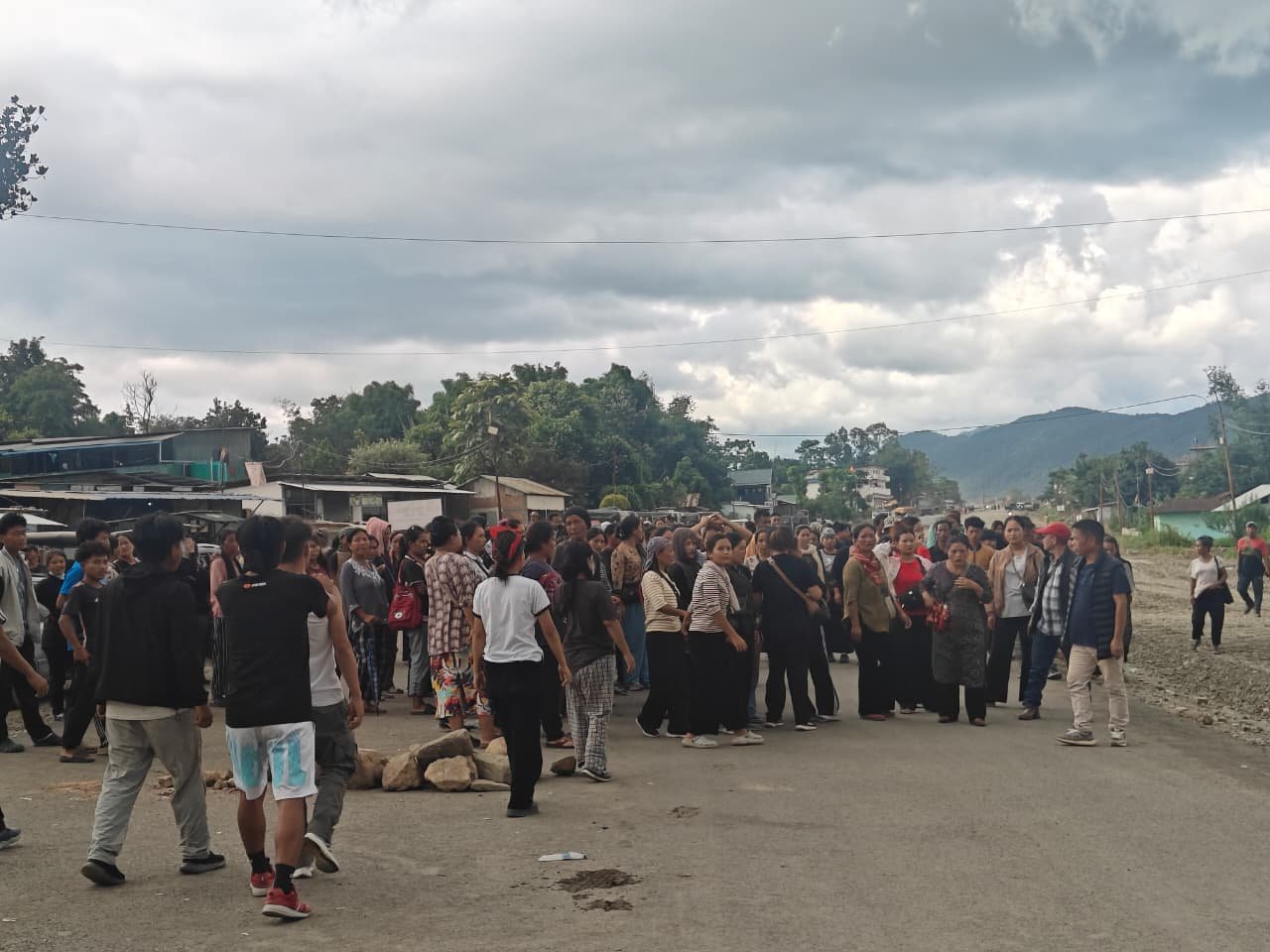
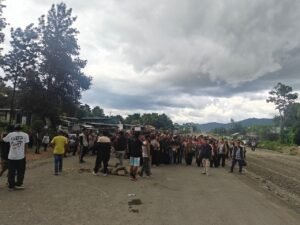
On July 2, hundreds of Kuki-Zo protesters under the banner of the Committee on Tribal Unity (CoTU) marched toward the buffer zone at Gamgiphai, demanding the immediate restoration of supplies along NH-2.
Security personnel stopped the procession before it reached the buffer zone and dispersed demonstrators using tear gas after tensions escalated.
CoTU described the prolonged blockade as a “chokehold” on Kuki-Zo-majority Kangpokpi district, alleging that unauthorized checkpoints and gates set up by Naga groups have effectively cut off the movement of essential supplies, including food, medicines, medical equipment, and other basic necessities.
Following the expiry of its ultimatum to the authorities, CoTU warned that it would not be held responsible for any consequences if Kuki-Zo volunteers were compelled to take what it described as “pre-emptive measures” to reopen the vital supply routes themselves. The organisation urged the government to restore free movement along National Highway-2 to prevent further escalation of tensions.
Blockades Become a Continuing Instrument of Conflict
Highway blockades have become one of the defining features of Manipur’s prolonged ethnic conflict.
Since violence first erupted in May 2023, different communities have repeatedly used road blockades to press political demands and exert pressure on rival groups and governments.
Kuki organisations themselves previously enforced blockades affecting major highways during the Meitei-Kuki conflict, although some restrictions were later eased following assurances from the government regarding essential supplies.
The current Naga blockade, however, has effectively isolated large Kuki-Zo population centres, transforming what was largely a Meitei-Kuki conflict into a broader three-way ethnic confrontation involving Naga organisations as well.
The prolonged disruption has exposed the state’s dependence on a limited number of highway corridors and demonstrated how control over transport routes has become a strategic tool in Manipur’s conflict.
Government Under Pressure from All Sides
Both Naga and Kuki-Zo organisations accuse the Manipur government and security agencies of failing to manage the crisis effectively.
Naga groups argue that authorities have focused primarily on escorting supply convoys instead of ensuring justice for the murdered civilians and addressing the underlying grievances behind the blockade.
Kuki-Zo organisations, meanwhile, contend that the government has failed to guarantee free movement on national highways or protect civilians from the humanitarian consequences of the blockade.
Adding to the uncertainty, fresh reports of arson attacks and renewed violence in villages near the India-Myanmar border, particularly in Kamjong district, have heightened fears that instability could spread further across the hill districts.
A Conflict Growing More Complex
Manipur has remained deeply divided since ethnic violence erupted in May 2023, initially involving clashes between Meitei and Kuki-Zo communities over issues including land rights, political representation, and demands for Scheduled Tribe status.
The latest confrontation between Naga and Kuki-Zo groups has added another layer to an already complicated conflict.
Although there have been occasional instances of cooperation between sections of Meitei and Naga civil society on broader political issues, longstanding historical grievances—including memories of the violent Naga-Kuki clashes of the 1990s—continue to shape present-day relations.
With the blockade nearing its third month, shortages continuing to worsen, and fresh incidents of violence being reported, pressure is mounting on both the Central and Manipur governments to intervene more decisively.
Civil society organisations across communities are increasingly calling for impartial investigations into all killings, secure humanitarian corridors for essential supplies, stronger protection for civilians, and meaningful dialogue involving all stakeholders.
Without sustained efforts to restore trust, reopen transport routes, and address competing grievances, observers warn that the cycle of retaliatory violence, economic blockades, and humanitarian suffering could further deepen divisions in one of India’s most fragile conflict zones.