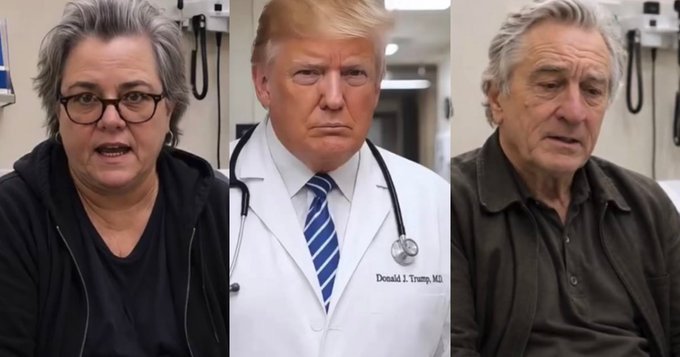
Styled as a parody pharmaceutical commercial, the AI-generated video features fictional versions of several Hollywood celebrities who have criticized Trump, portraying them as former “patients” cured of TDS.
BY PC Bureau
July 2026 — U.S. President Donald Trump has shared an AI-generated satirical video portraying himself as “Dr. Trump,” a fictional physician offering a humorous “treatment” for what he and his supporters refer to as “Trump Derangement Syndrome” (TDS).
The video was first posted on Trump’s social media platform, Truth Social, before gaining wider attention after it was shared on X by White House Deputy Chief of Staff Dan Scavino Jr.
AI Satire Styled as a Television Commercial
Produced in the style of a parody pharmaceutical advertisement, the AI-generated video opens with Trump dressed in a white doctor’s coat and stethoscope as he addresses viewers from a mock medical office.
In the opening scene, the AI-generated Trump asks:
“Have you or someone you know been diagnosed with TDS? The symptoms can be relentless. Fortunately, I’m Dr. Trump, and I have a treatment plan. Let’s hear what some of my patients have to say.”
The video then cuts to AI-generated portrayals of several well-known actors, comedians and television personalities who have publicly criticized Trump over the years. Among those depicted are:
- Rosie O’Donnell
- John Leguizamo
- Whoopi Goldberg
- Robert De Niro
- Julia Roberts
- Edward Norton
In the fictional skit, the AI-generated characters appear as former “patients” who jokingly claim their lives improved after receiving treatment for “Trump Derangement Syndrome,” playing on the long-running political phrase popular among Trump’s supporters.
READ: Papua Conflict Escalates as Separatist Rebels Kill US Pilot, Burn Aircraft
What Is ‘Trump Derangement Syndrome’?
“Trump Derangement Syndrome,” commonly abbreviated as TDS, is a political term widely used by Trump and many of his supporters to describe what they view as an irrational or excessive hostility toward the president that extends beyond ordinary political disagreement.
Supporters argue the phrase reflects what they see as emotionally driven opposition to Trump, while critics contend it is often used to dismiss legitimate criticism of his policies and actions.
The term has become a recurring feature of American political discourse since Trump’s first presidency.
“Dr. Trump” Treating Hollywood Critics
President Trump shared an AI-generated video portraying himself as “Doctor Trump,” mocking celebrity critics including Julia Roberts, Robert De Niro, Whoopi Goldberg, and Rosie O’Donnell.
In the clip, “Dr. Trump” offers a mock treatment… pic.twitter.com/gHoYZHjykU
— The Jewish Voice (@TJVNEWS) July 2, 2026
Trump’s Humorous ‘Prescription’
The video concludes with “Dr. Trump” delivering his mock prescription:
“Turn off fake news, say your prayers, and if you ever feel anxious, just have a Diet Coke like me, and you’re gonna see a remarkable difference in your life.”
The closing remark references Trump’s well-known preference for Diet Coke and reinforces the video’s light-hearted, self-deprecating tone.
AI and Politics
The video is the latest example of Trump’s use of artificial intelligence-generated images and videos as part of his online messaging strategy.
Its release comes amid growing debate over the use of AI-generated content in politics and entertainment. Advances in generative AI have made it easier to create highly realistic digital portrayals of public figures, prompting concerns about misinformation, consent, and the unauthorized use of a person’s likeness.
At the same time, AI-generated satire has become increasingly common in political communication, with supporters viewing such content as humorous commentary while critics warn that realistic synthetic media can blur the line between parody and deception.
The video has generated widespread discussion across social media, drawing reactions ranging from amusement among Trump’s supporters to criticism from opponents who argue it trivializes political disagreements. As AI tools become more sophisticated and widely available, synthetic media is expected to play an increasingly prominent role in political campaigns and online discourse.