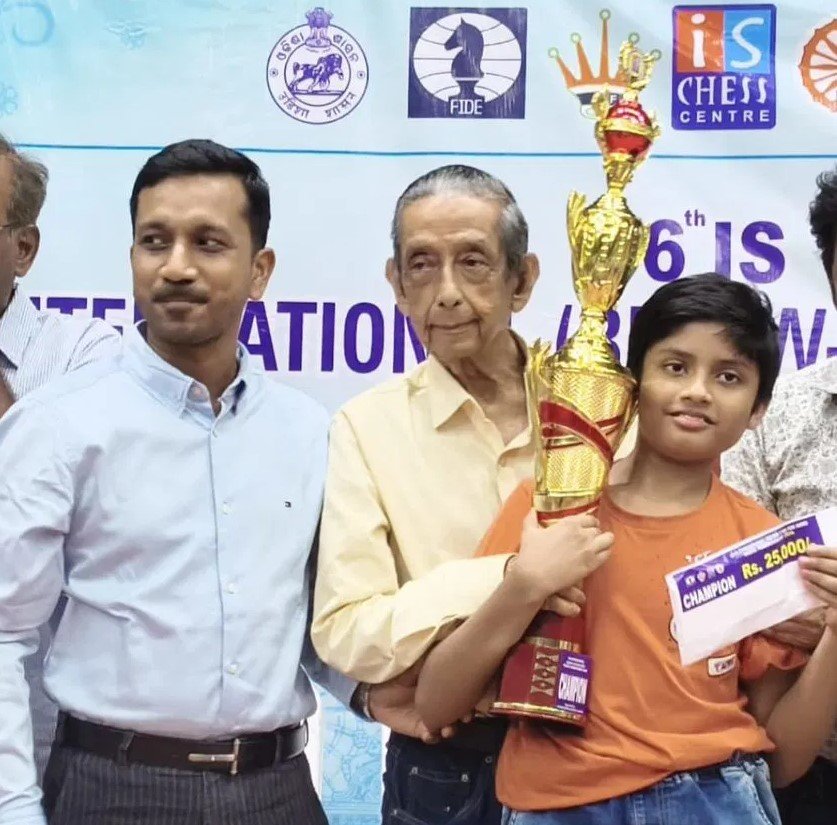
In late June 2026, 15-year-old Monoskam Mitra of West Bengal dominated the 6th IS International (Below-1700) classical chess tournament in Cuttack, India, scoring an unbeaten 8/9 to take clear first place. The event, held at the J.N. Indoor Stadium from 26–28 June 2026, was organized by the IS Chess Centre under the All Odisha Chess Association. Over 550 players (including unrated entrants) competed in a nine-round Swiss with a 45′+30″ time control. Mitra’s consistent play earned him the championship prize and a +100.8 rating-point gain. We present below a full report: the tournament context; final standings; Mitra’s round-by-round results; analysis of key games (with engine evaluation graphs); brief profiles of his main rivals; and the significance of this victory for Mitra’s career and rating.
Final Standings
Mitra finished first with 8.0/9, one point ahead of six players on 7.5/9 (tied for 2nd–7th). His final standing and top scorers are shown below (points and tiebreaks from Swiss-Manager):
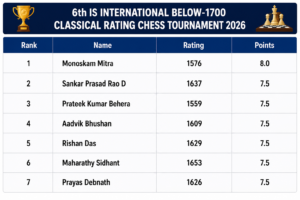
Mitra’s 8 points included seven wins and two draws. The runner-up (7.5 pts) was Sankar Prasad Rao D of Odisha (rating 1637), and 3rd place was Prateek Behera (1559) of Odisha. (Six players tied on 7.5, with Sankar and Prateek earning better Sonneborn–Berger tiebreaks for 2nd and 3rd.) Notably, Mitra remained undefeated through all 9 rounds.
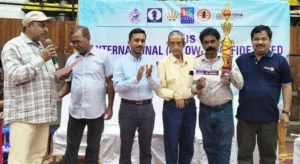
Mitra’s Round-by-Round Performance
The table below summarizes Monoskam Mitra’s round-by-round opponents, their ratings (FIDE), and his results:
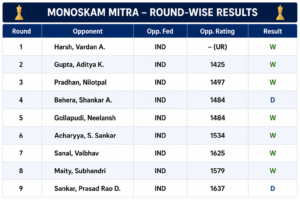
Mitra’s performance was characterized by early momentum (5/5 after Round 5) and solid technical play. After drawing one game (Round 4) he rebounded with four straight wins to clinch first. His toughest games were on the top boards in later rounds: notably, the final Round 9 against 1637-rated Sankar D (India), and Round 7 against 1625-rated Vaibhav Sanal (India). The following sections examine a few key games.
Main Challenger’s Profiles
The field’s top scorers included:
- Sankar Prasad Rao D (FIDE 1637) – An Odisha master, Sankar had the highest rating and finished second with 7.5/9. He was Mitra’s final-round opponent and a consistent force at the top boards. His playstyle is solid and cautious; in the final round he simply needed a draw to secure second place (which he achieved).
- Prateek Kumar Behera (1559) – An U15 player from Odisha, Prateek also scored 7.5/9, finishing third on tiebreak. He won several games with aggressive openings (often 1.d4) and had a sharp style but lost to Sankar in Round 8. Nonetheless, his strong performance earned him the second prize.
- Aadvik Bhushan (1609) – A young player from Jharkhand, Aadvik (U9!) tied for 2nd–7th (7.5 points). As an under-10, this rating and score are remarkable. He won many games decisively with tactical flair.
- Rishan Das (1629) – Rishan, an U15 from West Bengal, also scored 7.5. He plays a principled positional style and was unbeaten (6 wins, 3 draws).
- Maharathy Sidhant (1653) – Sidhant from Odisha was a top seed (1653 rating) who likewise finished on 7.5. Sidhant is known for sharp Sicilian play.
- Prayas Debnath (1626) – A West Bengal U15 player with 7.5 points, Debnath showed gritty defense in his wins.
These players, all under 1700 rating, form a strong cohort. Mitra himself (then 1576) was one of the lowest rated among the leaders, making his dominance particularly impressive.
The tournament also highlighted the growing depth of India’s grassroots chess talent, with several young players delivering impressive performances. As Monoskam builds on this success and continues to climb the rating ladder, his victory serves as another encouraging sign of the bright future awaiting Indian chess. With more rating events providing opportunities for emerging talents, performances like this are laying the foundation for the country’s next generation of titled players.