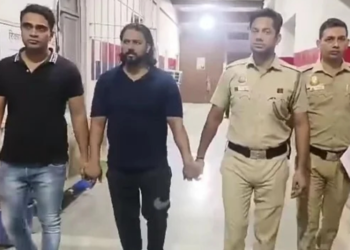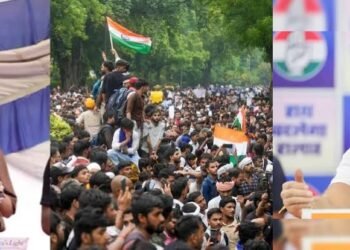
If an eight-year-old girl’s shorts can trigger outrage in the name of Hindu culture, then assaults, vandalism and public disorder during religious processions must invite the same scrutiny
BY PC Bureau
August 22, 2026: The question is not whether religious and historical sites deserve respect. They do. The real question is whether that respect is enforced consistently—or selectively, depending on who is being judged.
That question has acquired fresh urgency after an incident at Maharashtra’s historic Sinhagad Fort near Pune, where a family outing reportedly turned into an episode of alleged moral policing and violence.
On August 16, members of the Samast Hindu Bandhav Army, a right-wing organisation, allegedly confronted several groups of visitors over their clothing, objecting to shorts and sleeveless attire. According to reports, one confrontation involved an eight-year-old girl wearing Bermuda shorts near the samadhi of Tanaji Malusare.
What followed, according to the complaints and police action, went far beyond a disagreement over dress. Members of the group allegedly questioned visitors about why they were dressed in such clothes and accused them of having no understanding of “Hindu culture”. A man was allegedly slapped, his wife was reportedly dragged, and other visitors were allegedly assaulted.
The incidents are said to have involved four different groups between approximately 2 pm and 5 pm that afternoon.
Pune Rural Police subsequently booked eight people, including three women, under provisions of the Bharatiya Nyaya Sanhita relating to assault, rioting, unlawful assembly and other offences. Videos of the confrontations circulated widely, prompting authorities to consider tighter regulation of entry and crowd management at the fort.
There is nothing unreasonable about expecting visitors to behave respectfully at a site associated with Maratha history and the memory of Tanaji Malusare. Religious and historic sites around the world have legitimate rules governing conduct and, in some cases, dress.
But there is a fundamental distinction between requesting appropriate attire and imposing it through intimidation or violence.
READ: Iran Threatens ‘Crushing’ Response as Trump Claims HormuzUnveils Toughest Sanctions Yet
An adult visitor may be told that certain clothing is inappropriate for a particular religious or memorial space. He or she can be asked to leave or comply with clearly established rules. What cannot be justified is a group of self-appointed cultural guardians deciding that they have the authority to interrogate, humiliate or assault visitors—and especially to drag a family into a confrontation over the clothing of an eight-year-old child.
India has been hijacked by the narrow mentality people.
A family visiting Sinhagarh Fort (Pune) was allegedly assaulted after an argument over their 8 year old daughter wearing short.
According to the complaint, the situation escalated after the girl’s clothing became the… pic.twitter.com/OlmhG096vQ
— POL (@CptoneP) August 21, 2026
That brings us to a larger and uncomfortable question: Who gets to define “Hindu culture”, and when does that standard actually apply?
Consider the annual Kanwar Yatra, one of the largest religious pilgrimages in North India. Millions of Shiva devotees participate in the journey during the month of Sawan, many walking extraordinary distances in punishing heat and difficult conditions. For countless participants, it is a deeply personal expression of faith and devotion.
That devotion deserves respect.
But so does the law.
These are the “gems” of the 2026 Kanwar Yatra and the Government was providing security for them.
How are you going to justify this? Yet many Hindus were very proud of the Kanwar Yatra.
Most of the time just objectifying women body and nothing else. pic.twitter.com/iDBpuEt0kw
— Confid ?? (@Xp23_only) August 19, 2026
Over successive Kanwar seasons, including in recent years, there have also been repeated reports and videos of misconduct by sections of participants. These have included confrontations with motorists, attacks on police personnel and bystanders, damage to vehicles and shops, road blockades and clashes following minor accidents or perceived insults involving kanwars.
There have also been videos showing behaviour that sits uneasily with the image of a disciplined religious pilgrimage: smoking and drinking in some camps, provocative dancing around vehicles and DJs, and other forms of public disorder. Some widely circulated clips have shown people in religious attire behaving in ways that would normally attract criticism if performed outside a pilgrimage.
One viral video even appeared to show a person dressed as Lord Shiva holding what looked like an alcohol bottle.
Now Kanwariyas misbehaving with families in Indian railways.
There is no rule of law…..what a shame. pic.twitter.com/7lTjWthl5q
— ❤️ Priyanshi for RaGa❤️ Die hard Messi Fan (@RaGakiDeewani) August 20, 2026
The point is not to treat every such video as proof of wrongdoing by every Kanwariya. That would be as unfair as judging every tourist at Sinhagad by the behaviour of one visitor.
The Kanwar Yatra involves millions of people. When such a vast gathering takes place on public roads, isolated incidents of disorder are inevitable. The overwhelming majority of participants may well be peaceful and sincere.
But the same principle should work both ways.
If an isolated act by a tourist is sufficient to trigger a lecture on Hindu culture, then an assault by a pilgrim should not be dismissed as an unfortunate exception merely because the offender is carrying a saffron flag.
If “religious sentiment” is invoked to demand discipline from visitors, it cannot simultaneously become an excuse for indiscipline by devotees.
That is where the charge of selective outrage becomes difficult to dismiss.
There is a familiar pattern in public discourse: when a tourist wears shorts at a site associated with Hindu or Maratha history, the incident can quickly become a question of cultural decline, disrespect and the erosion of tradition.
But when members of a religious procession allegedly damage property, attack motorists, obstruct roads or clash with police, the response from sections of the same political and cultural ecosystem can be markedly different.
Suddenly, the language changes.
The perpetrators become “fringe elements”. The larger gathering is invoked. The devotion of millions is cited. Critics are accused of insulting faith. Political voices call for restraint and understanding.
All of those arguments can be legitimate—provided they are applied consistently.
The problem begins when the principle of collective responsibility is used selectively.
Nobody should portray the Kanwar Yatra itself as a lawless enterprise. That would be both inaccurate and unfair. The pilgrimage has a long religious tradition, and millions undertake it peacefully every year. Nor should every incident involving a Kanwariya be transformed into an indictment of Hinduism or Hindu devotees.
But neither should religious identity function as a shield against accountability.
The same applies to visitors at Sinhagad.
If there are official dress codes at a memorial or religious site, they should be clearly displayed and lawfully enforced. If there are no such rules, private groups cannot manufacture them and impose them through threats or violence. And even where rules exist, enforcement belongs to authorised personnel—not vigilante groups.
This distinction is crucial.
Culture and law are not the same thing.
Culture can ask for respect. Law determines what conduct is permissible.
A temple may have traditions. A memorial may have restrictions. A pilgrimage may have religious practices. None of these gives private citizens a licence to assault another person.
Nor should the State tolerate disorder because the people responsible happen to be participating in a religious event.
There is an even deeper irony here.
The people who claim to be defending Hindu culture through moral policing sometimes reduce culture to the length of a tourist’s shorts while overlooking values that are far more fundamental to any ethical tradition: restraint, compassion, hospitality, dignity and respect for fellow human beings.
If an eight-year-old’s clothing is treated as a threat to civilisation while an adult’s alleged assault is rationalised as the excess of a devotee, the issue is no longer cultural preservation.
It is power.
The weak are easy to police. Tourists who do not belong to the local social or political ecosystem are easy targets. A family visiting a fort has little ability to mobilise supporters, crowds or political influence.
A massive religious procession is different. It has numbers, symbolism and political weight. That can make authorities—and politicians—more cautious about confronting misconduct.
But the law cannot operate according to the political strength of the crowd standing behind the accused.
A motorist assaulted during a pilgrimage deserves the same protection as a pilgrim assaulted by a motorist. A police officer attacked by a procession participant deserves the same protection as a devotee attacked by a police officer. A tourist should be able to visit a historic fort without fear of vigilante violence. A pilgrim should be able to walk a traditional route without being stereotyped because of the misconduct of others.
The standard has to be one and the same.
No one gets a free pass for assault, vandalism, intimidation or public disorder because they are defending a religion. And no one should be beaten because their clothes offend someone’s personal interpretation of that religion.
There is nothing inherently wrong with asking people to dress appropriately at places of worship or historical importance. There is everything wrong with turning such expectations into an excuse for mob behaviour.
Likewise, there is nothing wrong with respecting the Kanwar Yatra as an important religious tradition. There is everything wrong with pretending that devotion automatically absolves individuals of responsibility for violence or vandalism.
The real defence of culture is not louder slogans, more aggressive policing of strangers or selective condemnation of behaviour.
It is consistency.
If Hindu culture demands respect, then respect must include restraint. If faith demands discipline, that discipline must apply to devotees as well as outsiders. If public order matters, it must matter on a fort as much as on a pilgrimage route.
Otherwise, “Hindu culture” becomes less a moral standard than a weapon selectively deployed against those with less power.
Culture is not defended by fists.
Faith is not strengthened by intimidation.
And law cannot be applied according to whose religious identity happens to be politically convenient.
The same rule must apply to everyone. That is not an attack on culture. It is the minimum requirement of a constitutional society.