The Vande Mataram row exposes an awkward political contrast: the BJP is pressing the Congress on the national song in Delhi, while its Nagaland ally rejects compulsory singing.
BY Navin Upadhyay
The Bharatiya Janata Party’s campaign against the Congress over Vande Mataram has run into an awkward contradiction in one of the states where the BJP itself is part of the ruling government.
While the BJP in Delhi has made the national song a political flashpoint and accused the Congress of disrespecting it, its coalition partner in Nagaland has said the state government will not force anyone to sing Vande Mataram.
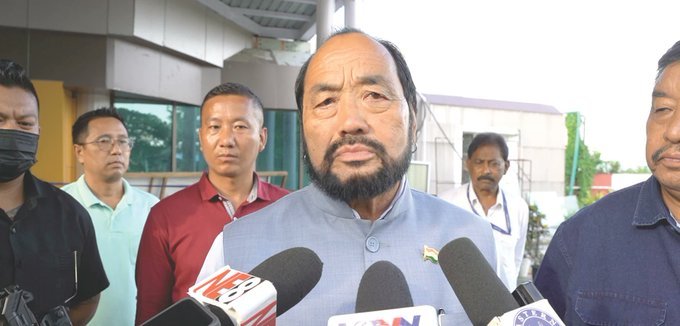
Nagaland Deputy Chief Minister and BJP leader Yanthungo Patton said on Friday that participation in the singing of Vande Mataram would remain a matter of individual choice, despite the Centre’s directive and amid opposition from several influential Naga civil society and church organisations.
“Nobody will be forced to sing, nobody will ask them to sing, and nobody can stop it,” Patton said at Dimapur Airport after returning from New Delhi. “This is a national song.”
The statement creates an obvious political contrast. The BJP has sought to make Vande Mataram a test of national commitment in its confrontation with the Congress, while a senior BJP minister in a BJP-allied state government has made clear that people will not be compelled to sing it.
The question, therefore, is not whether Vande Mataram is India’s national song. It is. The more politically significant question is whether the BJP believes the same standard should apply uniformly across the country—or whether its approach changes when it comes to an ally governing a state with distinctive constitutional and social sensitivities.
BJP’s Vande Mataram campaign meets a different reality in Nagaland
The dispute over Vande Mataram has become increasingly political in Delhi, with the BJP accusing the Congress of disrespecting a symbol of the freedom struggle and national identity.
But in Nagaland, the response from the BJP’s own Deputy Chief Minister is notably more cautious.
Local media reported Patton saying that the government would not compel students, employees or others to sing the song. He also indicated that the matter could be discussed during the forthcoming session of the Nagaland Legislative Assembly.
His remarks came amid opposition from organisations including the Naga Students’ Federation and the Nagaland Baptist Church Council to the singing of the full rendition of Vande Mataram in schools and official programmes.
The BJP is a partner in the Nagaland government headed by Chief Minister Neiphiu Rio of the Nationalist Democratic Progressive Party. Patton himself is a senior BJP leader and holds the Home and Border Affairs portfolios.
That makes his position politically significant.
The BJP cannot simply dismiss his remarks as those of an opposition-ruled state. Nagaland is governed by an alliance in which the BJP is a key partner.
And Patton is not merely saying that there may be practical difficulties in implementing the directive. He is explicitly saying that nobody will be forced to sing.
Article 371A adds another layer
The controversy also touches Nagaland’s special constitutional position.
Article 371A provides specific safeguards for the state, including provisions under which certain Acts of Parliament relating to specified matters do not apply to Nagaland unless the state Legislative Assembly decides otherwise.
Asked whether compulsory observance or singing of Vande Mataram could have implications for these constitutional safeguards, Patton said it would not affect Article 371A.
At the same time, he said the matter could be taken up in the Assembly.
That distinction matters.
The argument in Nagaland is not necessarily about rejecting Vande Mataram as a national symbol. It is about whether participation can be imposed in a state where questions of identity, customary practices, religion and constitutional autonomy carry particular political weight.
Patton’s position appears to be that the song may be recognised and permitted, but participation cannot be forced.
That is a significantly different tone from the political rhetoric emerging from the BJP in Delhi.
READ: When Shorts Threaten ‘Sanatan’ but Vulgarity Doesn’t
A political contradiction for the BJP
The BJP’s criticism of the Congress over Vande Mataram rests heavily on the idea that the song represents India’s national heritage and the sacrifices of the freedom movement.
Congress leaders, meanwhile, have accused the BJP of turning a national symbol into a political weapon and using compulsory observance to manufacture a test of patriotism.
The Nagaland episode complicates that battle.
If voluntary participation is acceptable in a BJP-governed coalition state, why should refusal to sing automatically become a political or ideological offence elsewhere?
And if compulsory singing is considered essential to national unity, why is a senior BJP minister saying that no one in Nagaland will be forced to participate?
The answer may lie in the realities of coalition politics.
The BJP is a powerful national party, but Nagaland has its own political history, social structure and constitutional protections. The NDPP-BJP government has to negotiate these realities, just as the Centre has to negotiate with regional allies on issues ranging from identity to governance.
The result is a familiar feature of Indian politics: national rhetoric often encounters local political arithmetic.
Congress, BJP and the politics of patriotism
There is also a larger question about the use of national symbols in partisan politics.
Vande Mataram occupies an important place in India’s freedom struggle. It was a rallying cry against colonial rule and has immense historical and cultural significance.
But converting participation into a political loyalty test raises a different question.
Patriotism cannot be reduced to whether an individual sings a particular song on command. Nor does declining to sing necessarily amount to disrespect for the nation.
At the same time, refusing to sing Vande Mataram does not entitle anyone to denigrate the song or the freedom struggle it represents.
A democratic society can accommodate both respect for national symbols and individual choice.
Indeed, that appears to be precisely the position articulated by Patton: Vande Mataram is a national song, but no one should be forced to sing it.
The BJP’s political challenge is that this formulation becomes difficult to reconcile with a campaign that portrays the Congress’s position on the song as evidence of a broader lack of national commitment.