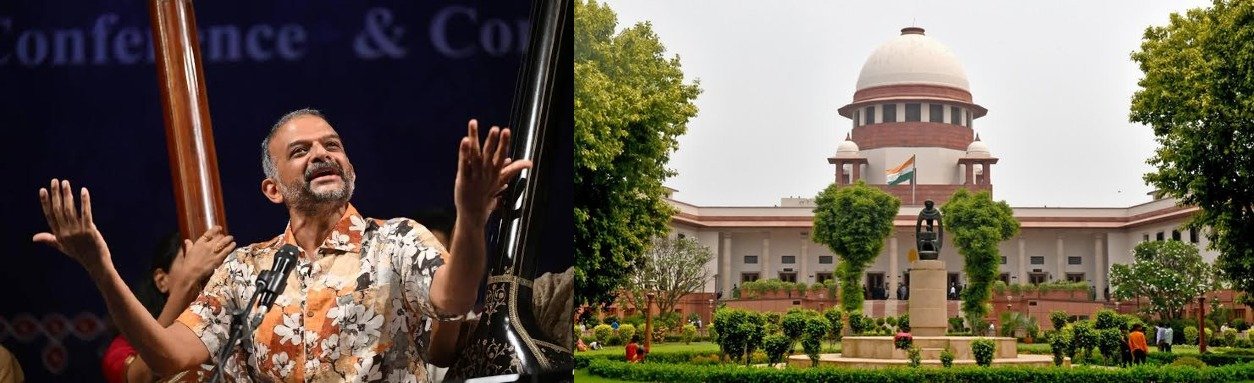
Hearing Carnatic vocalist T.M. Krishna’s challenge to the amended national honour law and MHA directions, the Supreme Court referred to its 1986 Bijoe Emmanuel judgment protecting conscientious objectors who respectfully declined to sing the national anthem.
BY PC Bureau
NEW DELHI — The Supreme Court on Tuesday agreed to examine whether a citizen can face criminal prosecution for refusing, on grounds of conscience or religion, to sing Vande Mataram, while making clear that it would not adjudicate the government’s decision to recognise the song as the national song or prescribe its full six-stanza version for official occasions.
A three-judge Bench headed by Chief Justice of India Surya Kant and comprising Justices Joymalya Bagchi and V. Mohana was hearing a petition filed by Carnatic vocalist T.M. Krishna, challenging the constitutional validity of the 2026 amendment to the Prevention of Insults to National Honour Act, 1971, as well as Ministry of Home Affairs directions requiring the complete six-stanza version of Vande Mataram to be sung at specified official, ceremonial and cultural events.
The Bench indicated that the question before it was not whether Vande Mataram should be the national song or whether all six stanzas should be prescribed. Rather, it would examine whether a refusal to sing could attract criminal consequences, particularly where the refusal is based on a genuine matter of conscience or religious belief.
READ: Bihar’s Moral Policing: Main Accused Shot in Leg in Police Encounter
Justice Bagchi referred to the Supreme Court’s 1986 ruling in Bijoe Emmanuel v. State of Kerala, in which the court protected three schoolchildren who had declined to sing the national anthem because of their religious beliefs but had stood respectfully during its rendition.
The Bench indicated that the principle laid down in Bijoe Emmanuel remained relevant and that a conscientious objector could not automatically be subjected to criminal prosecution merely for refusing to recite one or more stanzas of the national song. The judges also referred to the protection of freedom of conscience and religion under Articles 25 and 26 of the Constitution.
At the same time, the court did not accept the argument that it should determine whether the religious references in the later stanzas of Vande Mataram make the song constitutionally unsuitable for official recognition. The question of what constitutes the national song, and how it is to be formally rendered, was treated as a matter for the political branches rather than one for judicial determination.
What Krishna has challenged
Krishna has challenged the 2026 amendment extending the penal provisions of the 1971 Act to the national song. He has also challenged MHA directions dated January 28 and July 9 prescribing the complete six-stanza version of Vande Mataram at specified official functions.
In his petition, Krishna argues that several of the later stanzas invoke Hindu deities, including Durga, Lakshmi and Saraswati, and that compelling people to sing those portions at official functions raises questions concerning secularism, personal liberty and freedom of conscience.
He has also argued that the amended law is arbitrary and that the conduct attracting criminal liability is insufficiently defined for the purposes of a penal statute.
Under the amended provision, intentionally preventing the singing of the national anthem or national song, or causing disturbance at an assembly engaged in such singing, can attract imprisonment of up to three years, a fine, or both.
The Supreme Court did not issue formal notice on Tuesday. It directed Solicitor General Tushar Mehta, appearing for the Centre, to take the papers and file the government’s response within two weeks. Krishna has also sought interim protection from the operation of the challenged provisions.