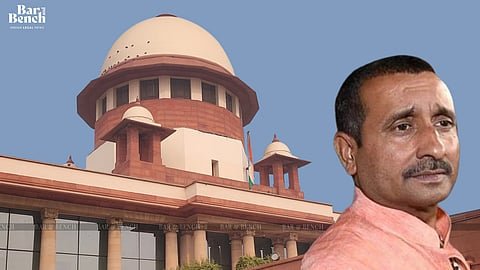
A bench led by Chief Justice of India Surya Kant said the “peculiar circumstances” of the case warranted a stay on Kuldip Sengar’s bail relief. The CBI argued that Sengar, as an elected legislator, held a position of power and should face aggravated punishment under the POCSO Act.
BY PC Bureau
New Delhi/May 15, 2026: In a major development in the high-profile 2017 Unnao rape case, the Supreme Court on December 29, 2025, stayed the Delhi High Court’s order suspending the life sentence of former BJP MLA Kuldeep Singh Sengar and granting him bail pending appeal. The apex court’s intervention ensures that Sengar will remain in custody for now.
A three-judge bench headed by Chief Justice of India Surya Kant, along with Justices J.K. Maheshwari and A.G. Masih, passed the order while hearing an appeal filed by the Central Bureau of Investigation (CBI) against the Delhi High Court’s December 23, 2025 ruling.
The Supreme Court noted the “peculiar facts and circumstances” of the case, particularly Sengar’s separate conviction and continued custody in connection with the custodial death of the rape survivor’s father.
“Keeping in mind these peculiar circumstances, we deem it appropriate to stay the operation of the [High Court] order,” the bench observed.
The court issued notice to the parties and scheduled the matter for further hearing.
The Delhi High Court had suspended Sengar’s life imprisonment on the ground that he did not qualify as a “public servant” under Section 5(c) of the Protection of Children from Sexual Offences (POCSO) Act, 2012. The High Court reasoned that an MLA is not covered under the definition of “public servant” borrowed from the Indian Penal Code, and therefore the offence would not attract the aggravated punishment of life imprisonment.
Since Sengar had already served more than the minimum seven-year sentence applicable to the non-aggravated offence, the High Court granted him bail on a personal bond of ₹15 lakh with sureties. It also imposed conditions, including that he remain in Delhi, stay at least five kilometres away from the survivor’s residence, and refrain from contacting or influencing the survivor or her family.
During the Supreme Court hearing, the CBI argued that as an elected legislator occupying a position of power and trust, Sengar exercised dominance over the minor survivor and should therefore fall within the ambit of aggravated penetrative sexual assault under the POCSO Act.
The bench also questioned the High Court’s interpretation, reportedly asking why a lower-ranking public servant such as a constable could face life imprisonment under the law while an MLA could not. The matter is now expected to address broader legal questions surrounding sentencing and the interpretation of “public servant” under the POCSO framework.
Background of the Unnao Rape Case
The case dates back to 2017, when the then 17-year-old survivor approached Sengar, then a sitting BJP MLA from Unnao in Uttar Pradesh, seeking employment. She later alleged that she had been kidnapped and repeatedly raped by Sengar and others at his residence.
The case drew nationwide attention in 2018 after the survivor attempted self-immolation outside the Chief Minister’s residence in Lucknow, accusing the police of inaction and alleging political pressure in the investigation.
Soon after, the survivor’s father was allegedly assaulted by Sengar’s supporters, arrested in a separate case, and later died in judicial custody in April 2018.
Following allegations of intimidation and political interference, the Supreme Court transferred the trial from Uttar Pradesh to Delhi.
In December 2019, a Delhi court convicted Kuldeep Singh Sengar of rape under the POCSO Act and sentenced him to life imprisonment along with a ₹25 lakh fine. In March 2020, he was separately convicted in the custodial death case involving the survivor’s father and sentenced to 10 years’ rigorous imprisonment for culpable homicide and criminal conspiracy.
READ: Poll Over, Petrol, Diesel, CNG Prices Rise
Sengar was later expelled from the Bharatiya Janata Party following his arrest.
The Delhi High Court’s December 2025 decision to suspend Sengar’s life sentence had triggered outrage and protests, with the survivor and her family expressing fears over their safety in the event of his release. The CBI subsequently moved the Supreme Court, arguing that the High Court order undermined public confidence in the justice system.
With the Supreme Court now staying the High Court’s order, Sengar will continue to remain in jail while the appeal is pending. The bench also observed that the survivor could approach the court for protection of her rights and would be provided free legal aid if required.
The case continues to remain a significant test of India’s criminal justice system, particularly concerning political influence, survivor protection, and the interpretation of laws dealing with sexual offences against minors by persons in positions of authority.