Delhi Police has reportedly removed Jantar Mantar from the list of designated protest venues, naming Ramlila Maidan, Burari Maidan and CBD Ground as alternatives. The move marks a major change in the capital’s arrangements for public demonstrations.
BY PC Bureau
NEW DELHI/ October 13 : Delhi Police has de-notified Jantar Mantar as a designated protest venue and identified three alternative sites for demonstrations, ending the capital’s decades-old arrangement of allowing authorised protests at the prominent central Delhi location, according to reports citing a police circular.
Under Standing Order No. L&O/48/2026, Ramlila Maidan, Burari Maidan and CBD Ground in East Delhi have been designated as protest sites. The decision was taken on the recommendations of a committee constituted by the Union Ministry of Home Affairs (MHA).
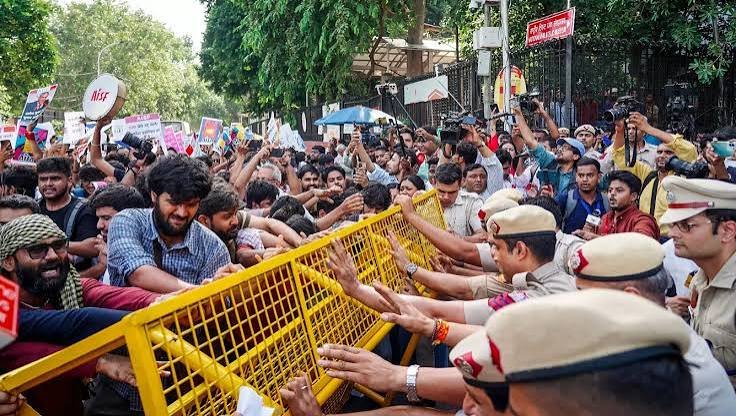
The move comes amid heightened tensions in the capital following protests against the Election Commission of India’s Special Intensive Revision (SIR) of electoral rolls and demands for Chief Election Commissioner Gyanesh Kumar’s resignation. Demonstrations on October 10 were accompanied by heavy security deployment, barricading and detentions, while protesters were prevented from assembling at Jantar Mantar.
Jantar Mantar denotified as designated protest site.
Ramlila Maidan, Burari Ground and CBD Ground are the new designated protest sites. https://t.co/UhtmlRIHow
— Arvind Gunasekar (@arvindgunasekar) October 12, 2026
READ: Rahul Gandhi Accuses BJP-RSS of Using ‘Goons’ to Intimidate Student Protesters
Supreme Court had sought alternative protest venue
The decision follows the Supreme Court’s October 9 intervention, when a Bench comprising Chief Justice of India Surya Kant and Justices Joymalya Bagchi and V. Mohana asked Delhi authorities to identify a suitable alternative to Jantar Mantar.
The Bench said the new venue should provide adequate facilities for demonstrators, including toilets, drinking water, medical assistance and portable cabins. It also stressed that the site should be spacious enough to accommodate protesters while ensuring public safety and uninterrupted access for emergency services.
The observations came during hearings on restrictions imposed on Metro and railway services ahead of the October 10 protests. The Court emphasised that security measures should be proportionate and should not unnecessarily disrupt essential public services.
During the hearing, senior advocate Kapil Sibal, representing CPI(M) general secretary Mariam Alexander Baby, had pointed out that Ramlila Maidan had previously served as an alternative protest venue but was no longer being offered when permission to demonstrate at Jantar Mantar was refused.
The latest police decision now formally identifies Ramlila Maidan, along with Burari Maidan and CBD Ground, as alternative locations.
Jantar Mantar’s place in Delhi’s protest history
Jantar Mantar has served for decades as one of the capital’s most prominent centres of political and civic dissent. Its central location has made it a natural gathering point for political parties, trade unions, students, farmers and civil society organisations seeking to draw public attention to their demands.
The site has hosted demonstrations on issues ranging from corruption and electoral reforms to employment, farmers’ rights and civil liberties. Its accessibility and proximity to key government institutions have helped make it a symbol of the right to peaceful protest in the national capital.
The de-notification marks a significant change in how demonstrations in Delhi will be organised. The practical implications will depend on how the new arrangements are implemented, including the process for obtaining permission, the capacity of the designated grounds and the facilities made available to demonstrators.
The development also raises questions about access to central Delhi for citizens seeking to protest against government policies and public institutions. While authorities can regulate demonstrations to protect public order and essential services, the Supreme Court has emphasised the need to preserve peaceful protest while balancing the rights and safety of other residents.